Multiply the midpoint line decision by two to remove the fraction. At the current pixel , maintainAt the initial endpoint this is . If is chosen, the next decision midpoint is displaced by and increases by . If is chosen, its displacement is and increases by . Both increments are constant, so the per-pixel work uses only integer arithmetic:The completed code, using the tie rule of part (b), is:
void midpointLine(int x0, int y0, int x1, int y1)
{
    int dx, dy, incrE, incrNE, d, x, y;
    x = x0; y = y0;
    dx = x1 - x0;
    dy = y1 - y0;
    incrE = 2 * dy;
    incrNE = 2 * (dy - dx);
    d = 2 * dy - dx;
    drawPoint(x, y);

    while (x < x1) {
        if (d < 0) {
            d += incrE;
        } else {
            d += incrNE;
            y++;
        }
        x++;
        drawPoint(x, y);
    }
    return;
}
Thus
guard1 is x < x1, and guard2 is d < 0. Multiplication by two is the only multiplication. Signed decision variables are convenient because and incrNE can be negative; this remains an integer arithmetic algorithm. A strictly unsigned hardware representation would need an equivalent biased or separated-sign encoding. As with the printed int skeleton, assume all intermediate values fit the chosen type; integer overflow would invalidate the mathematical decisions.To verify the geometry, write . The chosen ordinate isThe midpoint line decision selects exactly this nearest integer, rounding halves upward. Its increment between successive columns is zero or one. At and , it gives exactly and , respectively, so both endpoints are included and the line segment has precisely distinct pixels.
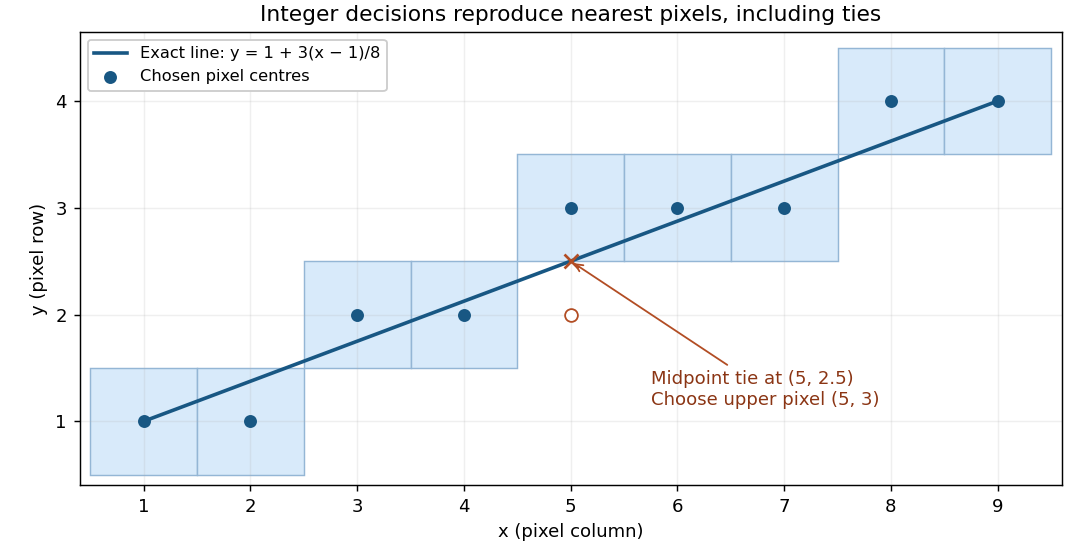

For the illustrated endpoints and , the ordinates are . In particular the exact ordinate at is , and the chosen pixel is .
Articles by others on the same topic
There are currently no matching articles.