The first assertion is true. Each deletion removes a value with no support in an adjacent constraint domain. If a complete solution still used that value, the solution’s neighboring value would supply exactly such a support, a contradiction. By mathematical induction, AC-3 never deletes a value used by an original solution. An empty constraint domain therefore proves that no solution exists.
The second assertion is false. Take three Boolean variables with constraint domains and the binary constraints , , . Every value has the opposite value as support across each edge, so AC-3 deletes nothing and returns true. Yet and imply , contradicting . Arc consistency checks local support, not compatibility of all supports in one complete assignment.
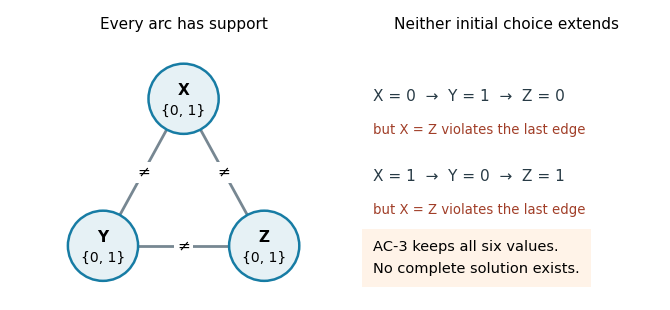
Every value has pairwise support, but following the three inequality constraints makes a complete assignment impossible
. Details. 
The third assertion is true under the usual explicit-input, constant-cost constraint-checking model. With variables, constrained pairs and maximum constraint domain size , AC-3 has time complexity in Big O notation. A revision costs ; each deletion can re-enqueue incoming arcs, and each constraint domain loses at most values, giving revisions including the initial arcs. For two-valued constraint domains, , so this is , linear in the explicit input size. This uses fixed-size relations, or already combined constant-time tests per pair. “Binary” normally describes constraint arity, not two-valued constraint domains; the latter restriction is the extra hypothesis needed here. As usual, initially empty constraint domains should be rejected before entering the algorithm, including isolated variables.
Articles by others on the same topic
There are currently no matching articles.