A screw axis combines rotation about a line with translation parallel to that line. An screw rotates through and advances by of the lattice repeat along the axis; a screw advances by half a repeat after a half-turn. The combined operation, rather than either component separately, must map every atomic species onto equivalent sites.
A glide plane combines reflection in a plane with a fractional translation parallel to it. Reflecting alone need not preserve the crystal. A crystallographic point symmetry is an isometry with a fixed point, such as a rotation, reflection, inversion, or rotoinversion. Point operations have no irreducible translational advance: a screw or a glide with nonzero fractional advance cannot be described merely as a rotation or mirror at a different origin. A crystal's point group records the rotational parts of its space-group operations, whereas the full space group retains their translations.
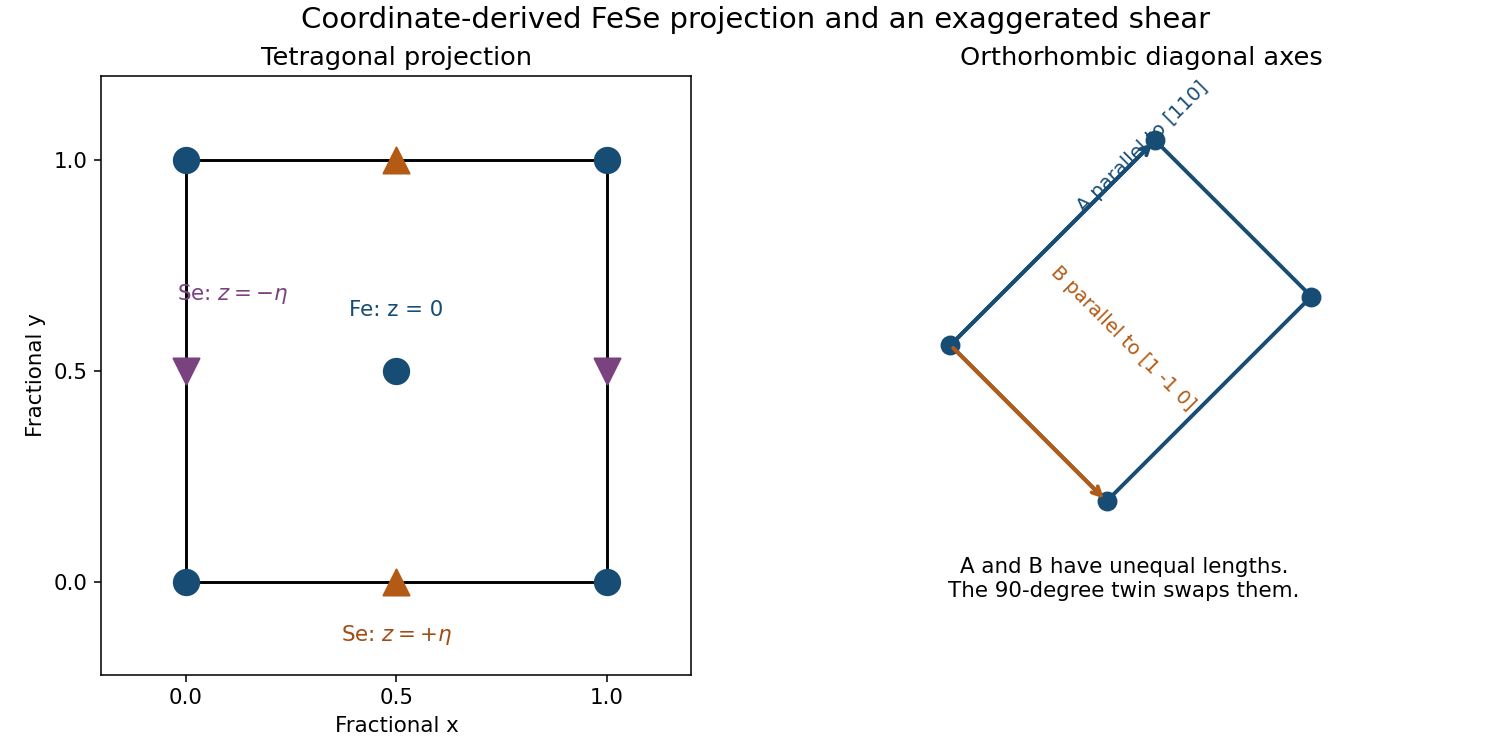
Take the square projection cell and label the heights rather than erasing them in projection. The Fe positions appear at the cell corners and at , both with . The Se projections are at height and at height , together with their periodic copies on opposite edges. These are distinct height classes even though the observer looks down the axis.
The corner Fe sites together count as one atom per cell, the central Fe as one, and each edge-shared Se projection contributes half at each of two equivalent edges. The count is therefore two Fe and two Se per primitive tetragonal lattice cell. The Fe sublattice has its shorter nearest-neighbor directions along the projected cell diagonals. The distinction between those directions and the conventional tetragonal axes matters for the distortion in d.

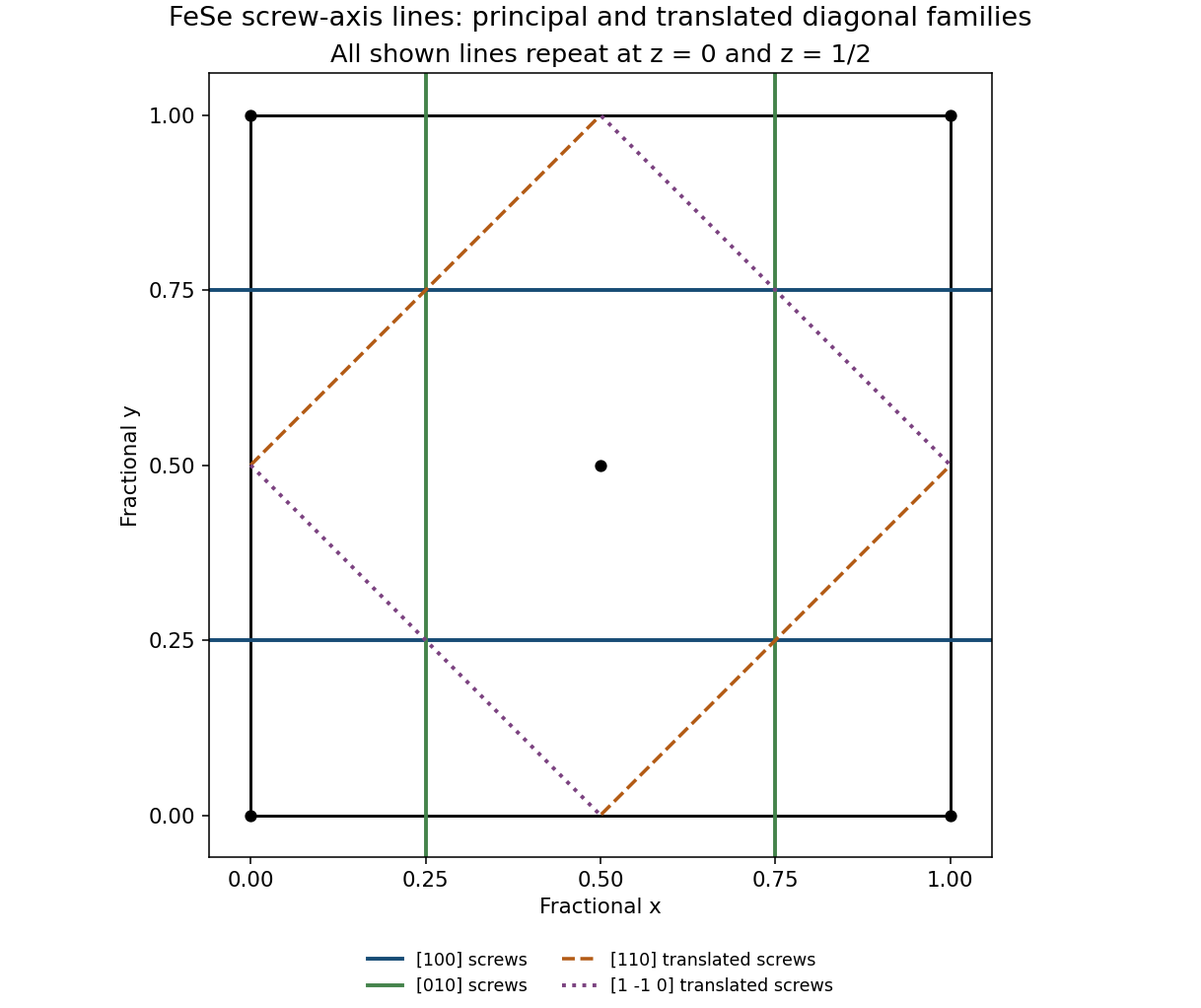
A representative half-turn-plus-translation operation about an axis parallel to isIt rotates about the line and translates by along . It exchanges the two Fe sites, and maps onto modulo a lattice translation. Likewise,is a screw about . Including translated equivalents gives the principal-axis screw linesThus the cell contains lines at the quarter and three-quarter coordinates, in both the and levels.
For completeness, translated diagonal twofold operations also produce diagonal screw lines. The operations and preserve the same basis. Their axial translations are and , half the primitive repeats along the corresponding diagonal directions. Their lines areDiagonal lines with integer instead support pure twofold rotations. Listing only rotational parts modulo primitive translations would hide these shifted screw lines. There is no fractional screw advance along : every Fe site has integer , so a symmetry taking the Fe layer into itself requires an integer vertical translation. Proper fourfold axes parallel to are therefore not , , or screws in this structure. All these statements can be checked directly on the four supplied coordinates without choosing an alternative tabulated origin.[ref]
Symmetry relations for space group 129 by International Union of Crystallography. P4/nmm, full Hermann-Mauguin symbol and origin-setting information; coordinate operations here are derived in the supplied origin

Reflection through interchanges the two Se height classes but, by itself, leaves their projected positions wrong. The required parallel translation isFor example, maps to , equivalent to the second Se site. The two Fe sites are also interchanged. This is a diagonal, or , glide; adding an integer lattice vector gives the same fractional translation class. Its translation is expressed in the conventional primitive tetragonal lattice coordinates, not in a smaller Fe-only cell that would discard the selenium height pattern.
At a point and its glide partner have equal scattering amplitudes and relative phase . Their joint contribution to the structure factor is proportional toIt vanishes for odd . Hence the allowed-condition statement isThis is a systematic absence: it follows independently of the numerical Fe and Se atomic scattering factors. Explicitly, the supplied basis givesand both braces vanish when is odd. When the sum is even a reflection is symmetry-allowed, but an accidental cancellation for particular scattering factors or experimental conditions can still make its intensity small. The glide alone does not promise that every allowed reflection has a nonzero measured intensity.
One crystallographic inversion center isThe inversion maps to ; it exchanges both the Fe pair and the Se pair modulo lattice translations.
A axis passes along through the Fe site , and likewise through . A representative rotoinversion isIt leaves the first Fe site fixed, maps the other Fe onto a translationally equivalent site, and exchanges the Se height classes. The operation includes a vertical reversal, so it must not be replaced by a pure -degree rotation about an Fe site. Such a pure rotation would put a selenium atom at the wrong height.
Choose orthorhombic basal axes along the tetragonal diagonals, and , and allow their lengths to differ slightly. Two orthorhombic twins interchange and . This corresponds to a small shear of the original tetragonal basal cell, or to unequal nearest-neighbor Fe–Fe distances along its two diagonal directions; it is not simply stretching the original tetragonal and axes unequally.
The tetragonal indices map to , . Thus tetragonal becomes orthorhombic in one twin and in the rotated twin. Their spacings are and , producing the two peaks. Equal populations of the symmetry-related twins explain their equal intensities.
In contrast, tetragonal becomes orthorhombic . Its inverse spacing squared is , invariant under exchanging and . It therefore does not split between those twins, exactly as observed. The diffraction facts determine the distortion's orientation and twin equivalence, but not its numerical strain amplitude without the measured peak separation.
Articles by others on the same topic
There are currently no matching articles.