The cover identifies the Part C major option, Trinity Term 2019, 17 June 2019, A11046W1; the bundle's 2018 filename does not determine the examination year. All six questions are treated. Figure 2(A) has missing image tiles, including part of its lower-left plot and some path labels. The readable portions and the standard silicon valley model support the conclusions below; the missing image content is not reconstructed. Numerical values read from plotted curves are estimates. Write for the elementary electric charge.
TODO: Recover the missing tiles of original Figure 2(A), affecting questions 2(a) and 2(e). The solutions distinguish the surviving figure and standard silicon-band interpretation from unavailable path labels and precise missing valence-sheet contours.
Infrared spectroscopy measures absorption as the incident photon frequency is swept through molecular normal mode frequencies. In the electric-dipole approximation the interaction is . Expanding the molecular electric dipole moment in a normal coordinate givesThe fundamental one-quantum vibrational transition dipole moment is proportional to the derivative multiplying . Thusis the criterion for vibrational infrared activity; the derivative must also have a component along the incident polarization of an electromagnetic wave. A permanent molecular electric dipole moment is not necessary. Absorption occurs near , with broadened lines reflecting finite lifetimes and the molecular environment.
Use the indicated out-of-plane displacements and the equivalence of the four oxygen sites and of the two carbon sites in the isolated planar oxalate ion. In , the two oxygen atoms on one side move oppositely to those on the other side, and the two carbon atoms also move oppositely. Their dipole changes cancel. The mode is even under molecular inversion symmetry, which independently forbids an electric-dipole transition.
In , all four oxygen atoms move together out of the plane while both carbon atoms move in the opposite direction. The positive and negative charge distributions acquire a relative out-of-plane displacement, producing a nonzero derivative of the molecular electric dipole moment.
In , two oxygen atoms move out and two move in, in a checkerboard arrangement, while the carbon atoms are stationary. The equivalent oxygen contributions cancel. This mode illustrates that being odd under inversion symmetry is necessary but not sufficient for vibrational infrared activity: its full symmetry does not transform like any component of an electric dipole moment.These conclusions concern the isolated-molecule displacements drawn in the source; a different crystal environment can alter selection rules through additional symmetry breaking.
There are six atoms in the nonlinear oxalate ion, hence positional degrees of freedom. Subtract three rigid translations and three rigid rotations to obtain vibrational normal modes. Planarity does not remove out-of-plane motions. Since three modes have been displayed,
The primitive unit cell contains two carbon atoms and four edge-shared oxygen atoms, each contributing one half: atoms. Equivalently, one molecular repeat contributes its two carbon atoms but only half of each of its four shared oxygen atoms. There are therefore phonon branches.
At the Brillouin zone centre, three rigid translations give three acoustic phonon branches; the remaining are optical phonon branches:A free layer has two in-plane acoustic modes and an out-of-plane flexural acoustic mode. A two-dimensional lattice does not imply that its atoms can move only in two directions. Artificially suppressing all out-of-plane motion would instead define a different model with two acoustic and six optical branches.
The primitive translations connect the two centred-rectangular sublattices. In the orientations marked in the source, points right and down, whereas points right and up. ThusTheir parallelogram has half the area of the rectangular cell, confirming that the latter contains two primitive unit cells.
Let the reciprocal lattice vector be , with each dual pair obeying and zero cross products. Its coefficients are obtained by dotting with the corresponding direct-space primitive lattice translation vectors:HenceFor actual integer-indexed reciprocal lattice vectors, this also explains the centred-rectangular condition that and have the same parity. General phonon wave vectors need not have integer coefficients.
Comparing the two coefficients in the reciprocal-coordinate transformation givesThe inverse transformation is , . This provides an independent check on the signs associated with the two primitive arrows in the source.
Apply the same change of reciprocal lattice coordinates to the phonon wave vectors:Although is an integer coordinate of the rectangular reciprocal grid, it is not a reciprocal lattice vector of the actual primitive crystal. Thus is not equivalent to the Brillouin zone centre.
For ordinary one-phonon infrared optical absorption, both an energy and a momentum selection rule must hold. The optical photon has negligible crystal momentum on the scale of the Brillouin zone, so crystal momentum conservation selects modulo a genuine reciprocal lattice vector. In addition, the mode must change the macroscopic electric polarization, with a component along the incident polarization of an electromagnetic wave.
In terms of atomic displacements and Born effective charge tensors , the relevant derivative is proportional to per primitive unit cell. Thus an optical phonon at is not automatically infrared active: its dipole contributions may cancel. Disorder-assisted and multiphonon processes relax these simple first-order selection rules.
has primitive coordinates and therefore fails the first-order optical momentum condition; its local pattern also has zero dipole derivative. is a zone-centre mode with the dipole-active pattern, so its molecular dipole changes add coherently.The allowed absorption for uses an polarization of an electromagnetic wave with an out-of-plane component. At normal incidence on an ideal free-standing layer the electric field is in the plane, so that specific measurement geometry would suppress it despite the mode's intrinsic vibrational infrared activity.
The lower curve is a valence band and the upper curve is a conduction band, separated by an indirect band gap. The readable upper curve has a minimum just inside the X boundary and slightly below the plotted chemical potential. It is therefore partially occupied, while the visible valence states lie below the chemical potential and are filled at low temperature. The sample is electron-doped, with electron pockets around the six symmetry-related conduction minima of silicon.
The full high-symmetry path and part of the lower-left dispersion are absent from the held image. Source gap: those missing path labels and curve segments cannot be read or reconstructed from this copy. The identification of the conventional six silicon valleys and the valence maximum at uses the usual silicon band model, rather than purported readings of missing pixels.
Two methods for calculating such an electronic band structure are density functional theory, solving a self-consistent periodic electronic problem, and a tight-binding model, diagonalizing a hopping Hamiltonian built from localized atomic orbitals. Neither is a measurement of the plotted dispersion relation.
For a nondegenerate band , define the reciprocal effective mass tensor byIt is the curvature tensor of the energy band. Near an extremum, , so positive principal curvatures give positive electron effective masses. Together with the group velocity and , it yields . Negative electron curvature at a valence band maximum is conventionally recast as a positive band effective mass for missing electrons.
In a parabolic conduction valley, . The Lorentz force on an electron gives . In the principal axes of the stated effective-mass tensor,Call the matrix on the right . Its characteristic polynomial isOne mode has zero frequency, corresponding to constant drift along the field; the other two have eigenvalues . ThusMore generally the ellipsoidal cyclotron mass is . The tensor axes must be rotated for the differently oriented valleys.
The photon energy fixes the resonant cyclotron frequency by . ConsequentlyRead the two absorption maxima as approximately -- and . For , the two valleys whose long axis is along have , whereas the other four have . HenceFor the representative reading , the values are and . The graph does not warrant additional precision. The larger longitudinal effective mass means flatter dispersion and a longer constant-energy ellipsoid along the valley axis.
For , its squared projection onto the long axis of every valley is . All six valleys therefore have the same cyclotron effective mass:At the fixed photon energy,Thus the two-peak spectrum is replaced by one peak near . The source does not determine the linewidth or absolute oscillator strength for the new direction; the sketch below shows only a normalized illustrative line at the computed position.
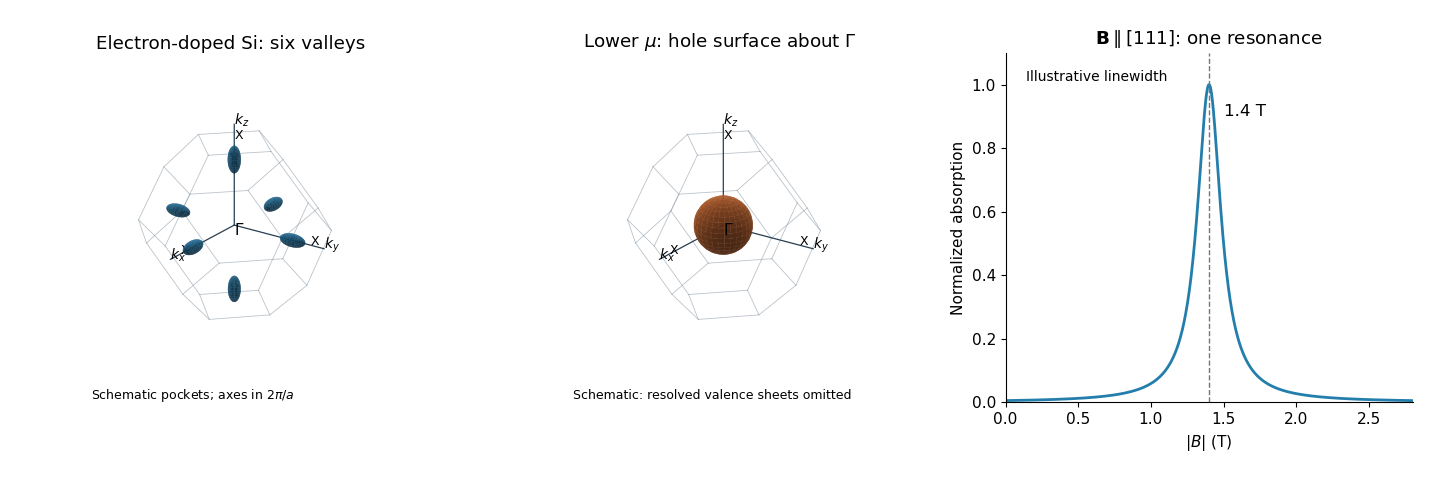

For the electron-doped sample, sketch six closed ellipsoids centred on the --X axes, just inside the six square faces of the face-centred-cubic first Brillouin zone, with long axes pointing radially toward X. In the parabolic approximation,The radial-to-transverse semiaxis ratio is . The readable conduction minimum near X and its crossing of support these electron Fermi surface pockets. The two cyclotron resonance fields arise from the two distinct orientations of the six ellipsoids, rather than two unrelated carrier species. The left panel of the original sketch includes axes, , and the three positive-axis X points; the negative-axis X points are symmetry-equivalent.
The surviving valence maximum lies roughly below the original . Lowering by therefore places it in the upper valence band in the conventional silicon band interpretation. The electron pockets disappear and one sketches a hole pocket centred at , as in the middle panel. Detailed valence-band warping and the number of spin-orbit-resolved sheets cannot be extracted from the damaged figure, and the single drawn surface is schematic rather than a claim that all such sheets coincide.
A discriminating physical property is the Hall coefficient: electron-dominated transport gives a negative value, whereas hole-dominated transport gives a positive value in the ordinary single-dominant-carrier regime. One should not infer a numerical resistivity change without the carrier densities and mobilities.
Use time dependence and assume the dopants supply mobile electrons per unit volume. The Drude model equation isThe free-carrier electric polarization is , so, after adding the bound-electron background,ThereforeThe symbol here is the background-screened plasma frequency; the unscreened carrier frequency is . For positive , the imaginary part of is positive in this time convention, consistent with absorption. Incomplete dopant ionization would replace the nominal doping density by the actual mobile carrier density.
For a nonmagnetic sample bordering air, the normal-incidence Fresnel equations giveAt short infrared wavelengths the carrier response becomes small and approaches the background value . Extrapolating the short-wavelength trend gives about , henceThe leftmost point at is about and has not quite reached that asymptote. As a consistency check, using the minimum below and gives without treating that point as the limiting value.
The minimum is near . For weak damping, zero optical reflectance means refractive-index matching, , rather than . Thususing . Given graphical uncertainty, about is an appropriate estimate. This is a carrier effective mass from a reflectivity minimum, not an independent determination of the bare electron mass.
Just beyond the minimum, passes through zero near . At longer wavelengths it becomes negative and reflection rises sharply toward the conducting regime. Finite damping rounds the edge, prevents a strictly exact zero minimum, and keeps the plotted long-wavelength reflectivity below unity.
The broad feature has the scale expected for a carrier plasmon, a longitudinal collective oscillation of the mobile electron density. Using the parameters just estimated and givesConversely a bare screened plasma oscillation at would require for the same parameters, consistent with the source's approximate density. Its broadness is also consistent with carrier damping, unlike the much sharper lattice line near .
This identifies a plasmon-related feature, not a uniquely determined undamped pure electronic mode. Gallium arsenide is polar, and its longitudinal optical phonon couples to the carrier plasmon. A more complete dielectric model has longitudinal eigenfrequenciesThe measured Raman scattering maximum can also shift with damping and the scattering matrix elements. Experimental Raman scattering from these coupled modes and carrier-collision broadening is established independently.[ref]
Raman Scattering by Coupled Optical-Phonon-Plasmon Modes in GaAs (1968). Abstract: differently doped samples, coupled modes, and linewidths dominated by electron collisions
The supplied approximate density and one broad spectrum do not determine a unique coupled-mode fit. Treating as an exact pure-plasmon eigenfrequency would overstate the available information.A possible assignment is a zone-centre transverse optical phonon of gallium arsenide: the two atomic sublattices oscillate oppositely, producing a narrow lattice Raman scattering line near . Its energy is , a reasonable optical-phonon scale. Unlike the broad carrier feature, its frequency is set mainly by interatomic force constants and ionic masses.
Whether this transverse optical phonon is allowed in an ideal first-order Raman scattering geometry depends on the surface orientation and incident and scattered polarizations; disorder or imperfect geometry can relax a forbidden selection rule. Those experimental details are unspecified, so this is a possible explanation rather than an exclusive assignment.
For a free transition-metal ion, degeneracy among different orbital states can support an orbital contribution to its magnetic moment. In a crystal, the electric fields and bonding of the surrounding ligands split those states. If the orbital ground state becomes nondegenerate and is separated from excited orbital states, its wavefunction can usually be chosen real in zero field. Since the orbital angular momentum operator is imaginary in a real-orbital basis, its expectation value then vanishes.
This suppression is orbital quenching. The remaining leading magnetic moment is the spin contribution, approximately with . Spin-orbit coupling admixes excited orbital states and produces residual anisotropy and shifts in the g-factor; quenching does not mean that every orbital matrix element or every higher-order orbital response vanishes. A degenerate ground orbital multiplet need not be quenched until a further distortion removes its degeneracy.
For the regular octahedron, repulsion from the six oxygen ligands raises the two orbitals, and , above the three orbitals, . The latter point between the metal-ligand axes and experience less direct repulsion. The crystal field splitting is therefore a lower triplet and an upper doublet.
For the V ion, Hund's rules put the two electrons into different orbitals with parallel spins, giving . There are three choices for the unoccupied orbital, so the orbital ground state is triply degenerate. Its spin degeneracy is separate. This orbital degeneracy makes a symmetry-lowering Jahn-Teller effect possible.
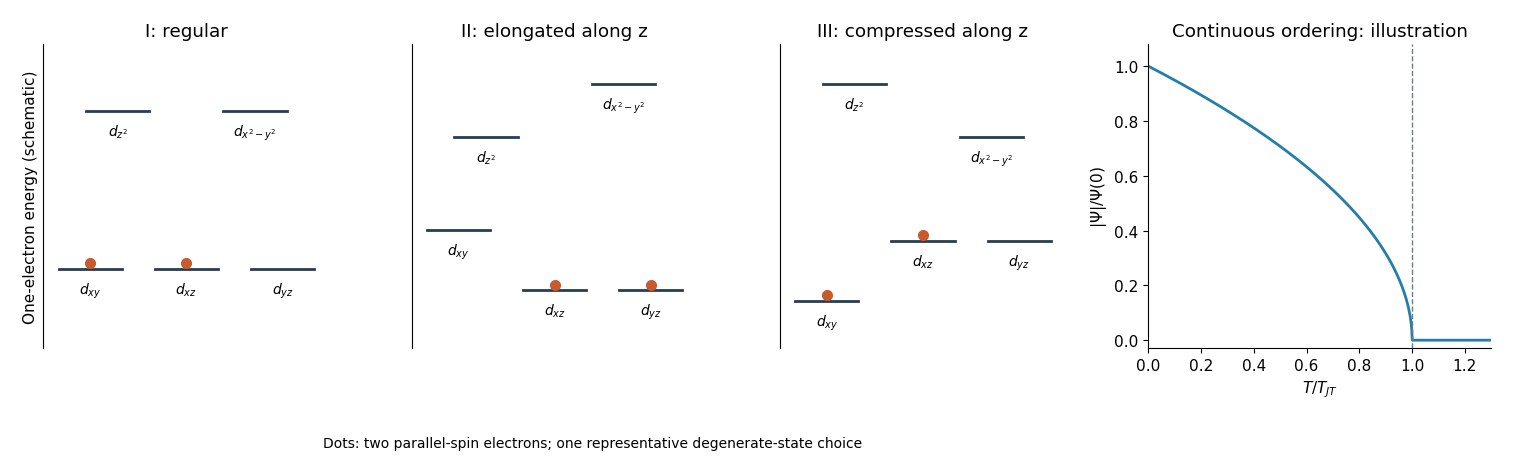
Take the elongation axis as . The axial oxygen ligands move farther away while the equatorial ones move closer, at fixed mean bond length. Orbitals containing are stabilized relative to their in-plane partners. Thus move below within , while moves below within . The schematic level ordering appears in the figure below; the octahedral gap remains open for a small distortion.
The two parallel-spin electrons occupy and , one each. Filling the entire lower doublet gives a unique orbital configuration, so its orbital degeneracy is one and the spin is still . This is the orbitally quenched configuration relevant to the later spin Hamiltonian.
The energetic preference can be made explicit in a traceless linear splitting model. For an elongation coordinate , write the levels relative to their barycentre as with . Their two-electron ground energy decreases by . For an equal-magnitude compression, the levels are and the two-electron energy decreases only by . With the same quadratic elastic cost, minimizing gives four times the stabilization of minimizing . Thus the small-distortion Jahn-Teller effect favors elongation for this high-spin filling. The argument assumes the linear coupling and harmonic elastic model, rather than claiming that symmetry alone fixes all real-material distortions.
For axial compression along , the ordering is reversed: lies below the doublet, and lies below within . One electron occupies and the other occupies either or , with parallel spins in the weak-distortion regime. The orbital degeneracy is therefore two, with .
The retained orbital degeneracy allows further symmetry lowering and explains why this compressed arrangement does not provide the fully quenched equilibrium of the elongated case in the specified simple model.

The term is the leading electronic energy gain from splitting the initially degenerate orbitals and occupying the lower levels. Its negative sign expresses the lowering of the occupied-electron energy for the chosen elongation branch of the Jahn-Teller effect. The positive coefficient is a linear electron-lattice coupling in this reduced model.
The term is the harmonic elastic cost of moving the ligands away from the undistorted reference structure. Mechanical stability requires . The competition between linear gain and quadratic cost produces a finite equilibrium distortion rather than indefinite elongation.
Complete the square:The minimum is stable because . HenceHere the Jahn-Teller stabilization energy is the positive magnitude of the energy reduction.
The low-temperature bond-length difference is . With the question's thermal criterion,Use and to obtainIn SI units these are about and , respectively. They are estimates within the stipulated energy criterion; a cooperative transition also involves interactions and entropy, so its temperature is not in general exactly an isolated-ion stabilization energy divided by .
Above the transition, and both site types have the same g-factor . For the given spin-only Zeeman Hamiltonian, adjacent levels have the same energy spacing, so fixed-frequency electron paramagnetic resonance gives a single resonance field , ignoring unresolved additional interactions.
Below the transition, half the elongation axes lie along and half along . A field along is parallel to the long bond on one sublattice and perpendicular on the other. The line splits intoThe separation grows on cooling as the distortion grows. Equal site populations give comparable integrated weights when the microwave coupling to the two sites is equivalent; populations alone do not fix all polarization-dependent intensities.
A suitable staggered structural order parameter isFor an -elongated A site and a -elongated B site, , with the opposite sign for the domain interchanging the pattern. The electron paramagnetic resonance data determine its magnitude fromFor small splitting this is equivalently proportional to , but the reciprocal-field formula follows directly from the stated g-factors. It does not fix the sign of the structural domain. In a continuous transition tends continuously to zero at and grows below it, eventually saturating. A mean-field sketch has close to the transition; continuity alone does not determine that exponent. The last panel of the original orbital figure shows this illustrative behavior.
Choose the four basis-spin signs as in the order of positions listed in the source; reversing all signs changes no diffraction intensity. Apart from the common magnetic form factor and perpendicular-moment factor, the magnetic structure factor isThe first factor is nonzero exactly when and have opposite parity, and the second exactly when is odd. Thus the magnetic Bragg peaks requireWhen both conditions hold, before geometric and magnetic-form-factor weights. These are magnetic selection rules for the antiferromagnetic component, not conditions forbidding all nuclear diffraction at other indices.
Measure several allowed magnetic reflections from an oriented single crystal by magnetic neutron diffraction, preferably with polarization analysis. A neutron couples to the component of the ordered magnetic moment perpendicular to the scattering vector . For a collinear arrangement, the geometric intensity factor isCompare reflections whose point in different crystal directions, correcting for the magnetic form factor and known experimental geometry. Their relative intensities distinguish candidate spin directions; a moment parallel to gives no magnetic signal from that component. Polarized neutrons help separate nuclear and magnetic contributions. Observing only peak positions establishes periodicity, not the spin direction.
Treat the ordered spins as classical vectors of fixed length , as in the requested mean-field energy. Each iron site has six nearest neighbors: four in the plane and two along . All are antiparallel in the collinear state. Each exchange bond contributes and is counted only once, giving per spin.
The easy-axis term contributes because . The cross product of two collinear spins is zero, so the term proportional to contributes nothing. Therefore
The canted pattern has opposite components but a common component. Write neighboring spins as and . Their scalar product is , and the cross-product magnitude is .
There are three exchange bonds per spin, two eligible bonds per spin for the term, and one single-ion term per spin. HenceFor the branch close to the collinear state,Minimization is equivalent to maximizing , which givesThe chosen branch is a minimum of the energy because it maximizes that positive-amplitude sinusoid. The resulting state is a canted antiferromagnet with a small common moment. The source's absolute-value interaction selects a canting magnitude but is symmetric between the two signs of the weak moment; it is not an oriented vector Dzyaloshinskii-Moriya interaction specifying a unique handedness.
Measure magnetization along at low temperature and use a small field to select a single weak-ferromagnetic domain. After domain alignment, subtract the approximately linear field-induced susceptibility background to obtain the spontaneous weak moment, using the extrapolated intercept of that branch rather than a multidomain zero-field average.
There are four iron ions per orthorhombic cell. If the spontaneous magnetization density is and the cell volume is , the ordered moment and dimensionless spin component per ion areHere spin components are expressed in units of as in the source Hamiltonian. Alternatively normalize the magnetic moment to the measured number of iron ions. A field too large to preserve the small-canting structure would not measure the zero-field component directly. For high-spin Fe with and , the angle above corresponds to approximately per iron ion.
In a conventional superconductor, an attractive pairing interaction forms Cooper pairs and a phase-coherent condensate. The elementary fermionic excitations have a superconducting energy gap ; breaking a pair into two excitations costs at least . The density of thermally excited quasiparticles is exponentially small for . Nevertheless the vanishing DC electrical resistivity below the critical temperature is a property of the coherent supercurrent, not a claim that all thermal quasiparticles disappear. Below the relevant critical-current and critical-field limits, a homogeneous bulk sample carries dissipationless current; above the superconducting transition the normal resistivity returns.
In a semiconductor, the band gap separates filled valence states from empty conduction states because of the periodic crystal potential and orbital hybridization. Thermally exciting carriers across the gap produces both conduction electrons and valence holes. For an intrinsic sample,Thus its electrical resistivity generally rises rapidly on cooling, with an activated factor up to mobility and density-of-states prefactors. This differs from the zero-resistivity condensate response. Dopant freeze-out and extrinsic-carrier regimes require their own activation scales; the intrinsic formula is not universal for every doped sample.
Use a normal-metal--insulator--superconductor junction with a weak tunnelling barrier. For a nearly constant normal-metal density of states, the differential conductance probes the thermally broadened superconducting quasiparticle density of states. At sufficiently low temperature, the ideal BCS theory result isThere is very little single-electron tunnelling for , while a sharp onset occurs at . The gap can therefore be obtained from the two symmetric onset voltages, . For this one-superconductor junction the threshold is , not .
Integrating at zero temperature gives the useful current sketchThe curve is odd, nearly flat inside the gap, and approaches the normal-state line at large . The ideal gap-edge singularity is in the slope, not in the current itself. At finite temperature below the transition the onset rounds and thermally activated subgap current appears. Measuring several temperatures distinguishes this rounding from the closing of .
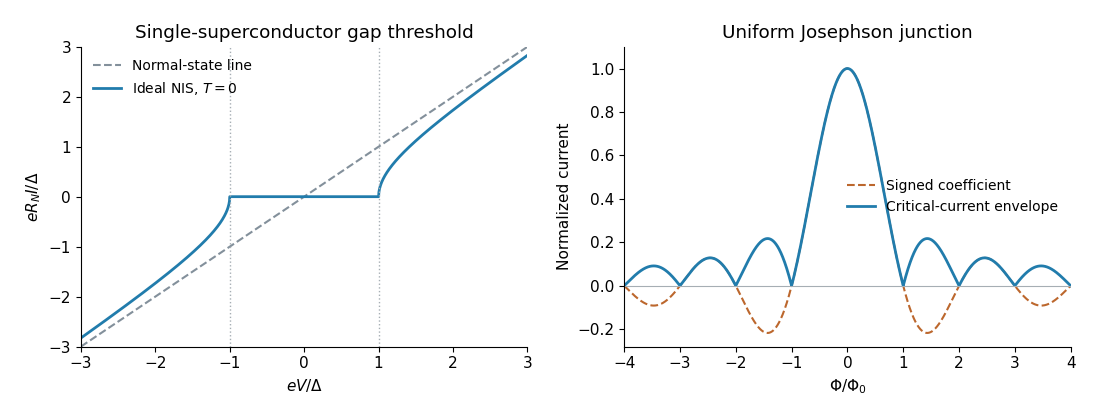
Gap threshold in NIS tunnelling and the Josephson interference envelope
. Original ideal-model plots. Left: the zero-temperature single-electron current into a fully gapped superconductor, with the normal-state line for comparison. Right: the signed sinc coefficient at a fixed phase and its nonnegative critical-current envelope. Finite temperature, nonuniform junction current density and self-field effects are omitted. Details.
Rearrange the source's condensate-current expression and integrate around a closed path lying in the superconducting material:Single-valuedness of the superconducting wavefunction requires , and Stokes theorem gives . Thus the exact result is fluxoid and flux quantization in a superconductor:Reversing the winding orientation absorbs the sign of . Since a Cooper pair has , the positive superconducting flux quantum isFor a thick ring, choose the path deep enough that the supercurrent is negligible; then the enclosed magnetic flux is . This is the flux quantization usually intended in the question.
Qualification of the unqualified flux claim: a thin ring can have a nonzero kinetic contribution around every available path, so it is the fluxoid that is exactly quantized. For example, with zero applied flux and geometric and kinetic inductances , a metastable winding- state has but . This concrete counterexample satisfies the given current law while its magnetic flux is not an integer multiple of .
Let cross the barrier from electrode 1 to 2, let run along its width, and take . In the ideal barrier-only model choose , which has . Then the crossing integral at fixed is . With the sign convention used in the source,Reversing the field or the phase orientation reverses the slope and does not change the interference envelope. The same result follows by comparing two paths across the junction and using the enclosed magnetic flux.
If field penetration into thick identical electrodes is included, the effective magnetic thickness is approximately , where is the London penetration depth. Replace and consistently by and . The linear phase profile assumes a uniform applied field and negligible magnetic self-field of the junction current.
Let be the junction length perpendicular to the width and be uniform. Put . Integrating the local current-phase relation of a superconducting weak link over the junction givesThe odd-in- term integrates to zero. At fixed central phase , define . ThenThe value at zero flux is the continuous limit, and zeros occur at nonzero integer multiples of . This signed formula is the source's expression for a fixed phase. If the measured quantity is the maximum sustainable current, maximize over the central phase instead:For example, at the signed coefficient is , whereas the critical current is positive. The absolute-value envelope is the Fraunhofer pattern of a Josephson junction, shown in the right panel of the original tunnelling figure. Its simple form relies on uniform and the linear phase profile; it is not the two-junction cosine pattern of a DC SQUID.
The original cover identifies 15 June 2018 despite the bundle filename. All six questions are treated. The missing Hall-voltage graph prevents the numerical calibration and field-specific assignments in Question 6; affected solutions contain explicit TODOs. Readings of the surviving graphs are approximate.
A phonon is one quantum of a normal vibrational mode of a crystal. In the harmonic approximation, each mode with wavevector , branch index and angular frequency is an oscillator with energies . A phonon changes the occupation by one; it is not a particular atom moving through the solid.
For a three-dimensional primitive cell containing atoms there are branches. Three acoustic branches approach zero frequency as : at zero wavevector they represent rigid translations, with all basis atoms displaced together. Their small-wavevector frequencies usually grow linearly with wavevector. The remaining optical branches have internal relative motion of basis atoms and generally nonzero zone-centre frequencies. The names reflect their coupling to radiation in suitable polar crystals, not a rule that every optical mode must be infrared active. Acoustic and optical branches can each have longitudinal or transverse polarizations.
Each atom supplies three displacement coordinates. Translational invariance gives three acoustic branches for either structure, leavingThese count branches at a general wavevector; a doubly degenerate pair still counts as two modes. The stated atom counts refer to primitive cells, so no additional centring factor is needed.
To obtain a crystal's point group, discard the translation parts of its space-group operations. A screw becomes a rotation and a glide becomes a mirror. Thus the tetragonal group's , and operations giveFor the orthorhombic structure the three perpendicular twofold/glide or screw/mirror directions giveThe primitive Bravais lattice symbol does not itself add a point operation; the fractional translations matter for the space group but disappear from this point-group reduction.
Articles were limited to the first 100 out of 305 total.
Articles by others on the same topic
There are currently no matching articles.