For the body-centered tetragonal direct lattice, conventional reciprocal labels are integer triples satisfying even. This follows because the extra translation must have phase one for a reciprocal lattice vector. In the section the condition is even. The reciprocal steps areWithin the strict index window , the reciprocal points are and . The neighboring and points lie on the excluded boundary but are useful for constructing the zone bisectors.
At the requested drawing scale, one conventional step in is cm and one step in is cm. Thus the four off-origin included points have drawing coordinates cm. Keeping these unequal physical scales avoids drawing a fictitious square reciprocal section.
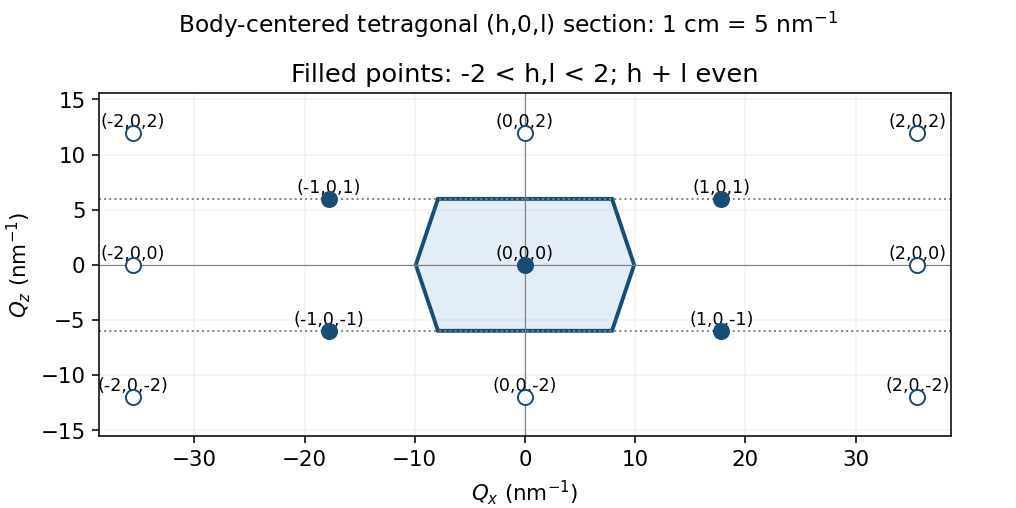

Construct the first Brillouin zone by the perpendicular bisectors between the origin and reciprocal lattice points. For a test point , the nearest relevant reciprocal points are and . Their inequalities areSet . The six vertices in conventional coordinates areNumerically these are and . The reciprocal lattice vectors must in principle be checked because the requested object is a section of a three-dimensional zone. For example gives the weaker bound , and gives a weaker vertical bound; neither clips this hexagon. Direct comparison with surrounding three-dimensional reciprocal lattice vectors confirms the displayed section. It is not the rectangular reciprocal conventional cell.
The difference of the two wave-vector labels is , an allowed reciprocal lattice vector because is even. Bloch's theorem of the lattice dynamical matrix therefore givesfor corresponding phonon branches. Neither individual odd-sum point needs to be a reciprocal lattice point. It is their difference that establishes equivalence. Structure factors and neutron polarization factors can still change the observed intensities at those two scattering vectors, so equal frequencies do not require identical measured spectra peak by peak in intensity.
There are three acoustic branches, not two. For propagation parallel to the tetragonal axis, one branch is a longitudinal wave, polarized parallel to . The other branches are transverse waves whose polarizations lie along the equivalent basal directions. The fourfold symmetry about makes those transverse modes degenerate along that axis.
Consequently at a generic nonzero wave vector along there are only two distinct acoustic frequencies: one longitudinal frequency and one doubly degenerate transverse frequency. At the zone center all acoustic frequencies go to zero as required by uniform translation invariance. The degeneracy would generally lift if propagation moved away from the symmetry axis or the basal tetragonal symmetry were broken.
Articles by others on the same topic
There are currently no matching articles.