Let and be gauge-invariant phase drops across the two identical junctions, oriented between the same terminal phases. Their currents obey the DC Josephson effect: and . For negligible loop self-inductance and no additional phase drops in the arms, fluxoid consistency fixes their difference modulo :Define the mean terminal phase and . Then and the two parallel branch currents add:Consequently the maximum magnitude of the current is , not a negative critical current when the cosine changes sign. The phase shifts by between such stable branches. Junction asymmetry or appreciable self-generated flux modifies the simplest interference pattern, so the stated idealization is required before treating as an externally prescribed flux.
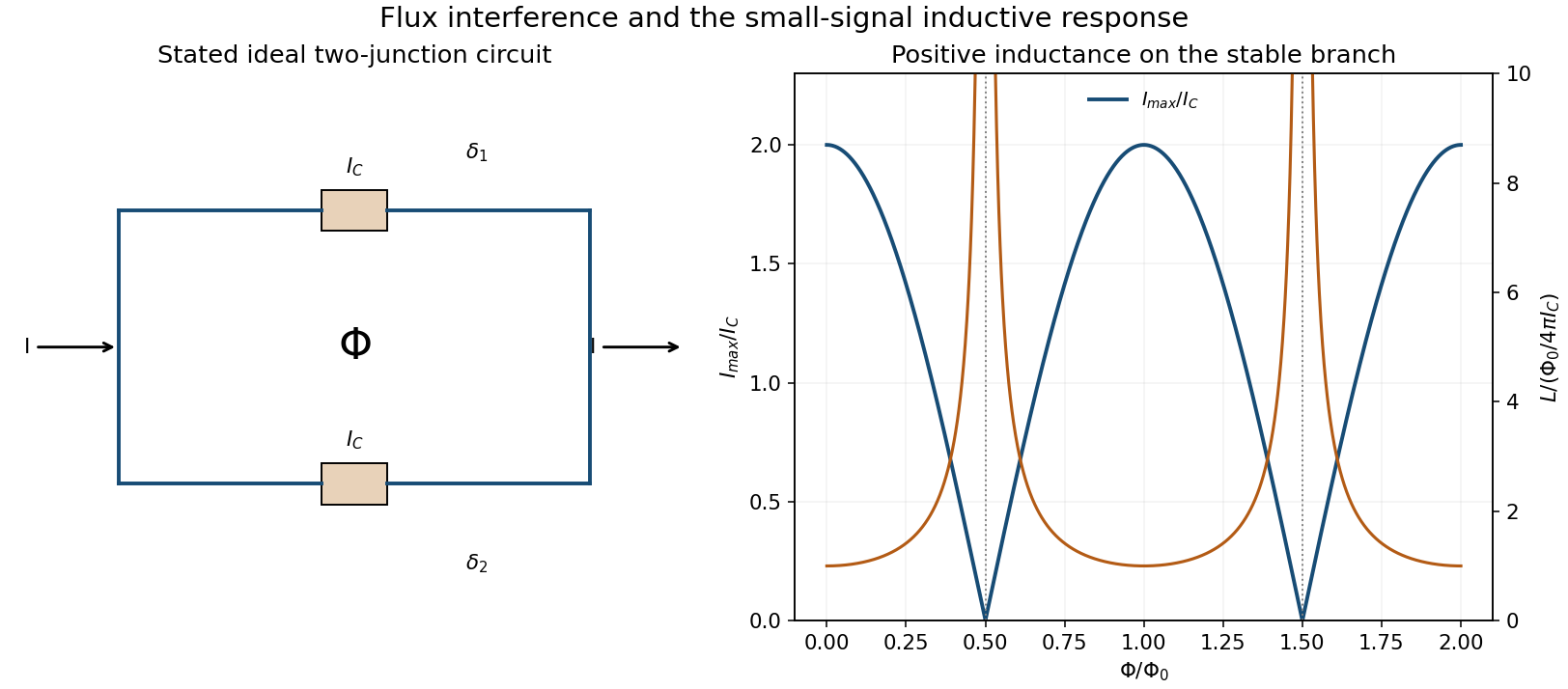
Two-junction superconducting interference and its stable inductive response
. Original circuit-level diagram of the stated ideal two-junction model, with a flux-dependent critical-current envelope and stable small-signal inductance. It does not reconstruct the missing source raster components. Details.
Articles by others on the same topic
There are currently no matching articles.