On a beta plane, , the preceding vorticity equation isIn the broad ocean interior, assume a statistically steady flow, weak advection of relative vorticity, and negligible friction compared with planetary-vorticity advection. The constant-depth, constant-density assumptions of 2(a) exclude topographic and baroclinic vorticity generation contributions. More precisely, require . Then Sverdrup balance isSmall Rossby number and slow forcing help justify these conditions in the interior; they do not justify them inside an intense western boundary current. For fluctuations, the mean eddy contribution to relative-vorticity advection must also be negligible.
The depth-integrated northward volume flux per unit zonal distance is . For a basin and wind stress independent of , the northward interior volume flux isA negative value denotes southward transport. The cancellation of is why this interior volume flux is insensitive to the chosen constant depth. In a closed, steady basin the net volume flux across a full latitude section is zero: a boundary return must compensate . Thus the displayed formula cannot represent the total closed-basin transport including that return.
For a concrete circulation sketch, use a northern-hemisphere subtropical basin andThis represents westward trade winds at the southern edge and eastward westerlies at the northern edge. The negative wind stress curl drives southward interior flow. Define an ocean transport streamfunction by , and impose no normal flow at the eastern wall through . Integrating Sverdrup balance westward givesSince at , this also gives no normal flow at the north and south walls. Interior water moves westward in the southern part, southward across the basin, and eastward in the northern part. A northward western boundary current completes the clockwise ocean gyre.
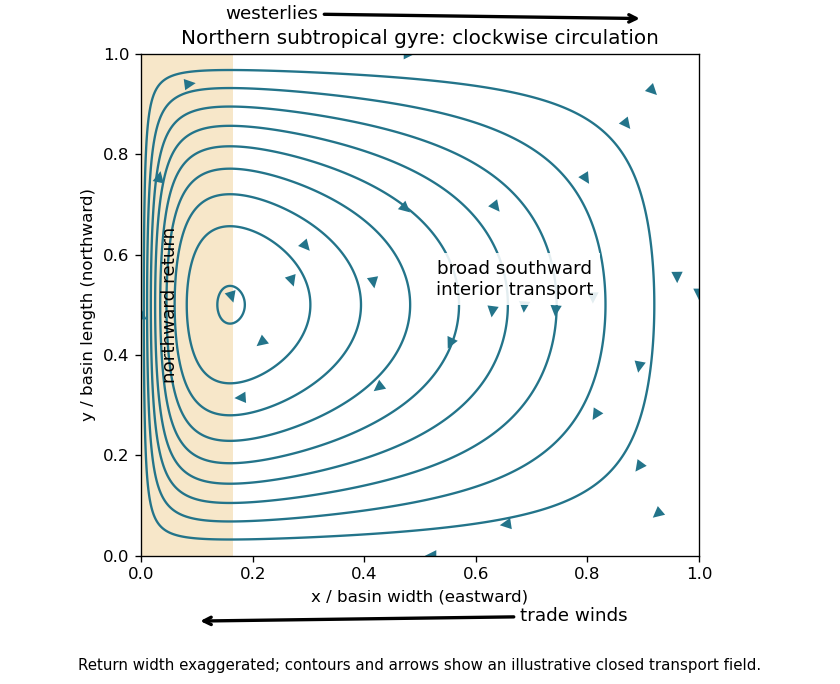
Northern-hemisphere subtropical Sverdrup interior and a schematic western return, with arrows indicating volume transport
. Details. 
Pure Sverdrup balance cannot satisfy the western impermeability condition as well: varies along that wall. Indeed imposing no normal flow on both east and west walls would require their constant streamfunction values to agree in this simply connected closed basin, whereas their difference here is the nonzero . The shaded return in the sketch represents a boundary region where the interior approximation breaks down. It is supplied by friction in 2(c), rather than inferred from Sverdrup balance alone. A southern-hemisphere subtropical ocean gyre has the reflected, anticlockwise circulation.
For an order-of-magnitude estimate, use , , , and a wind stress variation scale . ThenHere is a Sverdrup. The sinusoidal example has maximum ; taking makes it agree with the chosen variation scale. Other reasonable basin widths and wind profiles change the coefficient, but retain a transport of order tens of Sverdrups.
Articles by others on the same topic
There are currently no matching articles.