No. Colour the positive integers by alternating dyadic blocks:Every positive integer and its double have opposite colours. A nonempty set closed under addition contains both and , so no such set can lie in one class. In particular there is no infinite monochromatic additive subsemigroup.
The suggested arithmetic-progression argument gives another way to see the obstruction. If and is closed under addition, then all lie in . But every infinite arithmetic progression of positive step meets every sufficiently long dyadic block, because a block of at least consecutive integers contains a representative of the progression's residue class. Both colours contain arbitrarily long blocks, so neither colour contains an infinite arithmetic progression.
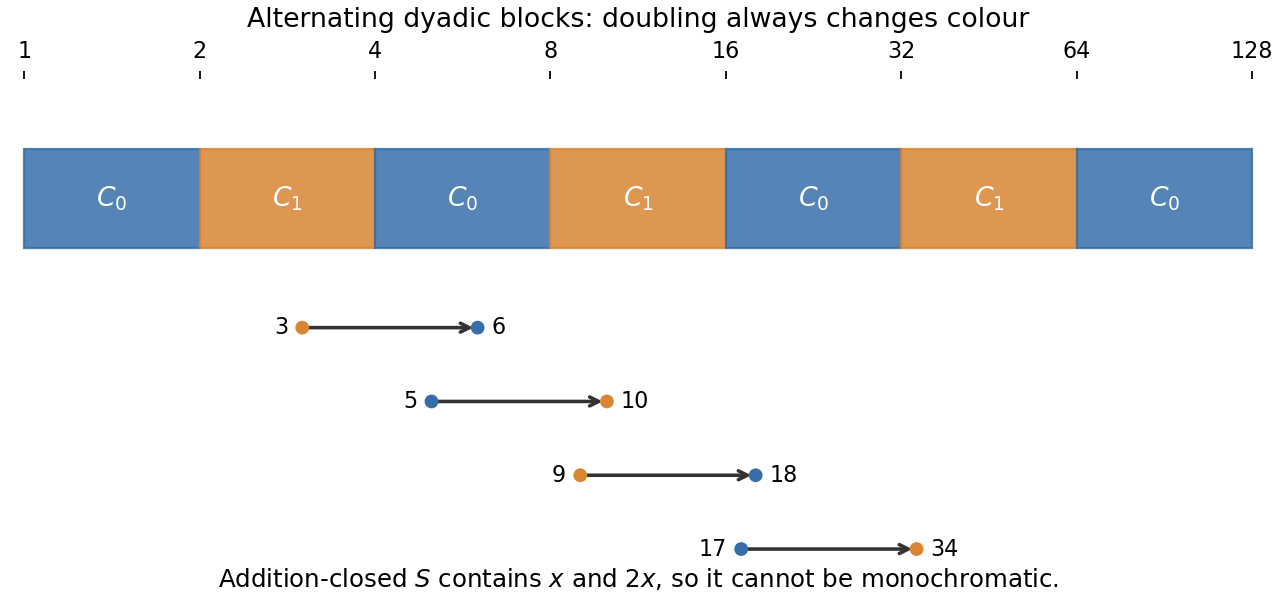
Alternating dyadic colouring and the doubling obstruction
. Every positive integer and its double lie in opposite coloured blocks. Details.
Articles by others on the same topic
There are currently no matching articles.