A crystal needs a nonzero effective second-order nonlinear optical susceptibility for the chosen polarizations. In the bulk electric-dipole approximation, centrosymmetry forbids this response. Transparency at the relevant frequencies and phase matching over the interaction length permit efficient buildup. Nonzero local generation can occur without exact phase matching, but contributions then tend to cancel as they propagate.
Write . Expanding the square and using the product-to-sum identity givesThese are respectively optical rectification, the two second-harmonic generation terms, sum-frequency generation and difference-frequency generation. Their phases and wavevectors are the corresponding sums or differences, not independently adjustable quantities.
For a vector field, . In the stated single-frequency amplitude convention, . If , comparison givesFor a real instantaneous tensor the zero-frequency contribution is . In a dispersive treatment, the tensors must carry their respective input and output frequency arguments.
The identical input-frequency pair is symmetric under , allowing contracted nonlinear susceptibility notation: replace the six pairs by . ThusThis contraction of a symmetric pair does not turn the physical susceptibility into a rank-two tensor. The factors of two account for both off-diagonal input orderings, and the prefactor follows from the question's explicit field convention.
For the proposed type-I process, energy conservation requires . HenceThe extraordinary pump and two ordinary output waves can be collinearly phase matched ifPut . Substituting the supplied angular extraordinary index and solving for yieldsThe required index lies between and , so a real angle exists. Using the rounded 2922 nm wavelength in the supplied data gives ; retaining the energy-conserving 2922.25 nm value gives about . Their common meaningful scale is about 47 degrees.
The spatial walk-off angle is the angle between the extraordinary wave's Poynting vector and its wavevector. For an optic-axis angle , the extraordinary dispersion surface givesHere the indices are those of the 780 nm pump. Since this is a negative uniaxial crystal, its energy flow is farther from the optic axis than its wavevector. The ordinary waves' energy flows follow their wavevectors. The pump therefore drifts out of spatial overlap by roughly , about over a millimetre. This limits the useful nonlinear interaction length even when phase matching is exact.
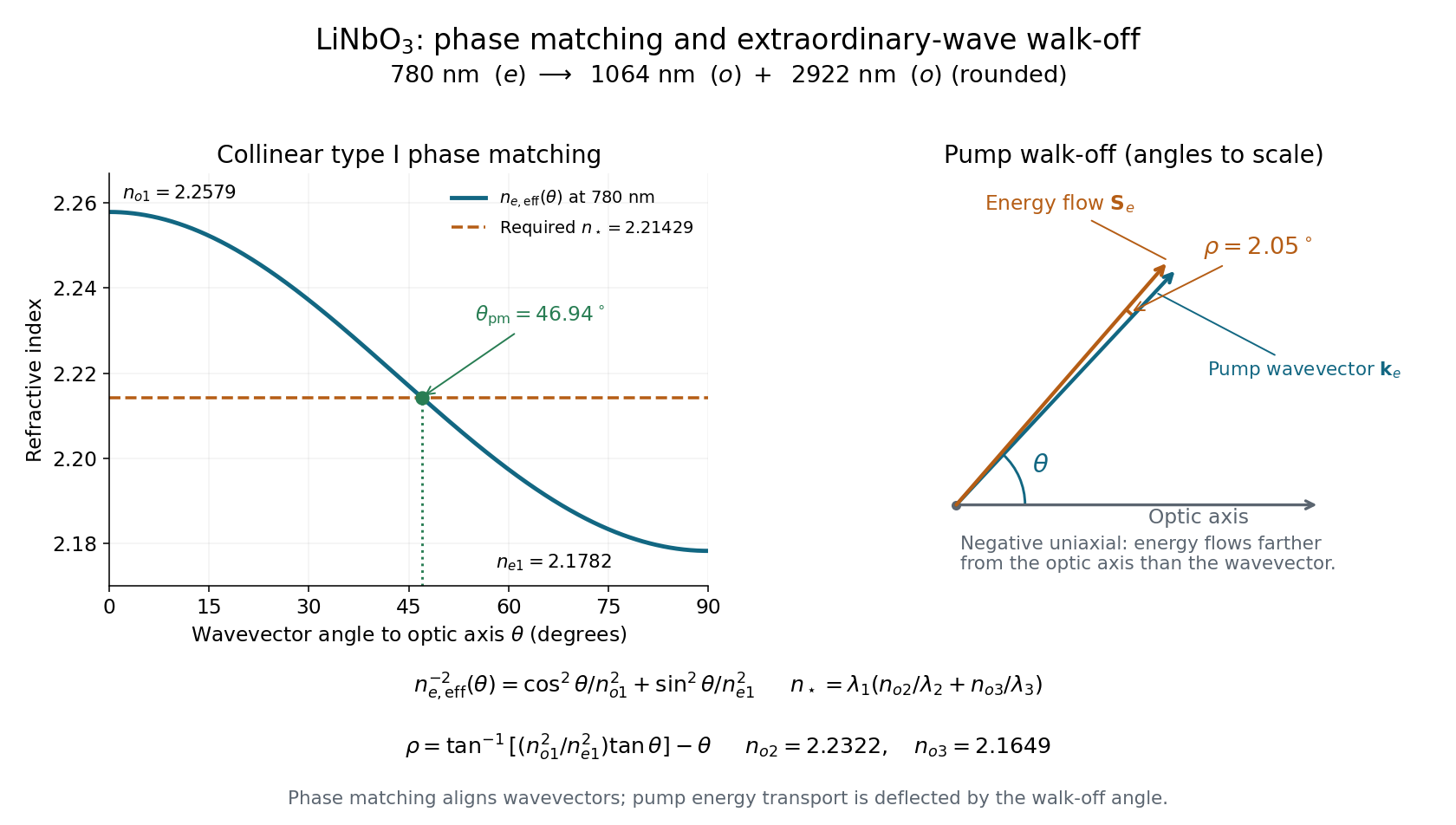
Type-I phase matching near forty-seven degrees and the extraordinary pump's two-degree spatial walk-off
. Details. 
Articles by others on the same topic
There are currently no matching articles.