Source bundle pages 25–30. The cover establishes 2022 despite the attachment filename. The solutions use the original PDF's port labels and distinguish signed carrier-phase conventions.
where S is intracavity photon number, N is the available inversion in compatible units, Rp is the pump rate and τc is the photon lifetime. During the short discharge, pumping and upper-state decay can often be neglected. The build-up and depletion rates determine the width; there is no universal equality between the width and τc. The initially stored energy and the output coupling also matter. Typical Q-switching produces nanosecond-scale optical pulses.
The carrier-envelope phase specifies where the carrier oscillation lies relative to the maximum of an optical pulse's envelope. With s=t−tm and E=F(s)e−iω0s+iψm, the signed complex-field phase at the envelope maximum is ψm. Consequently,
If instead the real electric field is written F(s)cos(ω0s+ϕCE,m), then ϕCE,m=−ψm and the conventionally quoted slip is ϕslip=+2πωce/Δω. These are the same physical shift with opposite phase definitions.
Near tm, the j=m term dominates when bT≫1. The other terms are exponentially small but not identically zero. A single Gaussian function used globally would decay between 0 and T, whereas the exact light intensity has equal maxima there; this supplies a concrete reason the isolated form cannot be an exact global identity. The extension to negative frequencies is the usual narrow-positive-band analytic-fieldapproximation when ω0≫b.
When the doubled low-frequency region overlaps the original high-frequency region, choosing r=p+q gives the beat at ∣ωce∣. More generally the nearest positive beat has angular frequency
For a finite stable Gaussian beam, 0<L<R. The same formula remains valid at R=2L, where self-consistency selects zR=L. At the geometrical hemispherical limit R=L it predicts zR=0; that marginal boundary has no finite-width stable fundamental Gaussian beam. Thus the source'sword “hemispherical” is used for the plano-concave family, including the near-hemispherical case below.
Equivalently, u=f+δ. The signs in u and v are the same. Real solutions require f2≥zAzB; a converging optical lens therefore needs f≥zAzB. At equality u=v=f. For the stated arrangement, additionally require u,v≥0 and that the chosen optical lensposition is accessible outside both optical resonators. A negative v is an algebraic virtual-waist solution, not a downstream beam waist.
Only the first branch has the target beam waist downstream of the optical lens. It is also geometrically accessible: the optical lens is u−L1≃0.62642m beyond the source output mirror, and the target input mirror is v−L2/2≃7.44786m beyond the optical lens. The total separation between beam waists is u+v≃14.07428m.
The same optical mode matchingcalculation applies, now with fmin=zAL2/2. Keeping the example's L2=10m gives zB=5m and fmin=0.707107m, compared with 0.930605m for the nonconfocal target. With f=1.5m, the two branches become
Scalable characterized qubits. Two long-lived hyperfine structure levels or an optical ground/metastable pair in each ion encode ∣0⟩,∣1⟩. An ion trap confines individually addressed ions. Extending a chain adds qubits, but increasing motional complexity, addressing errors and heating limit straightforward scaling; segmented traps and transport can help.
Initialization. Cooling plus optical pumping prepares the internal quantum state. Filling or rearranging traps prepares a usable register; motional cooling is needed when the chosen quantum gate depends on motion.
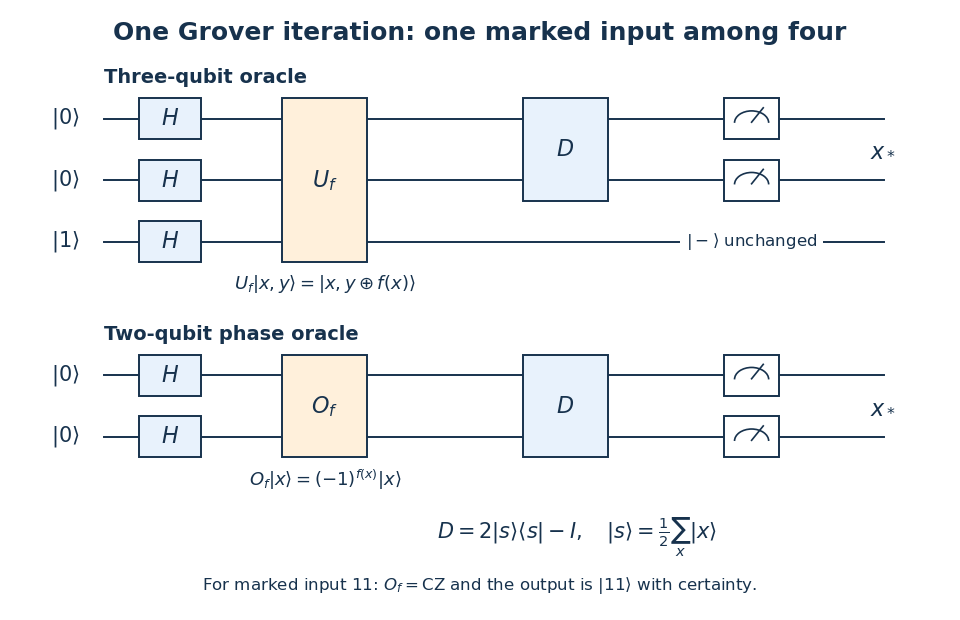
Here ∣−⟩=(∣0⟩−∣1⟩)/2. Since X∣−⟩=−∣−⟩, phase kickback gives Uf(∣x⟩∣−⟩)=(−1)f(x)∣x⟩∣−⟩. The third qubit remains separable and unchanged. A direct marked-state phase oracleOf∣x⟩=(−1)f(x)∣x⟩ therefore replaces the three-qubit query using only two qubits:
This equality follows directly by evaluating the four diagonal entries: the first three are +1 and the 11 entry is −1. Negative J can be handled by refocusing or reversing the effective interaction sign. The global phase can be ignored.
Both ∣+⟩ and ∣−⟩ give either final computational basis outcome with probability1/2. Thus, after Alice records the second outcome b, she assigns ∣b⟩, whereas Bob assigns
The Born rule in the orthonormal computational basis gives P00=∣a0∣2, P01=∣a1∣2, and similarly for the two outcomes beginning with one. Ignoring the second outcome therefore gives
Only the control qubit needs to be pure. A uniformly randomized computational basis preparation supplies the target maximally mixed state. This is the principle of trace estimation by a maximally mixed Hadamard test. The extension is algebraic; efficiently implementing controlled-U still requires a known suitable gate construction. Moreover, estimating the unnormalized trace to fixed additive precision requires increasingly precise estimation of the normalized signalas k grows. There is no automatic efficient reconstruction of all entries of U.
The relative phase in the first rule is essential to the repeated-path calculation. Overall port phases may be changed consistently; they cannot be changed on one pass alone while retaining the original scattering rules. In the following, take unit mirror reflection amplitudes by incorporating fixed reflection phases into the propagation-mode convention, and keep any unremoved propagation phase explicitly if needed.
Starting at port 1, the first beam splitter encounter sends amplitude c straight out through port 0 and stores amplitude −c towards M2. A return from M2 enters port 1′; it sends the stored amplitudetimes −c out through port 1 and times c towards M1. A return from M1 enters port 0′; it sends amplitudetimes c out through port 0 and times c towards M2. Both internal continuations carry +c, so two additional encounters multiply the surviving amplitude by +c2.
and c0,2j=c1,2j+1=0. The first nonzero terms are c0,1=1/2, c1,2=1/2, c0,3=−1/(22) and c1,4=1/4. If fixed reflection amplitudes r1,r2 are retained instead, multiply c0,2j+1 by (r1r2)j and c1,2j by r2jr1j−1, as well as the appropriate delay propagation phases. These unit-modulus factors do not alter the following probabilities.
Distinct exit events are orthogonal because they differ in output port or arrival-time bin. This requires the incident wavepacket to resolve the delay. Summing the squared moduli as geometric series gives
Their sum is one. After n encounters the probability of still being inside is 2−n, which tends to zero, so no trapped component is omitted.
The source drawing places the delay line in the M2 arm. A visit to M2 crosses that line in both directions. If τ is its one-way delay, then an exit after n encounters has crossed it 2⌊n/2⌋times:
If the phrase “delay time τ” instead denotes the complete M2-arm round-trip delay, replace 2τ by τ in the floor formula. The wording does not explicitly distinguish these conventions. Consecutive encounters can produce the same exit time in different ports: for example n=2,3 both follow one M2 visit. If the incident wavepacket were much longer than the arm delay, different histories in the same port would overlap and their probability amplitudes would have to be added before squaring; the asserted time-bin expansion would then not be an orthonormal eventbasis.
Let S denote immediate transmission through the BS1 subsystem between Bob's lower-right port and Alice's upper-left port; let L denote transmission after one visit to each internal mirror. From the same beam splitter rules as in b, the corresponding amplitudes in either direction are
up toa common fixed two-mirror propagation phase. The minus sign in L comes from the 1′→1 or reverse 1→1′scattering. The two paths selected by D0'stime gate are L on the outward journey followed by S on the return, and S outward followed by L on the return. They have the same total delay and fixed propagation phase, so their probability amplitudes interfere.
For the firsthistory, Alice applies eiϕA to the late component, while Bob's return-timemodulation is not encountered in the return delay arm. For the second, Alice's early component is unmodulated and Bob applies eiϕB in the return delay arm. Bob must time his modulation to the return passage, leaving the outward reference preparation unchanged; this is implicit in the stated encoding. Each enabled modulator is traversed twice, so its π/2 single-pass phase becomes the stipulated π.
For the allowed values 0,π, this is 1/16 when ϕA=ϕB and zero otherwise. The ignored trajectories exit other ports or other time bins; excluding them from D0's acceptance does not increase the success probability. Equal mirror reflection phases, channel phases and Alice'smirror phase multiply both accepted histories equally and cancel from the interference condition. A residual relative phase would need calibration.
Encode 0 by phase zero and 1 by phase π. Alice and Bob choose their bits independently and keep their choices private. Bob announces the trial numbers with a D0 click over an authenticated public channel. For each retained trial, c guarantees that their bits agree. In the ideal symmetric setup, the two equal-phase cases 00 and 11 give the same click probability, so announcing success does not itself reveal which shared bit was used.
The matching-phase cases occur with probability1/2, and a matching case succeeds with probability1/16. Therefore
Thus a no-click trial supplies neither a known equal bit nor a known complemented bit. This is why it cannot be retained by the direct error-free sifting rule. The source's “cannot use” should be understood in this sense: the events are not statistically independent, so an absolute claim that they contain no information would be false.
To obtain a secret final key, reveal and discard a random subset of retained bits to test the observed error rate, then apply reconciliation and privacy amplificationas required by a security analysis of the actual implementation. Resolving which time path a photon took removes the accepted histories' quantum coherence and can turn destructive interference into false D0 clicks, providing a simple disturbance test. Equal-phase click correlations alone are not a proof of security against every attack, particularly in the presence of losses and device imperfections. The supplied idealmodel fixes the sifted rate N/32; it does not fix a positive secure final length without an adversary model and observed parameters.
The cover dates this examination to 11 June 2021; the public bundle's filename is not the examination year. Source bundle pages 28–33. Solutions use the original conventions, with the Ramsey population-sign inconsistency identified explicitly in part 3(c).
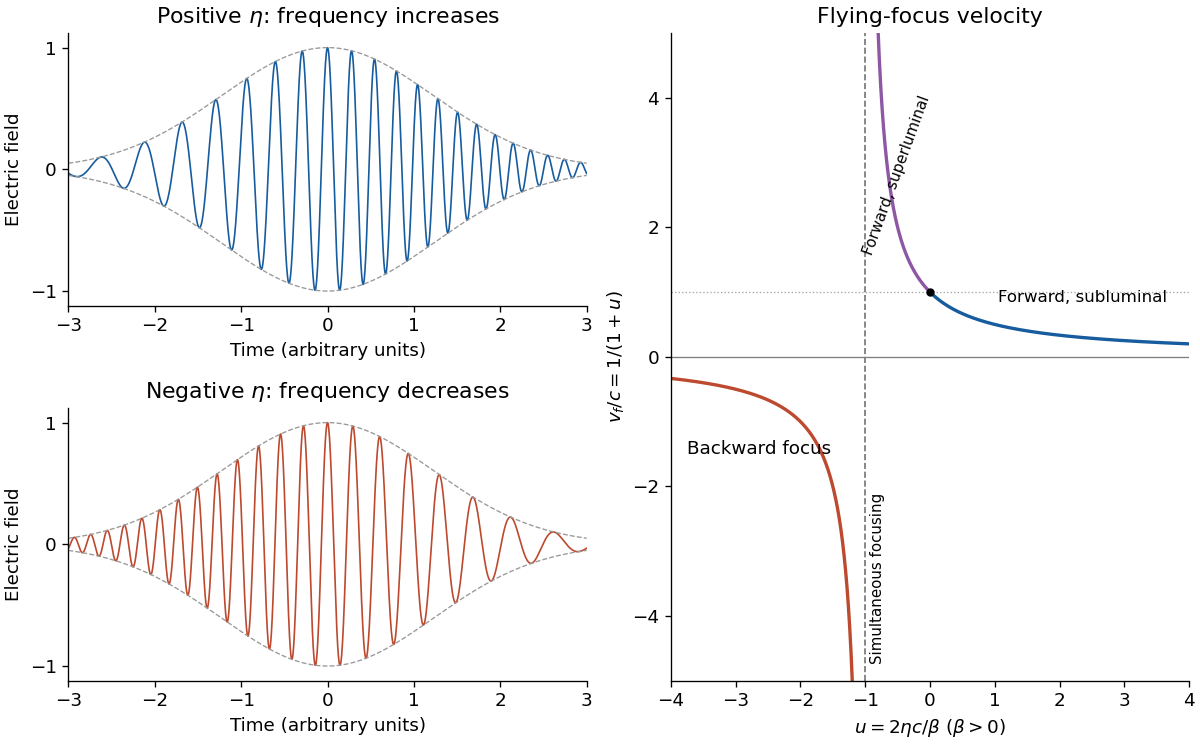
with a smooth localized envelope A(t). The carrier oscillations become closer together towards later times for positive η and farther apart for negative η.
For β>0, define u=2ηc/β. The velocitygraph in the preceding figure has horizontal asymptote zero and a vertical asymptote at u=−1. For η>0, 0<vf<c: the higher-frequency components both enter later and travel farther. At η=0, vf=c. For −β/(2c)<η<0, vf>c: the farther-focusing components leave earlier, partly compensating their extra travel. At η=−β/(2c) every component focuses at the same time, so the trajectory is not a finite-velocityfunction of time. For η<−β/(2c) the farther positions focus first, giving vf<0; it tends to zero from below as η→−∞.
The proportionality suppresses the optical transition matrix element and other smoothly varying optical prefactors. It assumes parabolic isotropic energy bands, an allowed direct transition, and negligible linewidth and many-body corrections. Here fv counts electrons, not electron holes.
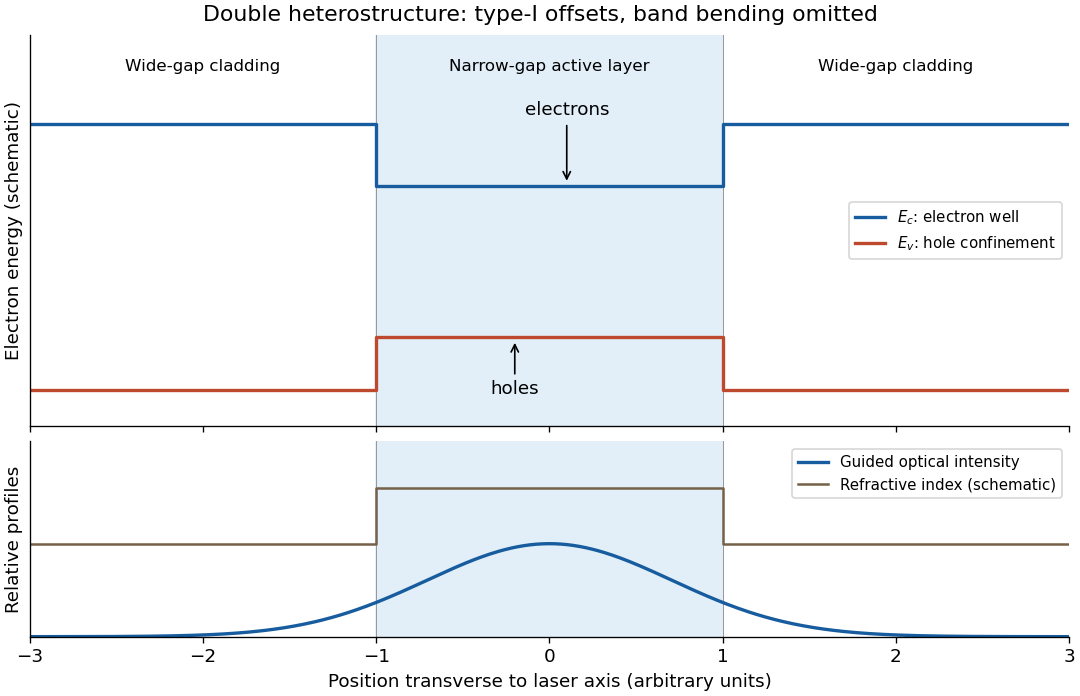
Writing Γ for the fraction of the optical normal mode overlapping the active layer, the threshold condition is Γg=αi+αm, with internal and mirror losses αi,αm. A larger overlap and a higher carrier number density at a given current both lower the threshold current. The figure shows composition-induced offsets; a working junction also has band bending under bias, which is omitted to make the confinement mechanism visible.
Thus it rotates right-handedly about the fixed axis Ω, preserving its length and its projection on that axis. For example, on resonanceδ=0, anorth-pole Bloch vector follows (0,−sinVt,cosVt) and reaches the south pole at t=π/V.
Take V>0, with the field phase chosen accordingly. The Hadamard gate is H=(σx+σz)/2. Align the axis with (1,0,1) and rotate through π:
There is a basis-ordering convention to make explicit: this H is the Hadamard gatematrix in the ordered basis(∣1⟩,∣0⟩) chosen in part (a). If instead its definition is the usual ket rules H01∣0⟩=(∣0⟩+∣1⟩)/2 and H01∣1⟩=(∣0⟩−∣1⟩)/2, its matrix in our order is (σx−σz)/2. For that definition choose δ=+V,τ=π/(2V). Both conventions use the same pulse duration; the sign of the Rabi detuning selects the desired axis.
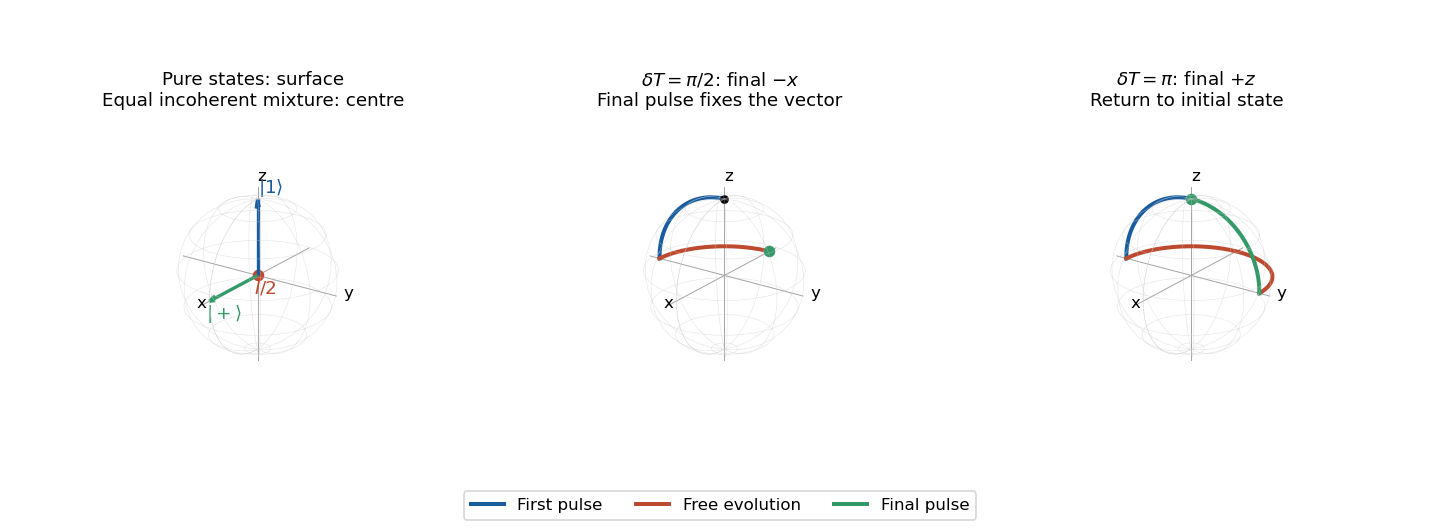
These formulas specify every arc in the two Bloch sphere sketches. For T=π/(2δ) the path is north →−y→−x, and the last pulseleaves −x fixed. For T=π/δ the path is north →−y→+y→ north.
More generally δT=−π/2(mod2π). With the alternative conventional ket definition H01 specified in part (b)(i), the required matrix is (σx−σz)/2, so TH01=π/(2δ) and UR=−iH01. The distinction concerns which basis order defines the named Hadamard gate; the evolution and the return population do not depend on that naming choice. Finally rz=−cosϕ, so the actual return population is
The printed plus sign is inconsistent with the two identical pulses. At T=0, UR=P2=−iσx, so ∣1⟩ becomes ∣0⟩ and ρ11(0)=0; the printed expression gives one. This counterexample is independent of Bloch sphere labeling. A plus sign would describe the complementary population ρ00, or the return population with an opposite-sign final pulse. That changed sequence also changes the gate question and must not be silently substituted.
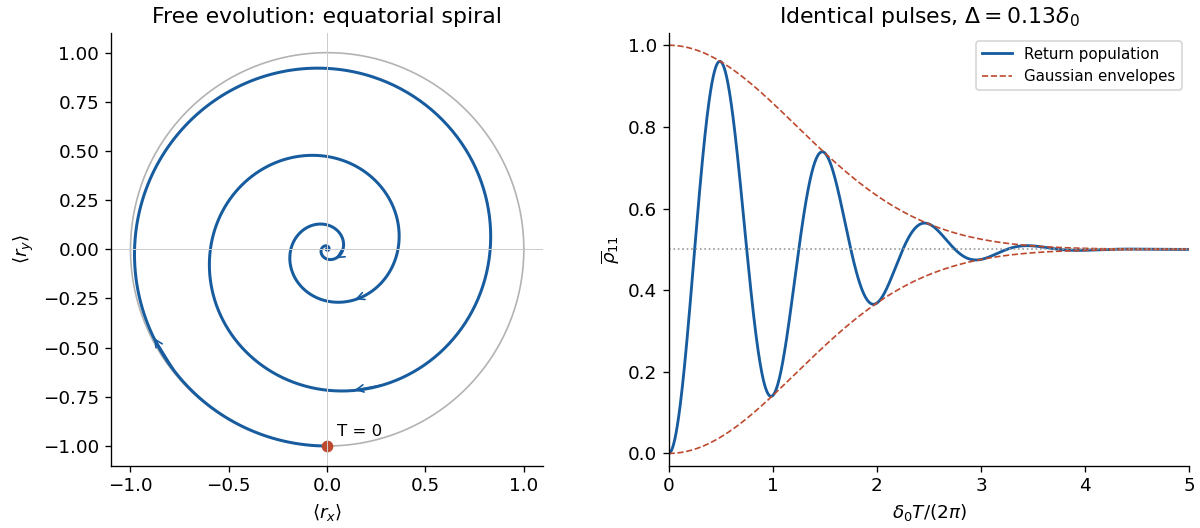
It starts at −y and spirals towards the origin in the equatorial plane, with period 2π/δ0 and shrinking length e−Δ2T2/2. Individual pure states retain unit-length Bloch vectors; only ensemble averaging produces the apparent loss of quantum coherence.
The oscillations lie between [1±e−Δ2T2/2]/2, start at zero, and tend to 1/2. The upper envelope has no implication of exponential energy relaxation: this is static inhomogeneous dephasing. If instead the intended Gaussian convention was p∝e−(δ−δ0)2/Δ2, every envelope above becomes e−Δ2T2/4. The printed-plus-sign convention would give the complementary fringe.
An ideal instantaneous NOT about x reverses each atom's accumulated phase relative to its subsequent freeprecession. Algebraically, XσzX=−σz, so for a static Rabi detuning and F=eiδTσz/4,
This spin echo restores the initial population even for the distribution of static Rabi detunings in part (d). It removes reversible inhomogeneous dephasing; fluctuating Rabi detuning, finite pulse errors and irreversible loss of quantum coherence need not refocus. With an opposite final pulse, the return population would instead be zero; this distinguishes that alternative from the sequence actually specified.
The one-qubit gates generate adense set of one-qubitunitary operators, and CNOT gates supply entangling operations. Approximate universality is the appropriate qualification for a finite discreteset: its finite circuits cannot exactly equal every member of a continuous uncountable unitary group.