The transmitted branch is the Kraus operatorFor nonzero loss it is not trace preserving: is the transmission probability. A complete channel includes an orthogonal vacuum or erasure flag, with a loss operator and . Postselecting only the first outcome gives the single-operator description in the question.
For , the unnormalized transmitted vector is . Its norm squared and normalized conditional state areThe reduced density matrix of either member of the initial pair has eigenvalues . Since the joint state is pure, its Von Neumann entropy is zero. With logarithms to base two and the binary entropy function,The two nonzero Schmidt coefficients show that this pure pair is entangled exactly when . Its mutual information rises from zero to two bits at and returns to zero.
For this known pure family, every positive mutual information signals entanglement. For an otherwise unspecified two-qubit state, positive mutual information can also be classical. The mutual information bound for separable states gives the stronger general witness bit. On this curve it holds for approximately ; the rest of the open interval is still entangled, but that generic one-bit witness alone would not certify it.
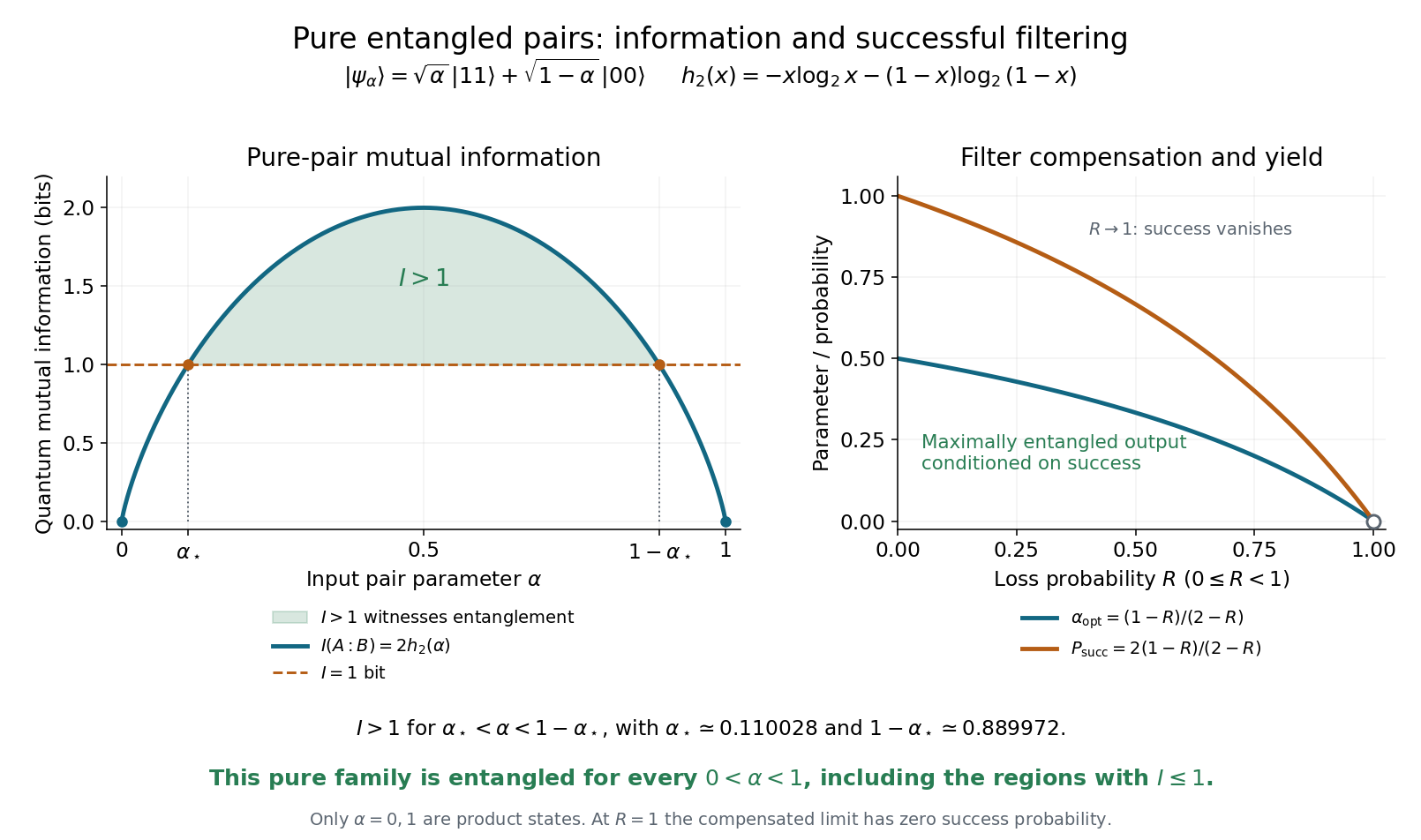
Mutual information of the pure pair, the generic one-bit entanglement witness, and the optimal lossy-filter compensation
. Details. 
If Bob's qubit passes through the channel, the unnormalized retained state is . ThusFor , equal Schmidt coefficients require , givingThe retained state is then . At , this limiting compensation has zero transmission probability and yields no maximally entangled pairs. Conditioning can increase the entanglement of retained pairs, while the discarded fraction accounts for the cost.
Articles by others on the same topic
There are currently no matching articles.