A periodic crystal cannot have a fivefold crystallographic rotation axis. The crystallographic restriction theorem permits rotation orders for a periodic Bravais lattice. A rotation cannot preserve such a lattice. This restriction concerns exact symmetry of the infinite crystal structure; an isolated finite cluster with fivefold symmetry is a different object.
A motif can have fivefold symmetry. For example, repeat an identically oriented regular pentagonal molecular motif at every point of a square translation lattice. Each isolated motif has fivefold rotational symmetry, while the crystal structure as a whole does not: rotating about one motif fails to map the other motif centres onto lattice points. The symmetry of an atomic basis of a crystal need not be a symmetry of its Bravais lattice.
Reduce the supplied fractional coordinates modulo one. The rutile structure has Ti at with height and at with height . The oxygen projections are at , and at . Include equivalent corner sites to show the boundary of a complete unit cell; the cell edges are along and .
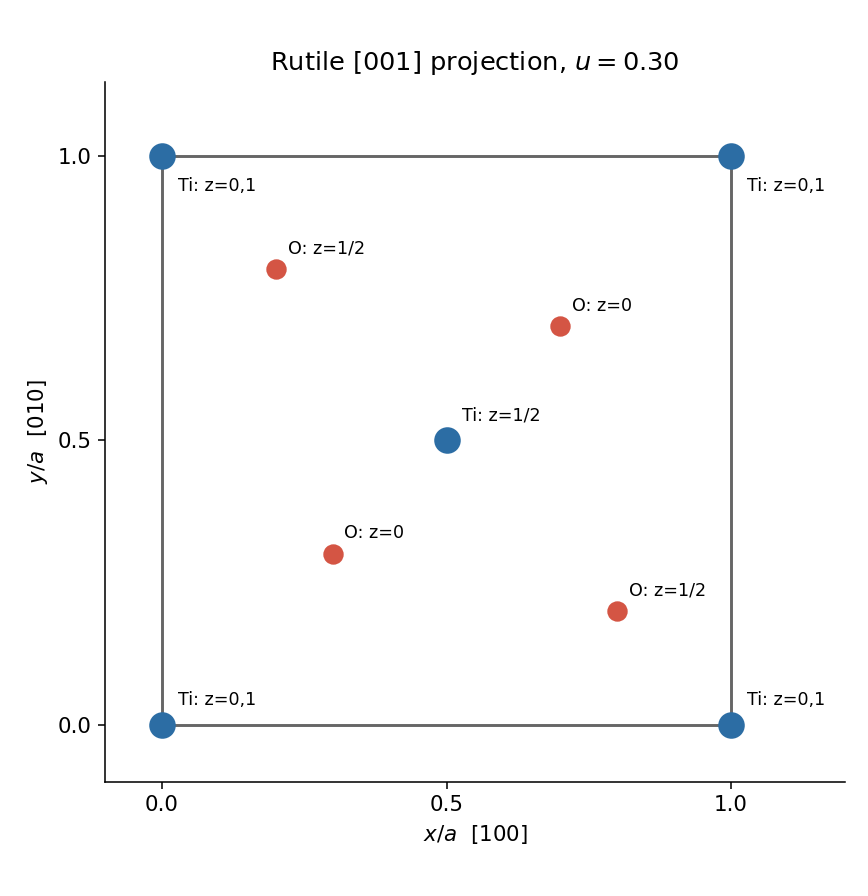
Rutile unit-cell projection along the tetragonal axis
. Original plan constructed from the fractional coordinates. Labels give height as a fraction of ; circle sizes distinguish species rather than ionic radii. Details.
Each Ti has coordination number six, with oxygen neighbours forming a distorted octahedron. Each oxygen has coordination number three, with titanium neighbours forming a planar triangle. For oxygen at , the nearest Ti positions can be taken as and ; all three lie in the plane . The triangle is not generally equilateral. Equal Ti–O bond lengths in the following calculation do not make every angle ideal.
In the tetragonal crystal system, physical squared distances use . Two Ti–O distances from the corner Ti have length ; the other four have length . Equating both to givesThus, within the equal-bond model,The rutile structure remains tetragonal and its octahedral angles remain distorted; these numbers are not a claim about measured ambient-pressure lattice parameters.
The Weiss zone law gives and , so a common direction is . Its physical vector is , while is parallel to . Their dot product therefore givesTaking a Euclidean angle directly between the index triples would incorrectly treat the tetragonal axes as equal in length. Reversing the chosen common direction gives the supplementary oriented angle.
Articles by others on the same topic
There are currently no matching articles.