A periodic crystal cannot have a fivefold crystallographic rotation axis. The crystallographic restriction theorem permits rotation orders for a periodic Bravais lattice. A rotation cannot preserve such a lattice. This restriction concerns exact symmetry of the infinite crystal structure; an isolated finite cluster with fivefold symmetry is a different object.
A motif can have fivefold symmetry. For example, repeat an identically oriented regular pentagonal molecular motif at every point of a square translation lattice. Each isolated motif has fivefold rotational symmetry, while the crystal structure as a whole does not: rotating about one motif fails to map the other motif centres onto lattice points. The symmetry of an atomic basis of a crystal need not be a symmetry of its Bravais lattice.
Reduce the supplied fractional coordinates modulo one. The rutile structure has Ti at with height and at with height . The oxygen projections are at , and at . Include equivalent corner sites to show the boundary of a complete unit cell; the cell edges are along and .
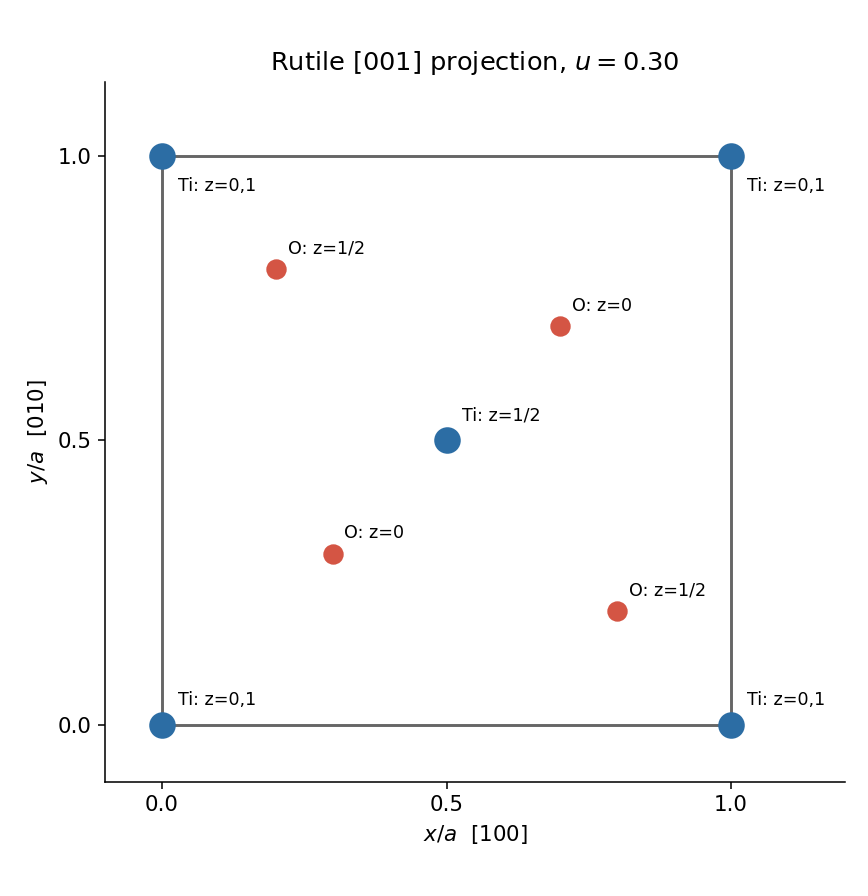
Rutile unit-cell projection along the tetragonal axis
. Original plan constructed from the fractional coordinates. Labels give height as a fraction of ; circle sizes distinguish species rather than ionic radii. Details.
Each Ti has coordination number six, with oxygen neighbours forming a distorted octahedron. Each oxygen has coordination number three, with titanium neighbours forming a planar triangle. For oxygen at , the nearest Ti positions can be taken as and ; all three lie in the plane . The triangle is not generally equilateral. Equal Ti–O bond lengths in the following calculation do not make every angle ideal.
In the tetragonal crystal system, physical squared distances use . Two Ti–O distances from the corner Ti have length ; the other four have length . Equating both to givesThus, within the equal-bond model,The rutile structure remains tetragonal and its octahedral angles remain distorted; these numbers are not a claim about measured ambient-pressure lattice parameters.
The Weiss zone law gives and , so a common direction is . Its physical vector is , while is parallel to . Their dot product therefore givesTaking a Euclidean angle directly between the index triples would incorrectly treat the tetragonal axes as equal in length. Reversing the chosen common direction gives the supplementary oriented angle.
The fluorite structure has Ce on the corner and face-centre sites of a face-centered cubic lattice. Oxygen occupies all eight positions with each coordinate independently or . In projection, there are four oxygen positions , each representing two heights. Accounting for shared boundary sites gives four Ce and eight O per conventional unit cell.
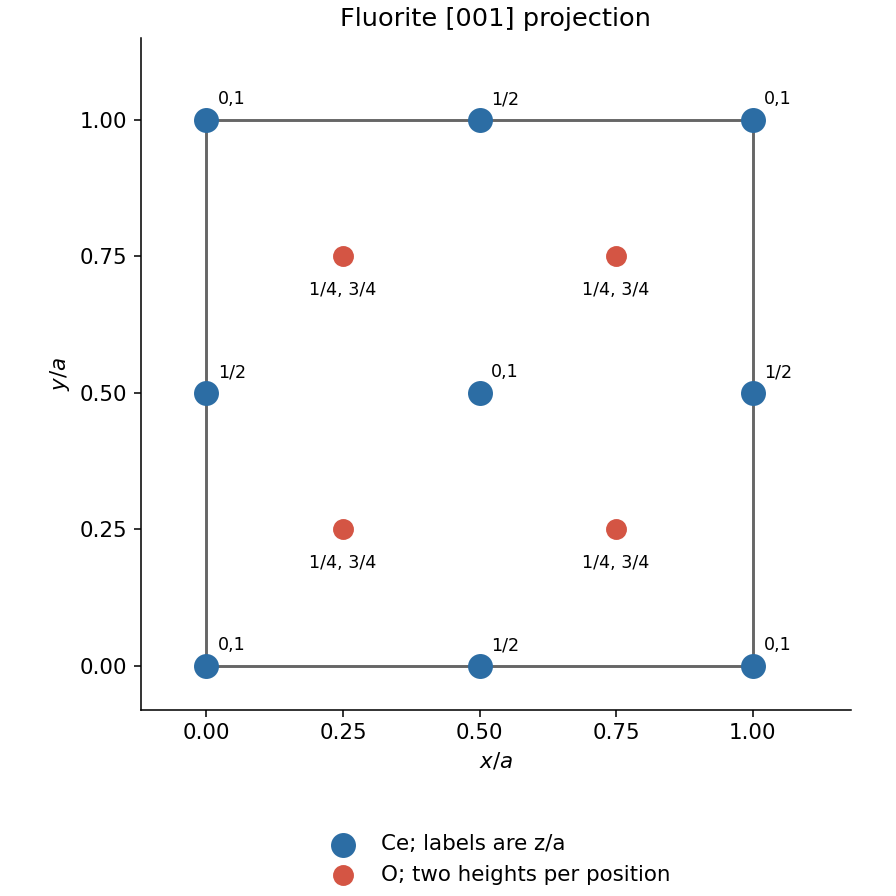

There are four cation sites per conventional unit cell, hence Gd substitutions per cell on average. Two substitutions of Gd for Ce require one oxygen vacancy for charge neutrality, so the cell contains vacancies. Equivalently, the composition is . ThereforeThis uses the supplied lattice parameter literally and treats it as the conventional fluorite-cell edge.
An oxygen vacancy has effective carrier charge . Combining its density with its own diffusion coefficient in the Nernst-Einstein relation givesat . The oxygen ions move oppositely to the vacancies and carry the same conventional current. This estimate assumes independently migrating vacancies, negligible correlation corrections, and negligible electronic contribution to the reported ionic conductivity.
Write the Arrhenius equation as . Eliminating the prefactor with two temperatures givesUse absolute temperatures and . Because the input is a vacancy diffusion coefficient, this is a migration activation energy inferred from that diffusivity; an additional vacancy-formation energy should not automatically be added.
Each missing oxide ion leaves two units of excess positive effective charge, compensated by reducing two Ce ions to Ce. For oxygen vacancies per conventional unit cell, of its four cerium ions must be trivalent: 10% Ce. This assumes the same number of cation sites per unit volume as in the doped calculation and that oxygen loss is compensated entirely by this cerium-valence change. If reduction changes the cell volume appreciably, matching the absolute vacancy density requires correcting the percentage for that change.
In the kinematic approximation, the face-centered cubic lattice contributes only reflections with all even or all odd. Viewing along selects the zero-order zone , so the nonzero allowed spots within the cutoff are , with the transmitted beam at the centre. The nearest-neighbour separation is in the crystallographic reciprocal-distance convention, or in the angular-wavevector convention. No matrix lattice parameter is supplied, so a numerical matrix spacing would require extra data.
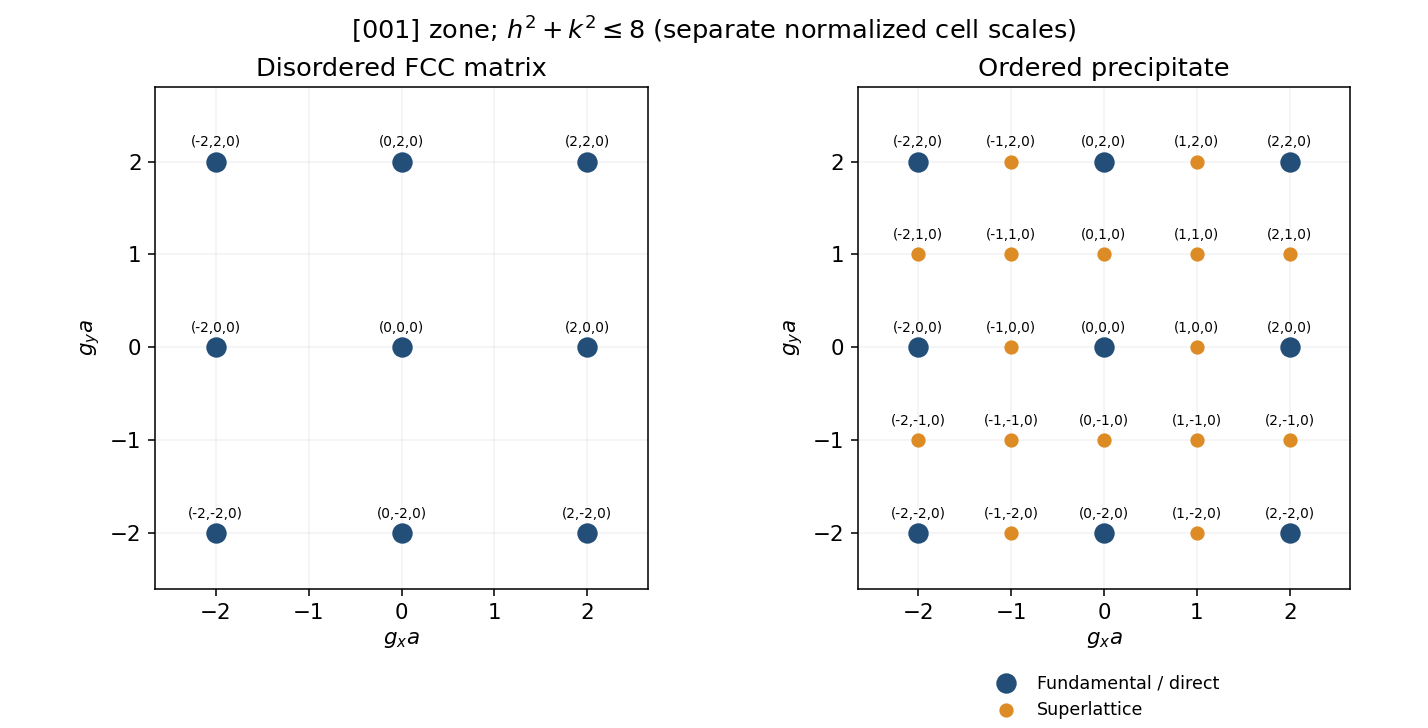
Calculated zero-order diffraction spots before and after chemical ordering
. Original kinematic spot diagrams with reciprocal coordinates normalized by the relevant cubic cell edge. The right panel shows additional superlattice positions; actual intensity also depends on thickness, excitation and scattering factors. Details.
For the L12 structure, the crystal basis structure factor isEqual parity of makes all three phase factors , henceThe electron scattering factors are evaluated at the reflection's scattering vector.
For mixed parity, one of the three pair sums is even and two are odd. Thus their phase factors sum to , givingThese superlattice reflections reveal chemical ordering. Their kinematic intensity is proportional to , and vanishes in the hypothetical limit of equal species scattering factors.
Keep the matrix spots and add precipitate reflections at all integer with . Even-even spots are fundamental; every other allowed position in this zone is a superlattice reflection. The added positions are and their symmetry-related signs. Each position actually denotes the corresponding signed index pair, not one radial ring. The precipitate grid spacing is ; the nearest fundamental separation is . If matrix and precipitates are coherent and similarly oriented, their fundamental spots approximately coincide, with finite mismatch potentially giving splitting or broadening. The sketch assumes common orientation, small strain, appreciable sampled precipitate volume and predominantly single scattering; electron diffraction can have dynamical intensity effects.
Choose an objective aperture around a precipitate superlattice reflection, such as , which is absent from the disordered aluminium matrix. The selected beam then makes precipitates bright in dark-field transmission electron microscopy, while the matrix gives little intensity in that beam. Tilt the grain to place the chosen reflection close to its Bragg diffraction condition and preferably approach a two-beam geometry. This reduces excitation error and can increase precipitate brightness; the exact maximum also depends on foil thickness, strain and dynamical scattering. Selecting a shared fundamental reflection would give much poorer chemical-order selectivity.
At , . Reading the carbon line gives to graphical accuracy. With , the characteristic diffusion length isIf “distance” means a one-coordinate root-mean-square displacement, use ; the three-dimensional radial root-mean-square is . The graph does not justify precision between these conventions. Equal diffusion distance in equal time requires equal diffusion coefficients. The copper line reaches this diffusivity around , giving , about . Carbon moves interstitially through ferrite, whereas copper self-diffusion is substitutional and vacancy-mediated, with a much higher effective activation barrier.
At the undercooling below the eutectoid temperature is small, so the free-energy driving force for forming pearlite is weak and nucleation is difficult. At the driving force is larger, but carbon diffusion is slow, limiting the coupled growth of ferrite and cementite. Their competition produces the nose of the isothermal transformation diagram near and . A roughly linear quench from – must pass left of this nose, requiring a rate of order –, then continue below the martensite-start region near . The tangent to the full start curve, rather than just the nose, refines this estimate; a true continuous-cooling diagram would be preferable. Martensite forms by a coordinated lattice-shape change without long-range carbon partitioning, so its formation is a displacive transformation. The tetragonal-to-monoclinic transformation of zirconia is a nonmetallic example.
As-quenched martensite generally has greater hardness and strength, but lower ductility and toughness, than ordinary pearlitic steel. Its supersaturated carbon and distorted lattice impede dislocation glide; quench stresses also promote cracking. Pearlite combines hard cementite lamellae with more deformable ferrite, with finer spacings generally giving greater strength. Austenitize, quench to martensite, then temper to obtain a useful compromise between indentation resistance and resistance to fast fracture. Tempering below the austenitizing range relieves stresses and develops a fine carbide-containing microstructure. It trades some maximum hardness for improved toughness; the temperature and time must suit the required balance.
The lamellae are ferrite and cementite, together forming pearlite. The displayed quantity is surface height in an atomic force microscopy image. Nital preferentially attacks the ferrite, leaving it lower and therefore darker; the narrow raised cementite lamellae appear bright. This is not the same contrast mechanism as brightness in an optical micrograph. Faster cooling that still permits pearlite formation causes transformation at greater undercooling and generally gives finer lamellar spacing. Cooling sufficiently rapidly to bypass diffusional transformation instead produces other products, potentially martensite; it does not merely keep making pearlite indefinitely finer.
The exponential in the Peierls stress makes a large core-width-to-Burgers vector ratio favourable for easy dislocation glide. Densely packed slip planes often have wider cores because the shear distortion can spread over more atomic rows, reducing the lattice-periodic barrier. Close-packed directions provide short lattice translations and hence small allowed Burgers vectors; their line energies, approximately proportional to , are also relatively low. These effects favour dense planes and directions, but the relation between packing and core width is a physical argument rather than a consequence of substituting arbitrary independent into the formula. Body-centred cubic metals have densely packed directions without a truly close-packed plane, and their screw-core behaviour can require additional qualifications.
The cosine of the angle between Burgers vector and line direction is , so the angle is : the dislocation is mixed. Both vectors must lie in its dislocation glide plane. Their cross product is proportional toso the plane is , a member of . The screw component magnitude is and the edge component magnitude is .
At small load the deformation is elastic: , and, using isotropic elasticity with , gives lateral contraction . At maximum load,For the specified slip system, the tensile direction is proportional to , the slip direction to and the plane normal to . Hence the Schmid factor isSchmid's law predicts glide when this reaches the critical resolved shear stress. Before that, unloading reverses the strain; after activation, glide produces permanent strain and may generate work hardening and additional slip. The supplied data do not fix the yield load. Neither the adjective “ultra-strong” nor supplies a critical shear stress or an absolute modulus. Other slip systems must also be checked before claiming which activates first. In particular, the specimen remains elastic through the maximum load if every relevant system stays below its activation threshold.
Burgers vector conservation gives two candidate reactions, depending on the relative signs of the approaching segments:Initially . The sum product has , while the difference product has . Thus the product is favoured by Frank's rule; the product is disfavoured. The result is not annihilation, because the two supplied vectors are not opposite. The same ordering survives a simple character correction: with , line energy proportional to gives the two parent segments a combined coefficient , whereas any character of the sum product has coefficient between and and any character of the difference product at least , comparing equal lengths and common logarithmic factors. A favourable dislocation junction can obstruct further glide and harden the crystal. Its actual mobility requires the junction line and allowed glide plane: the second screw can occupy several planes containing , so geometry is not unique. For instance, its plane intersects along ; an junction on that line would glide geometrically on , not either original plane. Dislocation cross-slip, junction unzipping or bypass can compete under load. An energy inequality alone is not a universal proof of a permanently sessile product.
The fixed support supplies the end shear force and the largest bending moment, . In elementary beam bending, the greatest longitudinal tensile and compressive stresses lie on opposite outer faces of the section at the fixed end, with zero longitudinal bending stress on the neutral axis. For a downward tip load on a horizontal cantilever, the upper face is in tension and the lower face in compression. Transverse shear stress has a different distribution, largest near the neutral axis for a rectangular section; “highest force” should therefore be interpreted with the stress component specified.
The rectangular second moment of area is . The maximum bending stress in the cantilever is . If is fixed, choose the minimum allowed width . Its mass is thenThus the material performance index to maximize isFor unequal tensile and compressive strengths, use the smaller permissible stress in this symmetric section. The derivation assumes bending-strength control, not a separate deflection, shear, buckling or existing-crack constraint.
With fixed, bending strength requires . Substitution into the cantilever mass givesThe material performance index to maximize is thereforeChanging the free geometric variable changes the strength exponent. A stiffness-limited problem would instead involve Young's modulus; the supplied modulus does not enter this strength-only index.
Both outer faces of the cantilever are loaded, so use the pine's lower longitudinal compressive strength, , rather than its tensile strength. Consistent SI units give values for steel, aluminium and pine respectively. Their values are . Hence Design A: steel best, pine worst; Design B: pine best, steel worst. Aluminium is intermediate in both cases. These rankings concern the stated strength constraint; a toughness or deflection constraint could change feasibility.
At identical applied load and fixed geometric constraints, minimum mass is inversely proportional to the appropriate material performance index. ThereforeThe same percentages apply to weight under the same gravitational acceleration. It would be incorrect to compare densities alone, since the required beam dimensions also change.
On a logarithmic strength–density materials selection chart, constant gives , a guideline of slope one; constant gives , of slope two. Moving each guideline upwards selects better candidates. A suitably qualified longitudinal carbon-fibre-reinforced polymer is a promising candidate for both designs. Composite families occupy favourable high-strength/low-density regions in published course selection charts, but a beam must meet its compressive as well as tensile allowable.[ref]
Examples of Materials Selection by Wright State University. Unit 5, strength–density charts and composite selection examples; family comparisons are screening evidence, not universal longitudinal compression data
For scale, an explicitly illustrative candidate with in both required loading senses and would have and , exceeding the best supplied materials. These are assumed screening values, not measured properties of a specified product.
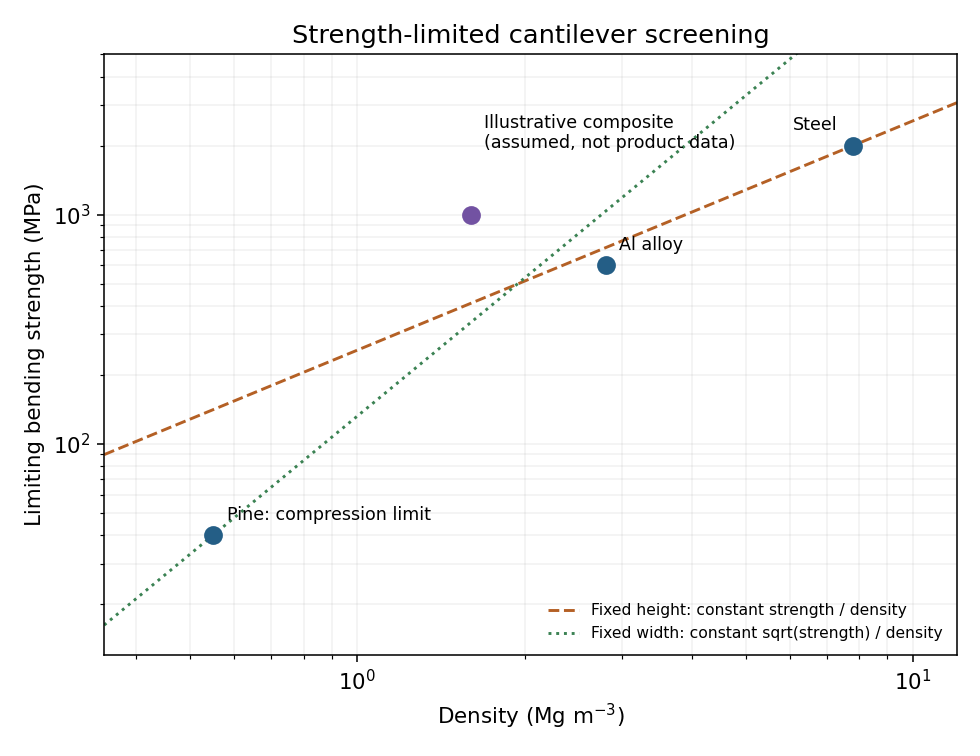
Strength–density selection with the two cantilever merit-index guidelines
. Original chart of the three supplied candidates and one explicitly assumed composite design point. Pine uses its compression limit; the figure is not a complete material-family database. Details.
Check stiffness and tip deflection using Young's modulus, failure from existing cracks using fracture toughness or the supplied critical energy-release rate, local crushing at supports, shear failure, buckling, fatigue and joint design. In a simple linear-elastic crack model, , so toughness cannot be inferred from strength alone. Wood also has grain-direction dependence, moisture sensitivity, natural defects, property scatter and time-dependent creep; the design must control grain alignment and compression-side stability. Metals raise issues of corrosion, mass, joining, machining, residual stress and heat-treatment state. Cost, availability, reproducibility, service temperature and end-of-life treatment can decide between otherwise feasible designs. A high merit index is a screening result, not a complete safety specification.
A diamond anvil cell concentrates force onto tiny opposing culets, reaching very high pressure with small samples and useful optical access through diamond; its small volume, pressure gradients, alignment demands and difficulties with some heating or sample environments can limit experiments. A multi-anvil press supports a much larger sample and is useful for high-temperature synthesis and bulk measurements, but usually reaches lower ultimate pressures and has more restricted optical access. Hydrostaticity, attainable temperature and calibration depend on the actual apparatus and pressure medium; neither design guarantees uniform pressure.
Use mass density , with . The rock salt structure has formula units per conventional cell; the CsCl structure has . In pressure order the densities are approximatelyThe increase across the transition is approximately , much greater than the smooth compression within either branch. Comparing directly without correcting the different would create a fictitious volume discontinuity.
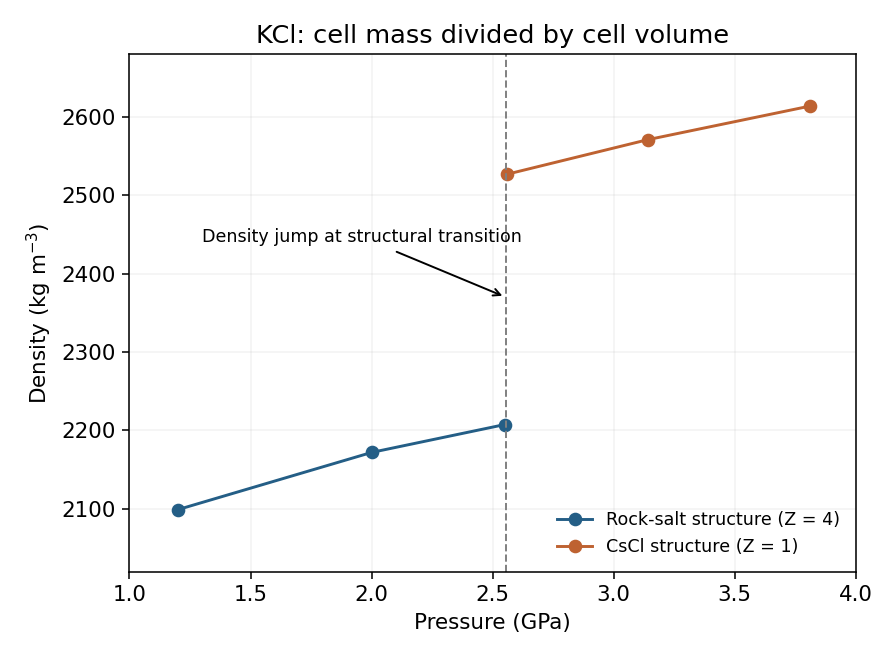
KCl density calculated separately for the two crystal structures
. Original calculation from cell mass and volume. The narrow gap brackets the transition; separate lines avoid implying a continuous single-phase density through the jump. Details.
Within each cubic phase, increasing pressure decreases , so decreases and Bragg's law moves a given reflection to higher . Near , peaks of the rock salt structure disappear as those of the CsCl structure appear, potentially with a coexistence interval. The former has an FCC translation selection rule, with all even or all odd; mixed-parity reflections vanish kinematically. The latter has primitive-cubic translations and basis factor , so it has no FCC extinction rule. Odd-sum reflections may nevertheless be weak because the two ionic scattering factors are similar. Peak spacings, relative intensities and the cell volume per formula unit change discontinuously. A simple uniform shift of the entire original pattern cannot describe the structural transition.
Use only the high-pressure CsCl structure branch to extrapolate its volume per formula unit . A straight-line least-squares fit to those three measurements gives approximatelywith in GPa. Thus , and . Taking Cu K wavelength in Bragg's law givesThe estimate is model-dependent: a straight-line extrapolation of instead gives . The data stop at , so the absence of further phase transitions does not by itself determine an exact equation of state to . The peak can also be weak because its basis factor is .
The coordination number rises from six in the rock salt structure to eight in the CsCl structure. In the elementary hard-sphere ionic bonding model, accommodating eight opposite neighbours favours a larger cation/anion radius ratio: the geometrical limiting ratios are for sixfold and for eightfold coordination. The high-pressure change is therefore consistent with increasing under compression. Sincethe chloride ion is inferred to be more compressible than the potassium ion in this radius-ratio interpretation. This is a qualitative structural argument; real ionic radii depend on coordination and electronic structure, and the transition does not uniquely determine separate microscopic compressibilities.
The original printed labels are retained; biological question 7 is deferred.
In crystal polymorphism, the same chemical composition has different crystal structures; for an chemical element, this is a form of allotropy. Diamond has a three-dimensional tetrahedral network of covalent bonds, giving high hardness and a wide band gap. Graphite has strongly bonded planar sheets, with weaker interactions between sheets. Sliding between sheets makes it a useful solid lubricant; mobile electronic states give good electrical conduction within the sheets. Their different properties come from different bonding and structures, despite both being carbon.
Barium titanate has a high-temperature cubic perovskite structure, with Ti centred in its oxygen octahedron on average. This phase is paraelectric. Near room temperature the structure is tetragonal, with relative ionic displacements that give a spontaneous electric polarization. This phase is ferroelectric: an applied electric field can switch between differently polarized domains. Both phases have the same composition, BaTiO; the transition near changes crystal symmetry and electrical response.
The zinc blende structure has an FCC sulfur sublattice and zinc on half its tetrahedral sites. One conventional unit cell uses S at and Zn at those positions displaced by , reduced modulo one. The wurtzite structure has ABAB sulfur layers, instead of ABCABC layers. One hexagonal-cell convention uses S at and Zn at , with ideal . Looking along superposes S and Zn in that latter coordinate convention; the height labels distinguish them.
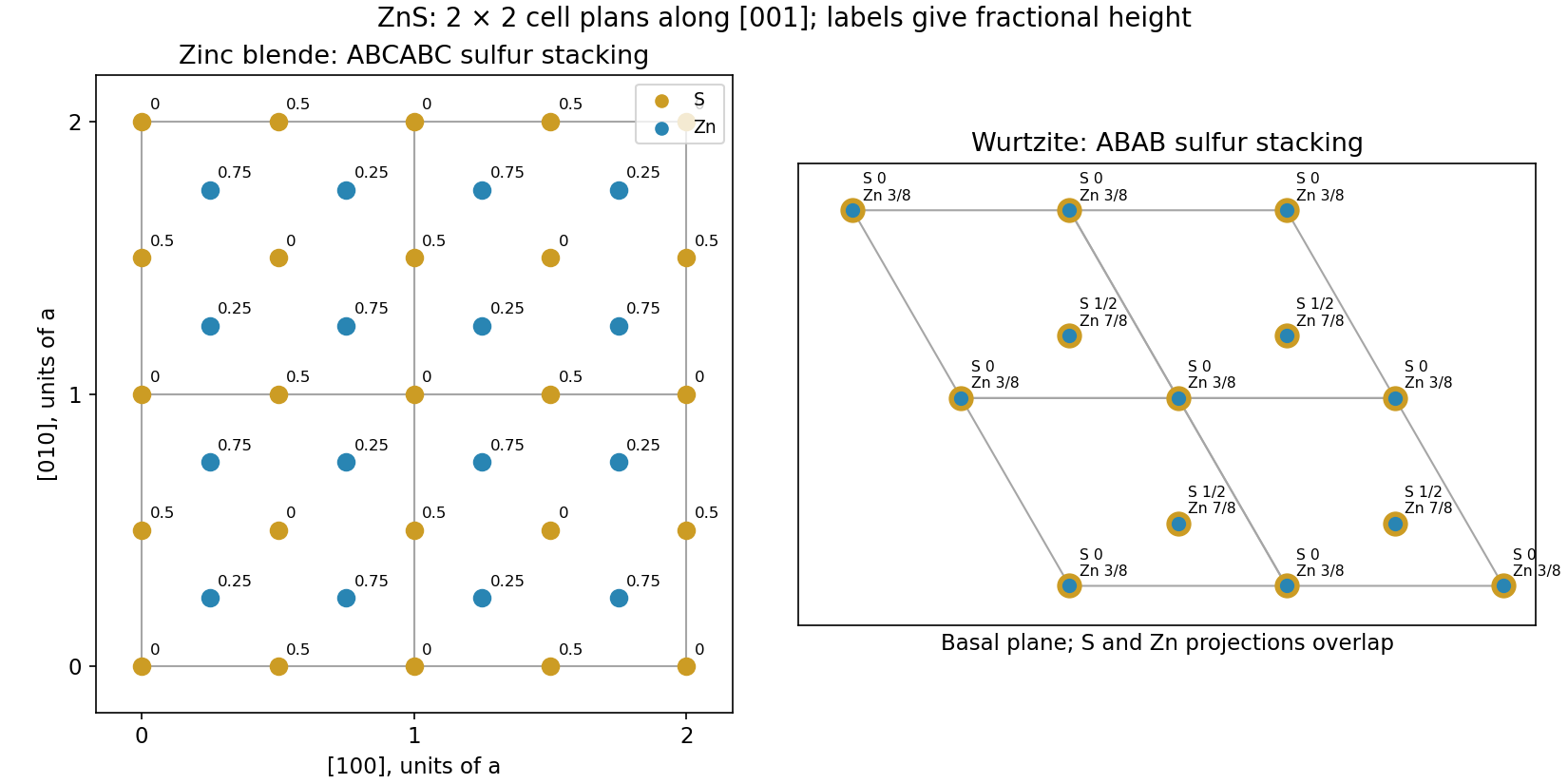
Two-by-two zinc sulfide unit-cell projections along the stacking axes
. Original coordinate constructions. Heights are fractional coordinates along the viewing axis. The hexagonal plan uses basal vectors at 120 degrees. Details.
The closest-packed sulfur planes are , with four distinct plane orientations, for zinc blende structure, and , with one orientation, for wurtzite structure. Opposite normals describe the same unoriented plane orientation. Hexagonal four-index notation writes the latter basal family as .
Articles were limited to the first 100 out of 514 total.
Articles by others on the same topic
There are currently no matching articles.