In the kinematic approximation, the face-centered cubic lattice contributes only reflections with all even or all odd. Viewing along selects the zero-order zone , so the nonzero allowed spots within the cutoff are , with the transmitted beam at the centre. The nearest-neighbour separation is in the crystallographic reciprocal-distance convention, or in the angular-wavevector convention. No matrix lattice parameter is supplied, so a numerical matrix spacing would require extra data.
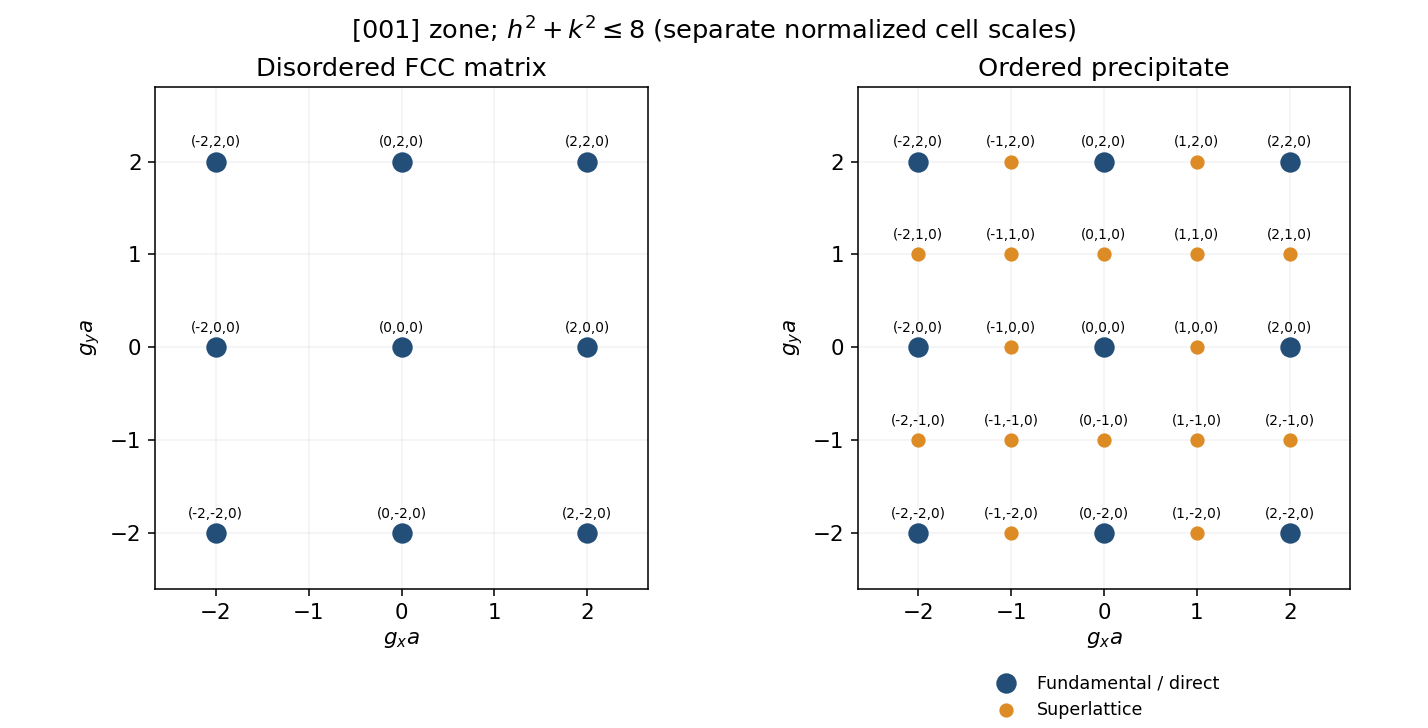
Calculated zero-order diffraction spots before and after chemical ordering
. Original kinematic spot diagrams with reciprocal coordinates normalized by the relevant cubic cell edge. The right panel shows additional superlattice positions; actual intensity also depends on thickness, excitation and scattering factors. Details.
Articles by others on the same topic
There are currently no matching articles.