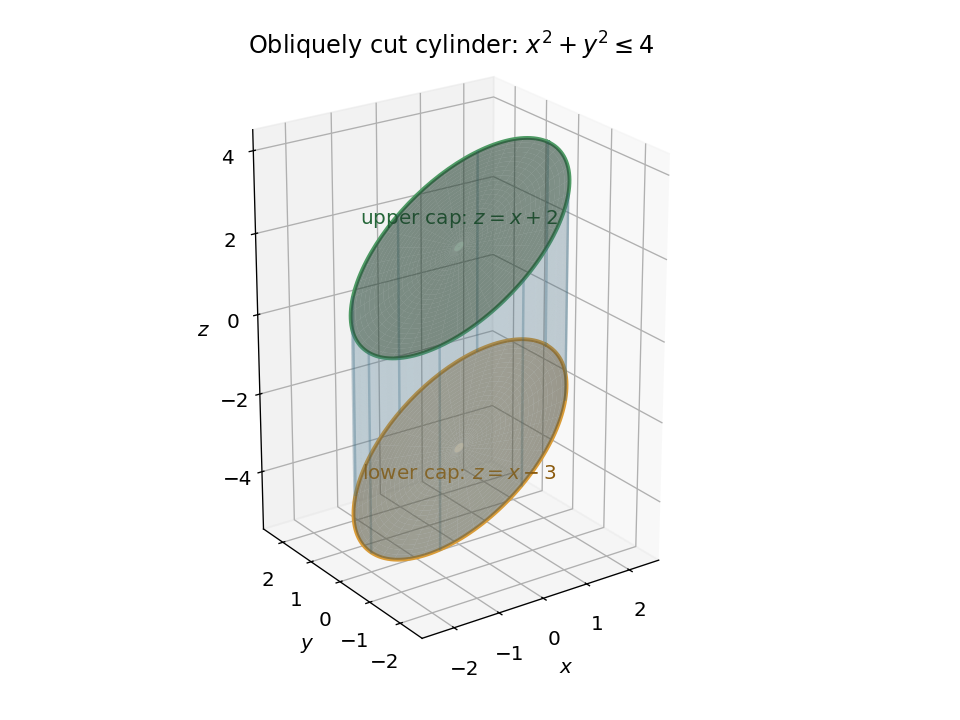
For the scalar surface integral over an obliquely cut cylinder, split the scalar surface integral into the curved cylinder and its two planar caps. Write , so the solid has and . On the curved cylinder, use the parametrizationThe surface area element follows fromConsequently the curved contribution isOn either cap , the surface area element is over a radius-two disk. The lower cap has and the upper cap has . Thusand the complete scalar surface integral isThe surface area element is unsigned: opposite outward normals on the caps do not introduce extra minus signs.

Articles by others on the same topic
There are currently no matching articles.