The initial table of content was limited to the first level because it is larger than 1000 articles. There are 3801 articles in total. Expand a branch to load its children.
All questions and inline Roman subparts are covered. The solutions distinguish signed from unsigned distances, branches of complex powers, and the exceptional zero-frequency differential equation.
Let . Taking the scalar product with in the first expansion kills its other two terms. Taking the scalar product with in the second expansion does the same. Thus the two requested coordinates areThe scalar triple product condition guarantees linear independence and the existence of these reciprocal bases. The second coordinate is not obtained by merely normalizing the first basis vector: the two expansions use different bases.
On an interval with , the zero function is one solution. For a nonzero solution, set . Dividing the equation by two and differentiating gives the linear ordinary differential equationIts integrating factor is , so and . Absorbing the factor four into the integration constant givesFor real solutions, choose a connected interval avoiding on which , with a fixed sign. The special straight solutions are already included at . The separate zero solution would be lost by the division used in the substitution.
Using the complex-angle identity,Since , the real part can vanish only when . Then the imaginary part requires . Therefore all roots areSubstitution gives for every integer , and the positivity of shows that no other real parts were missed. The imaginary offsets are the two values .
Set . The second-order position equation becomes the first-order linear ordinary differential equation . For , multiply by the integrating factor and impose :The limiting terminal velocity is , consistent with upward-positive position and downward gravity. The continuous zero-drag limit is ; one must take that limit of the whole expression rather than set in its two singular-looking terms separately.
Multiplication by rotates the components by counterclockwise when viewed from positive toward the origin, leaving unchanged. It is a proper rotation about the axis, with determinant . Multiplication by sends to : it is a reflection in the plane, with determinant . Neither operation changes a vector's Euclidean norm.
Directly multiplying the columns' scalar products gives , and direct evaluation gives . Thus the operation is a proper rotation. Its trace is zero. A three-dimensional proper rotation has eigenvalues , hence . ThereforeThis determines the usual unsigned angle in without changing coordinates. The axis can be checked, if desired, from . The determinant test must precede the trace formula: an improper rotation instead has trace .
Let and . The roots of the characteristic polynomial are , so the real underdamped solution is . The initial charge gives and the zero initial current gives . HenceThis solves the homogeneous RLC circuit equation supplied in the question. A nonzero applied voltage would appear as a forcing term and require a particular solution; it is not present in that equation.
The additive identity for the shifted operation must satisfy , giving . The additive inverse must satisfy , givingThe notation distinguishes the new additive identity from the ordinary zero vector. This is a translated abelian group structure on the same underlying set.
The translated vector-space structure follows by translating the new origin to the ordinary one using the bijection . Transporting ordinary scalar multiplication through givesThen and , so the transported operations satisfy all vector space axioms. In particular, an explicit distributive check isThe other distributive law follows in the same coordinates, or directly by expanding .
For , this is the sphere centered at with radius . If , its locus is the singleton ; if , it is empty, because a Euclidean norm cannot be negative. The equation describes the surface, not the enclosed ball.
Assume and allow all . Put and . Every resulting vector is perpendicular to and has . Conversely, for and any perpendicular to with , chooseThe vector triple product gives , and . Thus every point of the closed disk centered at the origin, perpendicular to , of radius is attained. The boundary circle alone would omit allowed directions of . For the locus is the origin; for the original expression is undefined.
A vector from the point on to the point on isChoosing the opposite direction negates this vector and does not change its norm or the shortest distance.
For nonparallel direction vectors, let . Every joining vector has the same normal component, . Its norm is therefore at least the absolute value of that component. Minimizing makes it perpendicular to both directions, and hence parallel to , attaining the bound:The expression printed without absolute values is an oriented separation, not a nonnegative distance. Reversing either line's parametrization can flip its sign. For parallel nonzero directions, this normal is undefined and the distance is instead .
Write , , and . Differentiating with respect to the two parameters givesFor nonparallel directions, . Solving this linear system yieldsThe quadratic being minimized is strictly convex in the two parameters under this nonparallel assumption, so the critical point gives the unique pair of closest points. Parallel lines do not select a unique value of .
Parametrize the first line by and the second by . Equality of the components gives and , hence , . The components then require . ThusThe two independent component equations fixed the parameters before the remaining component determined , so no extra intersection case was discarded.
The right-hand side has modulus two and argument . Its fifth roots therefore haveThey are the vertices of a regular pentagon on the circle of radius , beginning at angle . These five roots are distinct, and a degree-five polynomial has no further complex roots.
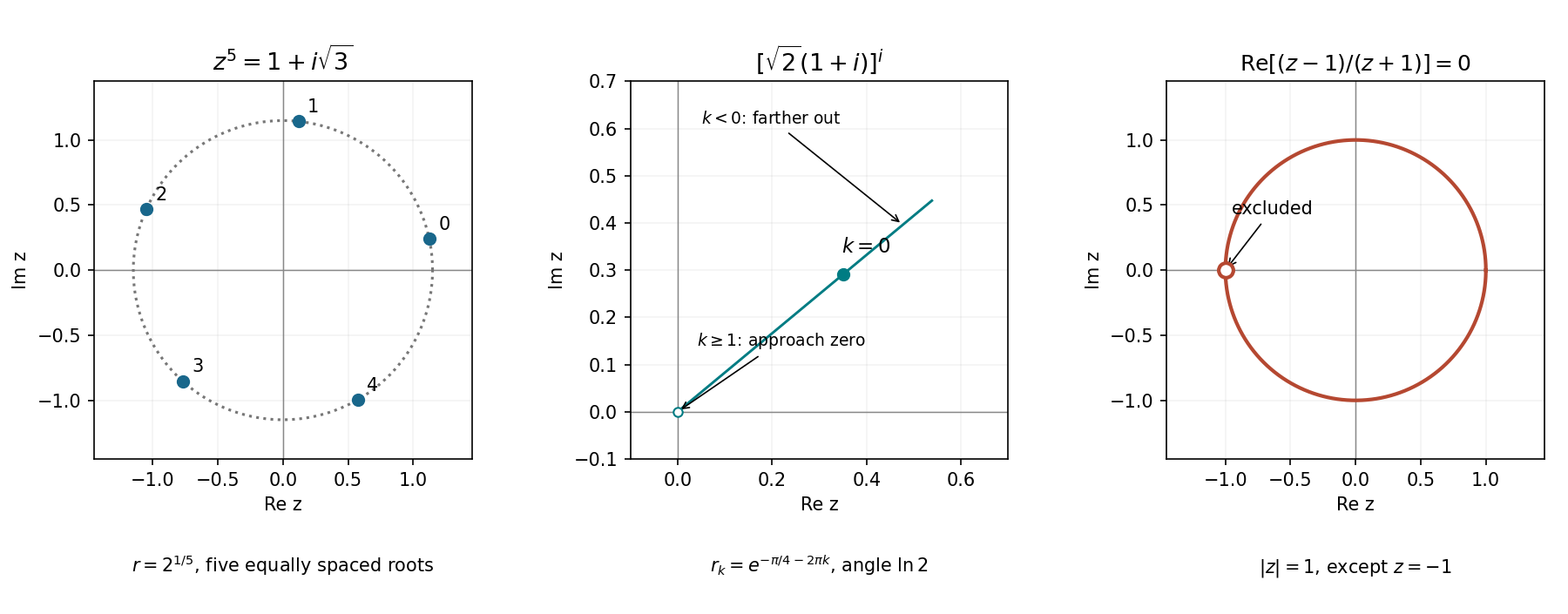
The fifth roots, the discrete ray of values of a complex power, and the unit-circle locus with its excluded point
. Details. The base is . Its complex logarithms are , . Exponentiating times each logarithm gives all values of the multivalued power:The values form a discrete geometric sequence along the Argand ray of angle . Consecutive radii differ by . The origin is an accumulation point but is not itself a value. If the power is instead defined using the principal logarithm, only is retained. The phrase “all values” requires this branch distinction.
For , multiply numerator and denominator by . The real part isThus its zero locus isIt is the unit circle with the point removed. That point cannot be restored by the zero numerator obtained after clearing a denominator: the original expression is undefined there.
Use the imaginary part of the finite complex sum:The identity then givesHere is a nonnegative integer. Keeping the signed cosine raised to the integer power makes the result valid even when ; inserting an absolute value would lose the sign for odd .
For unitary matrices, and . The adjoint matrix reverses the order of multiplication, soThus the product is unitary. Likewise , or this follows from invertibility in finite dimension.
Take the adjoint matrix of to obtain . Evaluating using this equation and givesHence . The proof does not assume that is a normal matrix or diagonalizable.
In general the spectrum of an adjoint matrix is the complex conjugate of the original spectrum, not necessarily the same set. The equality of the two sets in the question is an additional assumption, possible for a conjugation-invariant spectrum; the displayed orthogonality proof only uses the two stated eigenvalue equations.
A column of coordinates transforms as , because the columns of are the new orthonormal basis vectors expressed in the old coordinates. A symmetric unitary choice isIts first and third columns are orthogonal eigenvectors of the block, with eigenvalues and respectively; its second column is the axis with eigenvalue . Direct multiplication checks , while the displayed entries give . The symmetry here means transpose symmetry, not Hermitian symmetry.
Separation of variables gives for a nonzero solution. Including the zero solution in the arbitrary real amplitude givesDifferentiating the exponent verifies the equation. This form keeps the zero solution that a division by could otherwise conceal.
On the component containing the boundary point, divide by and use integrating factor :Integration gives , and fixes . ThereforeAlthough the function has a continuous limit at zero, its derivative diverges there; the solution with this boundary datum does not extend as a differentiable solution through the singular point of the equation.
The exponential substitution removing a constant first derivative, , reduces the equation to . For and , solve the homogeneous harmonic equation and use a constant plus a cosine for the particular solution:There is a further exceptional case inside the printed condition : must be treated separately. It gives , henceThis retains the constant forcing's resonance with the zero-frequency homogeneous equation. Substitution verifies both branches.
For , the reduced equation is . The constant forcing has particular solution one, while the resonant cosine requires . ThusThe secular factor is the signature of resonance. It must replace the divergent nonresonant coefficient ; substituting directly into that coefficient is invalid.
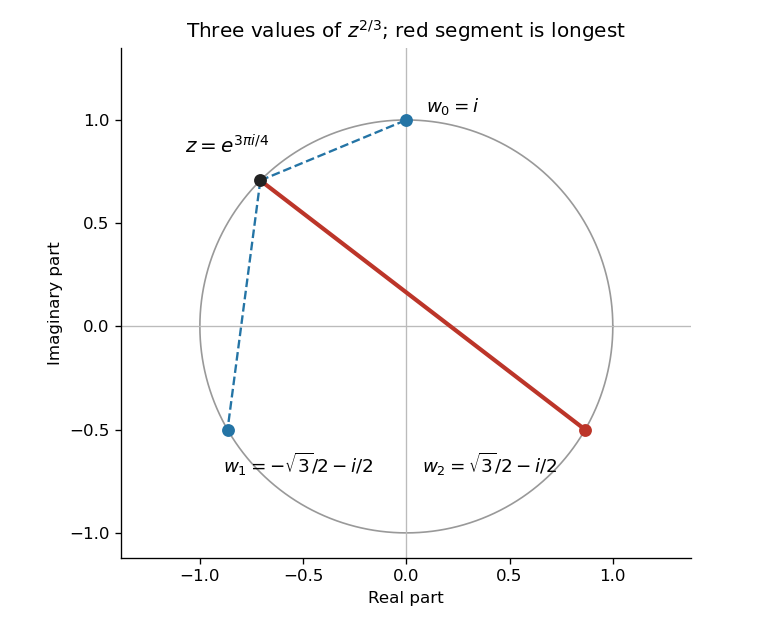
The polar form is . Interpreting the fractional complex exponentiation as all its values, a candidate satisfies . The three roots of a complex number areThey have arguments , and , respectively. Since all have modulus one, their squared distances from in the complex plane are , givingThe last is strictly largest, so the required root of a complex number isRestricting complex exponentiation to its principal value would give only ; the request to choose among roots requires all three values.
Multiply numerator and denominator by the denominator's complex conjugate:Thus the real part and imaginary part are
Using Euler's formula, the difference of the two complex exponentials is . HenceThese are the real part and imaginary part, respectively.
The normal vectors are and . Their dot product is , and their norms are and . The usual angle between two planes is the smaller, unoriented angle, soFor the particular signed normal vectors printed above, the angle is the supplement . Reversing either normal vector exchanges these two angles without changing either plane.
A parallel plane has the same normal vector, so write . Substitution of the given point gives . ThusA displacement between the two planes has a component of magnitude along their common unit vector normal. The distance between parallel planes is consequently
The parallelepiped volume is the absolute value of the scalar triple product of its edge vectors, equivalently the absolute determinant of the matrix with those columns. Expansion along the first row givesTherefore
Multiplying a three-dimensional matrix by a real multiplies its determinant by , whereas multiplicativity of the determinant gives . Therefore equality of the two parallelepiped volumes meansBoth real signs are allowed:A negative value reverses the oriented volume while preserving the ordinary volume. If a positive scale factor is intended, select the positive sign.
The characteristic polynomial isThus the eigenvalues are and . There is no real diagonalization, because a real diagonal matrix would have real eigenvalues. Over the complex numbers, the two distinct eigenvalues give linearly independent eigenvectors, so the matrix is diagonalizable.
For , the first row gives . Choose , giving . Its standard complex norm is ; the conjugate eigenvector belongs to . Hence normalized eigenvectors and a suitable change of basis areDirectly, and , soNormalization does not assert that these eigenvectors are orthogonal.
An invertible matrix is a square matrix admitting a matrix inverse with , where is the identity matrix. Equivalently, its associated linear map is bijective.
Let with eigenvector . The eigenvalue cannot be zero: otherwise applying gives . Apply to the eigenvector equation:Thus is an eigenvalue of with the same eigenvector.
An exact differential is for a scalar potential function , so and . Equality is necessary, and is sufficient on a simply connected space when these partial derivatives are continuous.
Here, after multiplying the ordinary differential equation by ,On either half-plane or , integrate with respect to :Comparison of with gives , hence up to a constant. The solution is therefore the family of level setsLocally these define differentiable graphs wherever , by the implicit function theorem. When , on this domain, so a finite derivative cannot satisfy there; such points are vertical tangents of the implicit curves, rather than additional classical graph solutions.
Differentiation satisfies for constant scalars , so it is a linear map on suitable vector spaces of differentiable functions. An arbitrary set need not even be a vector space, and an endomorphism interpretation also requires .
For a noninvertible example, take . Then and the kernel of a linear map is the nonzero linear span of , so is not injective. The matrix in this basis is .
For an invertible example, take . In this basis, has matrix , andThus differentiation is not always invertible; the domain and codomain determine the answer.
For an invertible matrix whose columns give the new basis in old coordinates, the new matrix is . Multiplicativity of the determinant givessince .
To justify the cyclic property of the trace directly, for two square matrices ,Apply it with and :Thus both the determinant and trace are invariant under change of basis.
Articles were limited to the first 100 out of 3801 total.


