Write for the dual cone, , and for the affine toric variety. This is the variety denoted in the source; the subscripts there refer to the cone of exponents, whereas refers to the cone in .
For a face of a polyhedral cone , define . If is in the relative interior of , nonnegativity on shows that a functional in vanishes on exactly when it vanishes on all of . Hence is a face of . Conversely a face of gives . Every polyhedral face is exposed: the supporting functionals for its containing facets can be added, since they are nonnegative. If , then , soThe same argument applied to proves , using the closed-cone identity . That identity follows from separation of a point outside a closed convex cone. Finally, enlarging makes its annihilator smaller. Thus these maps are inverse order-reversing bijections, proving face duality for polyhedral cones even when is not full-dimensional.
For the given integral exposing functional , we claimOne inclusion is immediate since vanishes on . For the other, let be nonnegative on and test it on finitely many generating rays of . Where vanishes, those rays belong to , so is already nonnegative. On every other ray is positive, so choosing a sufficiently large integer makes nonnegative on all the rays. This proves the claim. The corresponding semigroup algebra identity isThus the face chart is an open subvariety.
For a face , the span of monomials with is an ideal: if with , the face property forces both into . Its quotient is , defining the closed subvariety . If , this subvariety lies in .
Conversely, at a point , the exponents with form a semigroup face: a product is nonzero exactly when both factors are. These exponents are precisely the point of the toric lattices of a face of . To see the geometric assertion, choose finitely many monoid generators by the Gordan lemma. The nonzero generators span a cone. If that cone were not a face, a rational nonnegative relation would express a sum of its generators using an omitted generator with a positive coefficient. Clearing denominators and evaluating the corresponding monomials would equate a nonzero product to zero. Conversely, any point of the toric lattice in their cone has a positive integral multiple expressible using them, so its monomial must also be nonzero. This proves the monomial support face of a toric point assertion. If , then and every monomial outside vanishes at , placing in . Therefore, as reduced closed subvarieties,The assertion concerns the closed set with its reduced structure; a monomial's principal zero subscheme can have multiplicities.
For the intersection assertion, choose integral exposing functionals for . Both are nonnegative on , so . Localization then givesThis uses the dual of the intersection, as printed in the PDF; the TeX's perpendicular symbol in that position is not the correct transcription.
For a general toric fan, the points with a fixed monomial support face form a torus orbit. The nonzero evaluations extend to a character of the lattice generated by that face, and restriction from the ambient algebraic torus is surjective over . Thus the affine calculation yields the orbit-cone correspondence: contains exactly the orbits for faces . The orbit associated to has character lattice , so it is the source's . The same monomial ideal calculation, chart by chart, shows that its closure isIndeed, inside a chart containing , the closure has exponent face , and its smaller support faces correspond exactly to cones containing .
Fix , as required for its affine chart. If is not contained in , none of the larger cones can be contained in , so is disjoint from . Conversely every orbit outside has a cone not contained in , and it lies in . Consequently the global complement is exactly
The smoothness criterion for a toric variety says that every cone must be regular: its primitive ray generators must be part of a lattice basis of . Such a -dimensional cone gives the chart ; all charts are smooth precisely under this criterion.
Here is a terminating construction of a smooth fan subdivision. First subdivide compatibly into simplicial polyhedral cones. One method is the barycentric subdivision: choose a rational interior ray in each nonzero cone and perform the star subdivisions in decreasing dimension. Its cones correspond to chains of faces, hence are simplicial. For a simplicial cone with primitive generators , let its multiplicity be the index of their integer span in the saturated lattice .
If a cone is not regular, choose a nonregular face minimal under inclusion. Its half-open fundamental parallelepiped contains a nonzero point of the toric lattice , . Every coefficient is positive: otherwise lies in the span of a regular proper face, whose generators extend to a lattice basis, forcing all the remaining coefficients to be integers and hence zero. Replace by the primitive vector on its ray; its coefficients still satisfy . Star-subdivide the entire fan at this ray. In each cone containing , the new maximal cones replace one of these by , so multilinearity of the determinant makes the new multiplicity times the old one. It is a positive integer strictly smaller than the old multiplicity. Other cones are unchanged. Select inside a maximal cone of largest multiplicity. The number of maximal cones having that largest multiplicity decreases, and once it reaches zero the largest multiplicity decreases. This lexicographic integer descent terminates at multiplicity one. It proves every finite rational fan has a smooth subdivision, not merely a simplicial one; this is multiplicity descent in toric desingularization.
For the specified threefold, abbreviate the primitive rays byIts boundary two-dimensional faces are . For example their supporting normals, chosen inward, are ; each is zero on the named pair and positive on the other two rays. These normals are primitive. Equivalently the greatest common divisor of the two-by-two minors for each ray pair is one, so these faces are regular; the rays themselves are primitive as well. The full cone is three-dimensional with four extremal rays, hence not simplicial and not regular. The orbit-cone correspondence now shows the closed torus-fixed point is its only singular point: every other orbit belongs to the smooth chart of a proper face.
Define the first subdivision by its maximal conesHere a string of letters denotes their nonnegative span; all faces are included. This is the triangulation along diagonal of a positive cross-section. Both determinants have absolute value one, so it is smooth. The subdivision has the same support as the original cone, hence its toric morphism is proper and birational and is a resolution. No new rays were added, so it has no exceptional surfaces. Its internal wall gives a compact exceptional curve isomorphic to , by the two-ray quotient fan at that wall. The only proper coarsening is the original nonregular cone, so this resolution is minimal in the stated fan sense.
For a second resolution, setStart with the other diagonal . The cone is regular, but has determinant of absolute value two. Its primitive interior point divides it into the three regular cones shown, each with determinant of absolute value one. Therefore is again a smooth resolution and is different from .
This fan has exactly one new ray, so its only exceptional surface is . To identify it, quotient by . The three neighboring rays are , their sum is zero, and consecutive pairs are bases because are regular. Their quotient fan is the simplex fan of the projective plane. In fact its normal bundle is : the chart before subdivision is since its index-two lattice extension is generated by , and the new radial parameter is the square of the ordinary radial parameter of . It has the transition factors of .
For minimality, the ray cannot be deleted in a smooth coarsening. Deleting an interior ray in this triangulation merges all three incident cones into , which is nonregular, or merges further into the original nonsimplicial cone. If is retained, deleting a wall between its three incident cones gives a nonconvex union unless all three are merged, again giving . The remaining internal wall separates and ; their union has four extremal rays , since , and is not regular. Thus no proper coarsening is smooth. These are the two minimal toric resolutions of a four-ray threefold cone.
The factorization can be made completely explicit. Starting with , add in the wall , producing a smooth fan with maximal cones . Next addin the wall . The resulting common fan has maximal conesStarting instead with , the star subdivision at in the wall gives exactly the same six cones. Each insertion is the sum of the generators of a smooth two-dimensional cone. Such a star subdivision is the toric blowup along an orbit closure of its smooth invariant curve: in local coordinates the center has ideal , and the two blowup charts with ratios and give the two new cones. We have the zigzag of blowup morphismsThe required birational map is the composite of the inverses of the first two morphisms with the last. This supplies individual smooth toric blowups, rather than appealing to an abstract factorization theorem.
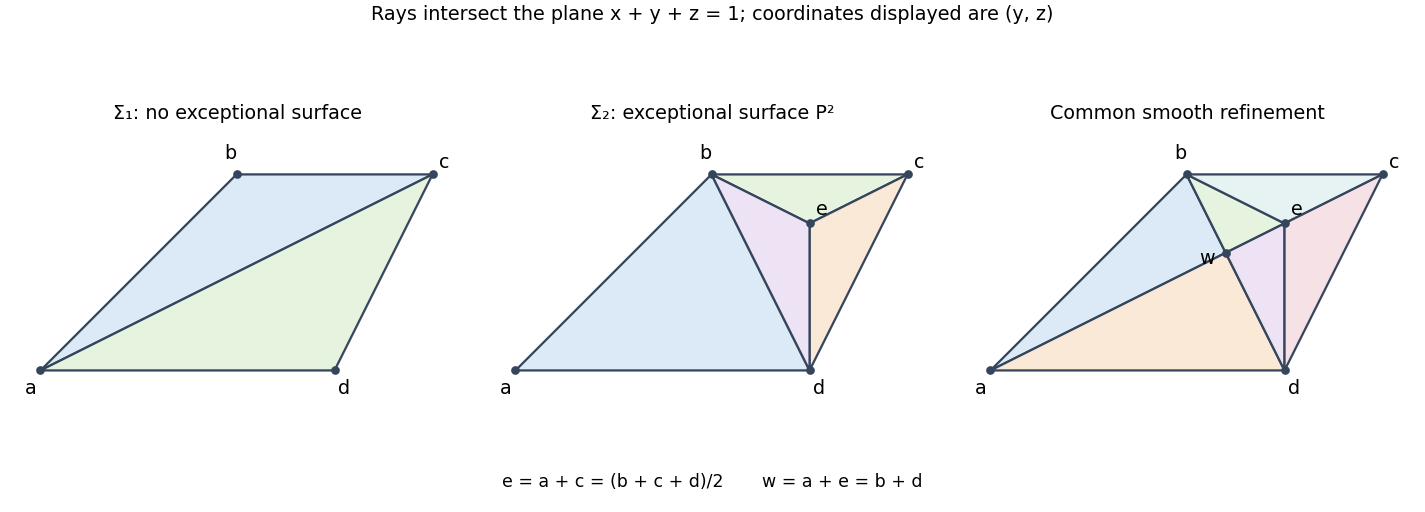
Cross-sections of the two minimal smooth fans and their common refinement obtained by invariant-curve blowups
. Details. 
A singular two-dimensional affine toric variety in the normal fan construction must come from a full-dimensional pointed cone; cones of smaller dimension give smooth charts with a torus factor. Let its primitive boundary generators be . Choose an oriented lattice basis with , and write the other generator as , . Primitivity gives . Changing the second basis vector by a multiple of the first lets us write the cone asHere because determinant one would give a smooth chart. The sublattice has index , and its affine chart is . The quotient is cyclic, generated by , whose coordinates in the two boundary generators are . Thus the kernel of the corresponding finite map of tori acts on the two affine coordinates as . More explicitly, invariant monomials are exactly those with , which are the elements of the original dual lattice in the first quadrant. Their ring is . Hence the singularity is the cyclic quotientThe choice of the two boundary axes is unordered; exchanging them replaces by its inverse modulo .
The Hirzebruch–Jung resolution is computed by the negative Euclidean algorithm. Put , and recursively setThe nonzero remainders strictly decrease, , and their greatest common divisor stays one; the process terminates with , . All , and unwinding the recursion gives the negative continued fractionStart with and and define . The determinant of every consecutive pair is one, by induction. Moreoveragain by the same recursion and the initial values . Each intermediate ray is therefore inside . To check the ordering explicitly, the first coordinates after are negative, the second coordinates positive, and successive determinants are positive. At the last step the determinant with the endpoint is zero. The vector is primitive, points in the same direction as , and hence equals it. Subdivide by all the intermediate rays . Every new cone is regular, and the subdivision has the same support, so it gives a proper smooth resolution.
Each internal ray has a compact invariant curve , because the quotient fan at it has the two opposite primitive rays. The relation gives its self-intersection . This can also be checked directly: on the chart for use coordinates with ; on the next chart the coordinates are , with . The normal-coordinate transition is that of , proving the self-intersection. Neighboring exceptional curves meet transversely once and nonneighbors do not meet.
Since , there is no exceptional minus-one curve. Combinatorially, deleting gives a cone of determinant . Deleting a longer consecutive block cannot give a regular cone either: determinants of successively more distant rays satisfy the same recursion with coefficients at least two and grow from to integers at least two. Thus no proper smooth coarsening of this subdivision exists. This proves the minimality of the minimal resolution of a cyclic quotient surface singularity; equivalently its exceptional chain has no curve that can be blown down to a smooth point. The number of exceptional curves is the length of the negative continued fraction.
If , then is an integer, so coprimality gives . Conversely gives the single coefficient and one curve. If , thenThe numerator and denominator on the right are coprime, so and . Therefore and . Conversely, if these conditions hold, then , give exactly this two-term expansion. Hence the requested equivalences are
Now consider a complete fan in dimension two with three rays and at most one singularity. Its three two-dimensional cones are the consecutive ray pairs. At least two cones are regular, and they share a ray. After an oriented lattice change, take their consecutive generators to be , and : the first cone is a basis, and forces the first coordinate . Completeness forces , because the third pair must span the missing sector with positive determinant . Write , . The unique positive primitive relation is , so the fan is that of the weighted projective plane , or after permuting weights. For this is ; for its remaining cone has type . This proves the full three-ray classificationThese are the complete three-ray toric surfaces with at most one singular point, including the smooth case.
For four rays and exactly the specified singularity, place the three regular cones consecutively. Normalize the middle one to have generators . Its neighboring regular cones then force the cyclic ray listThe remaining cone has determinant , so . Thus have opposite signs, and is a positive divisor of . In the oriented lattice basis ,so the singular cone has quotient parameter . It follows that its parameter is congruent to . If identification with the specified singularity exchanges the two boundary rays, the parameter is inverted; this does not change the criterion, since for we have , and is the complementary positive factor. The same identity with a minus sign handles .
Conversely suppose and , . Choose and in the displayed four rays. They are primitive and cyclically ordered, with all four gaps less than a half-plane; the opposite signs of ensure completeness. Three consecutive determinants are one, and the fourth is . Its quotient parameter is , so the only singular point has the required type. We have proved the four-ray completion criterion for a cyclic quotient surface singularity:
Let be the primitive lattice generator of the ray . In the toric divisor class sequence, the first map sends a torus character exponent to its principal divisor on a toric variety:The second map sends an invariant Weil divisor to its class modulo principal divisors. Completeness makes the rays span , so the first map is injective. These are the maps in the given sequence; its exactness need not be reproved.
For , letThe torus characters with form a basis of . This works for Weil divisors, not only for Cartier divisors. It is the character basis associated to the lattice polytope of a toric divisor.
For a Cartier divisor, the toric ampleness criterion is as follows. Each maximal cone has local Cartier data satisfying on its rays. The divisor is ample exactly whenEquivalently the support function is strictly concave, with these linear pieces. For a Q-Cartier Weil divisor use rational and clear their denominators; the criterion means that a positive multiple is ample Cartier. An arbitrary Weil divisor need not be Q-Cartier, so this qualification cannot be omitted.
Take positive weights , reduced so their common greatest common divisor is one. A toric definition of weighted projective space usesIf the weights are well-formed, meaning for every , the are primitive: the quotient has torsion of order that omitted-weight greatest common divisor. The lattice itself is free because is primitive. The positive relation implies that proper subsets generate pointed cones and that they meet along common faces. Completeness can be seen directly: represent a vector by real coordinates and subtract times . The resulting coordinates are nonnegative and at least one is zero, placing the vector in one of the displayed cones. Their common-face property follows from this unique normalization of each class modulo . This gives the fan of the well-formed weighted projective space.
The dual lattice isIts map in the divisor sequence is simply inclusion in , so the homomorphism identifies the cokernel with . It is onto by coprimality of all the weights. ThusChoose integers by the Bezout identity . Then explicitly represents the positive generator .
To verify ampleness in the Weil/Q-Cartier sense, put . On the maximal cone omitting ray , defineThis is integral and has . Its pairings with the included rays are , while on the omitted ray they equal . Consequently is Cartier and ample by the numerical criterion. This is an explicit class-group generator of a well-formed weighted projective space.
The generator is generally ample Weil, not Cartier. If the source's word “ample” is interpreted as requiring a Cartier divisor, its generator request is false in general: on , take . On the chart omitting the weight-two ray, the Cartier equations force , which is not in the integral dual lattice. Twice this datum is integral, so the class-one divisor has Cartier index two and no Cartier divisor generates its class group. With the usual ample-Q-Cartier-Weil interpretation, the construction above proves exactly the requested result. This distinction also explains the use of the divisorial spaces rather than assuming an invertible sheaf .
Finally let an ample divisor represent the class-group generator. Its class is the positive generator; the negative generator cannot be ample because a positive Cartier multiple has negative degree on the curves where the positive generator has positive degree. After replacing by a linearly equivalent invariant divisor, write it as with . A character basis element of has exponent with . Set . Then and . Conversely every nonnegative exponent vector of weighted degree gives the unique . Thereforeis a bijection of bases in each degree. Adding and under multiplication adds these nonnegative exponent vectors, so it preserves products and the unit. A different linearly equivalent representative changes the basis by the corresponding rational-function power and gives the same graded-ring isomorphism. Hence the divisorial section ring is the weighted polynomial ring:The character construction is defined over the ground field , so this is an isomorphism of graded -algebras. It proves the divisorial section ring of a well-formed weighted projective space assertion even when its ample generator is not Cartier.
Articles by others on the same topic
There are currently no matching articles.