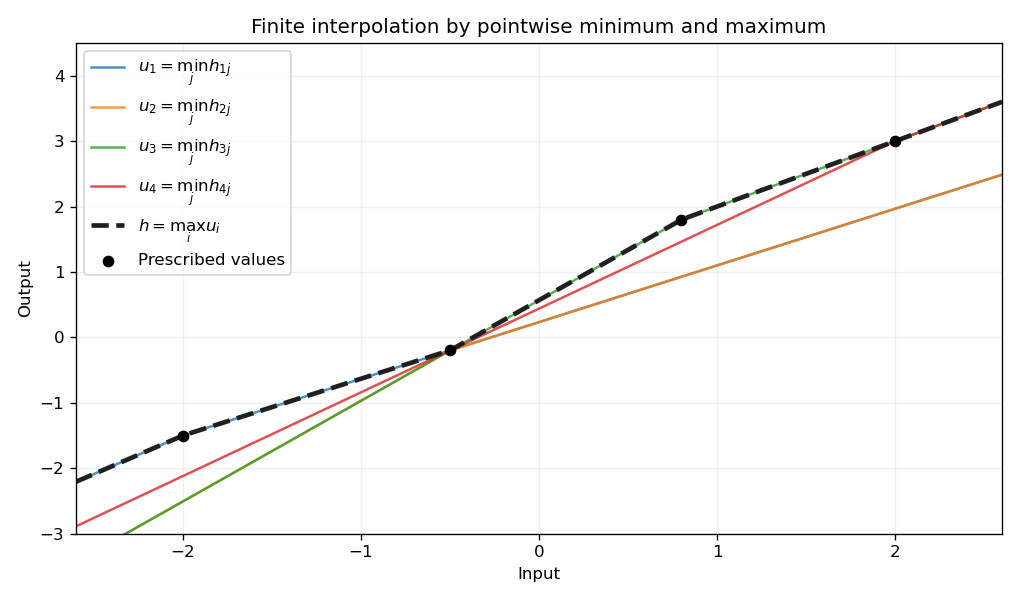
Here transitivity is order n-transitivity: increasing tuples are compared, rather than arbitrary reorderings. For increasing tuples α1<⋯<αn and β1<⋯<βn, choose hij sending both αi to βi and αj to βj when i=j, using order two-transitivity. For i=j, choose an element sending the single point to its target, using transitivity. Define
This belongs to the lattice-ordered permutation group. At αi, all terms in its ith inner meet equal βi. At αk, every inner meet is at most βk, because its j=k term takes that value. The outer join is consequently exactly βk there. Thus hmaps the whole tuple to its target. This finite interpolation by lattice operations proves every finite order-transitivity without assuming the group permits arbitrary cut-and-paste restrictions of its elements.