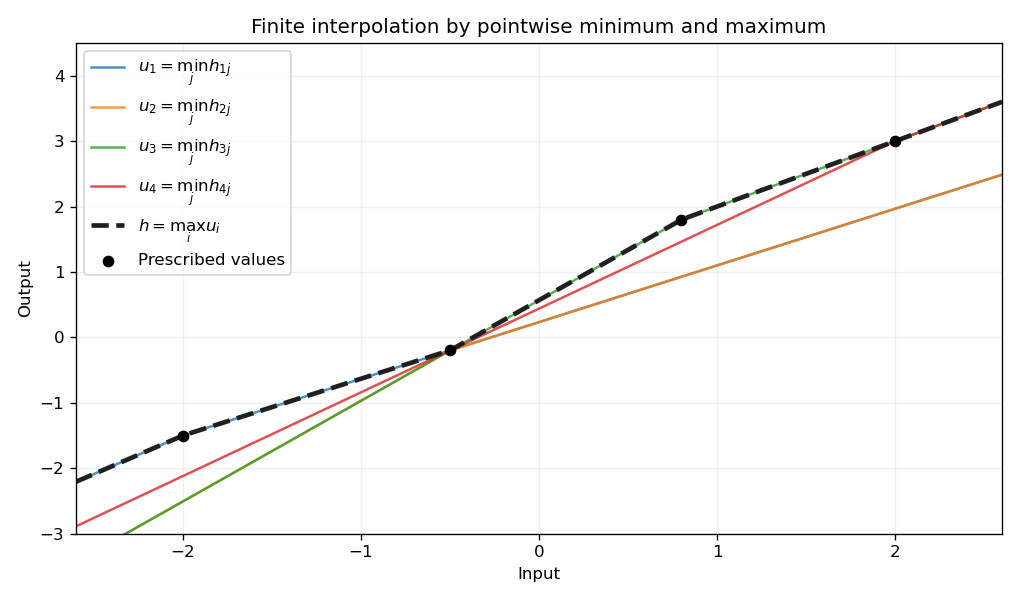
Here transitivity is order n-transitivity: increasing tuples are compared, rather than arbitrary reorderings. For increasing tuples α1<⋯<αn and β1<⋯<βn, choose hij sending both αi to βi and αj to βj when i=j, using order two-transitivity. For i=j, choose an element sending the single point to its target, using transitivity. Define
This belongs to the lattice-ordered permutation group. At αi, all terms in its ith inner meet equal βi. At αk, every inner meet is at most βk, because its j=k term takes that value. The outer join is consequently exactly βk there. Thus hmaps the whole tuple to its target. This finite interpolation by lattice operations proves every finite order-transitivity without assuming the group permits arbitrary cut-and-paste restrictions of its elements.
For a faithful transitive ordered action, primitivity here means that the only invariant equivalence relations with convex classes are equality and the universal relation. The trichotomy is: a regular Archimedean action, an order two-transitive action, or a periodic action. In the regular case the chain is an ordered additive subgroup of R, acting by translations. In the periodic case there is afixed-point-free period z on the Dedekind completion, commuting with the action and having cofinal and coinitial integer iterates; inside a period interval the relevant stabilizer acts order two-transitively. These are the cases of the McCleary trichotomy theorem.
Only the regular Archimedean case satisfies the inequality. It is a linearly ordered group. For positive a,b, if a≤b, then ab≤b2≤b2a2; if b≤a, then ab≤a2≤b2a2. Taking a=∣f∣, b=∣g∣ proves the displayed inequality.
To exclude an order two-transitive action, choose x<y<z<t. Choose an automorphism taking (x,y) to (y,z) and replace it by its pointwise join with the identity, giving positive a with xa=y, ya=z. Similarly obtain positive b with xb=x, yb=t. Then
Thus ab≤b2a2, while ∣a∣=a and ∣b∣=b. The same construction inside a period interval excludes the periodic case, using the order two-transitive stabilizer supplied by the classification.