Two nonzero vectors are linearly independent when implies . Their span then has dimension two. If they are linearly dependent, one is a scalar multiple of the other, so their span is a nonzero line and has dimension one. Thus the requested dimensions are two and one, respectively.
The dot product and corresponding Euclidean norm areThe Cauchy-Schwarz inequality states . If this is immediate. Otherwise the nonnegativity of a squared norm, with , givesMultiplying by and taking square roots proves the inequality. Equality holds precisely when the vectors are linearly dependent. Expanding another squared norm and using the inequality givesand hence the triangle inequality .
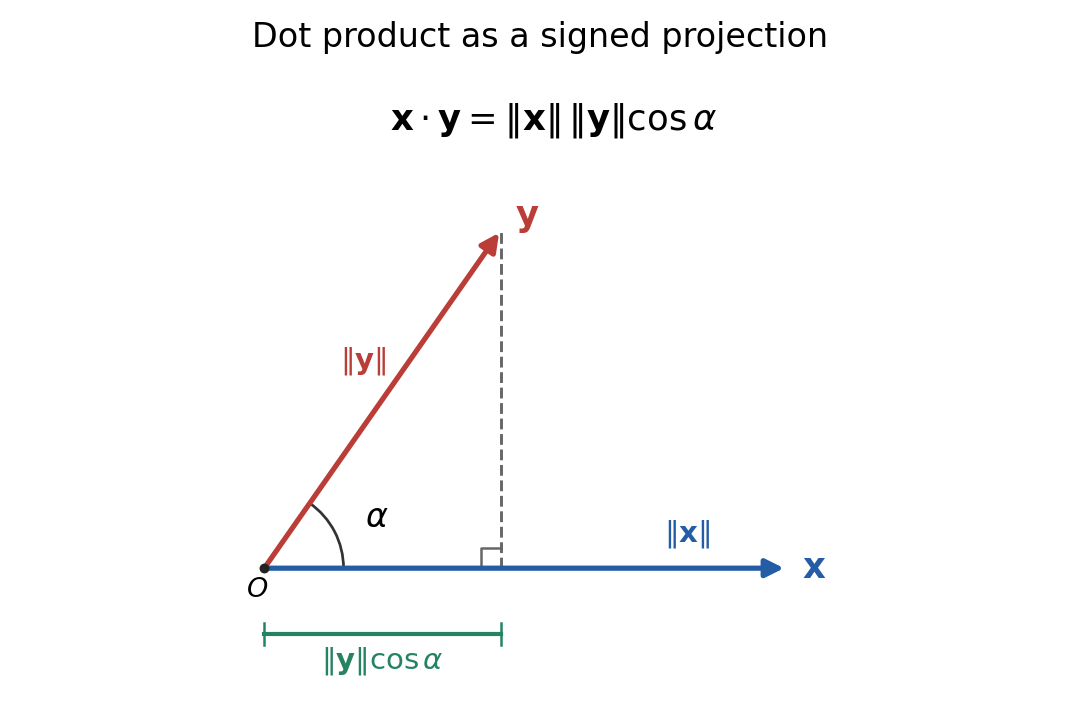
In , the two vectors lie in a common plane. If their directions make angle , the law of cosines gives . Comparing with the dot-product expansion yieldsThe sketch shows the same relation as a projection: multiply the length of by the signed component of in its direction. That component is negative for obtuse .

A unit vector is a vector of Euclidean norm one, equivalently . In particular the dot product of two unit vectors is the cosine of their mutual angle.
Articles by others on the same topic
There are currently no matching articles.