A finite family of vectors in a vector space over a specified field is linearly dependent if it has a nontrivial linear relation: with and at least one coefficient nonzero. One can then solve for a vector whose coefficient is nonzero as a linear combination of the others; removing that entry preserves the linear span. Repeated vectors in a list give linear dependence: for example has the linear relation . A list keeps both entries even though the set has only one element. Strang's notes illustrate redundant columns by expressing one as the sum of two others.[ref]
https://ocw.mit.edu/courses/18-06sc-linear-algebra-fall-2011/0bbc30e3f1d7933ea07a2d2e9ab050d9_MIT18_06SCF11_Ses1.9sum.pdf. MIT 18.06SC, Strang lecture summary 9, pp. 2–3: dependent columns
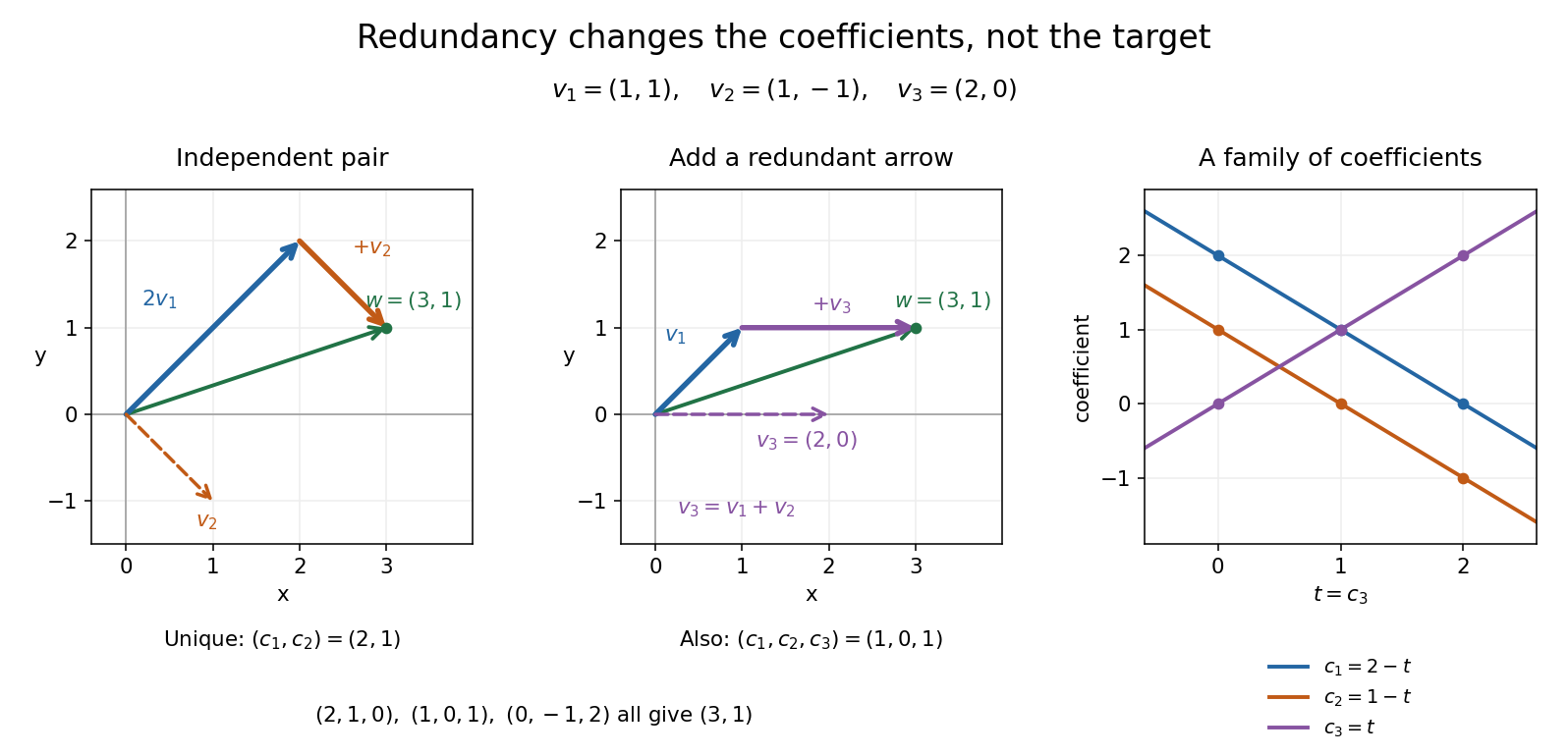
Keep and , and add . The three vectors still have linear span , but nowThe two coefficient triples and differ by the nontrivial linear relation . In fact all linear combination representations of this target areTo check both completeness and correctness, use . Linear independence of forces and , giving exactly the displayed family. Redundancy therefore preserves attainable targets while allowing their coefficients to move. For solving a linear system, these alternatives matter; for assigning unique coordinate vectors, one instead chooses a basis.

The following example shows why linear independence depends on the scalar field.
Consider the vectors in the complex numbers, where is the imaginary unit. With scalar field , a linear relation has . Taking its real part and imaginary part gives , so the pair is linearly independent. Every complex number also has coefficients in the real numbers, so form a basis and the dimension of a vector space is two.
With scalar field , the same pair is linearly dependent, sinceuses the nonzero coefficients from the complex numbers. The single vector is now a basis, because for every complex number , giving dimension of a vector space one. For example : the second representation uses a coefficient unavailable over the real numbers. Specifying the field is part of the definition of linear independence.
A linear relation among vectors is a coefficient tuple satisfying . It is nontrivial if at least one coefficient is nonzero. For the matrix with these vectors as columns, the space of relations is its kernel. The vectors are linearly independent exactly when this kernel is zero. An invertible change of coordinates preserves every relation, since if and only if .
Articles by others on the same topic
There are currently no matching articles.