Compose permutations from right to left. Tracking the four symbols through the two permutation cycles gives and . Thus the cycle decomposition of a permutation isThe disjoint transpositions commute, and squaring their product gives the identity element, while the product itself is nonidentity. Its order of a group element is therefore two. Each transposition has negative sign of a permutation, so the product has sign : it is an even permutation.
If , cancellation of successive factors gives for every positive integer . Hence is the identity element exactly when is, proving that conjugate group elements have the same order of a group element. For permutations, the sign group homomorphism similarly givesThus conjugate permutations have the same sign of a permutation.
The converse is false: permutation order and sign do not determine conjugacy. In the symmetric group , take and . Both have order three and positive sign. However, fixes three symbols whereas fixes none. If fixes a symbol , then fixes , and applying the inverse conjugation gives a bijection between the fixed-symbol sets. Their different fixed-point counts therefore prove that are not conjugate. Equivalently their cycle types and differ. Equal order and sign are necessary, but not sufficient, for conjugacy.
The two diagonal blocks allow the characteristic polynomial to factor immediately:Thus the characteristic equation isSolving the two block eigenvalue equations gives the following nonzero eigenvectors and corresponding eigenvalues:For example, the lower block maps to , and maps to zero. The four eigenvalues are distinct. Alternatively, the determinant of the matrix with columns is . Hence they form a basis and span the complex vector space . Their nonzero scalar multiples are all the corresponding eigenvectors.
For any eigenvector with eigenvalue , its one-dimensional vector subspace satisfies . If , every has preimage , so the restricted linear map is onto that same subspace. ConsequentlyThe last line is the kernel of a linear map direction: multiplication by collapses that line to the zero-dimensional subspace.
A real function is differentiable at an interior point when the finite limitexists, with restricted so lies in its domain. In quantified form, for every there is such that implies that the difference quotient differs from by less than .
To prove differentiability implies continuity, the convergent difference quotient is bounded by for sufficiently small nonzero . Thus . This is exactly continuity at .
At zero, the particular function has difference quotient . The bound and the squeeze theorem giveFor , the product rule and chain rule giveAt this equals , although and . At it equals . Hence the derivative has no limit at zero and is not continuous there. This demonstrates that differentiability does not imply continuity of the derivative, even though the function itself is continuous.
The radius of convergence of a power series is the unique for which the series converges absolutely when and diverges when . When it converges for every complex ; when it converges only at the centre. The definition makes no assertion about convergence on , so boundary points must be checked separately.
The absolute ratio of successive terms is . The ratio test gives convergence for and divergence for , so the radius of convergence is . On the boundary, andThe positive partial sums are bounded, and thus converge. By the comparison test for series, the original power series converges absolutely at every point of .
The coefficient ratio isThus the ratio test again gives radius of convergence . On , however, the terms have absolute value , which does not tend to zero. The necessary term condition for a convergent series fails at every boundary point. Therefore this power series diverges everywhere on .
A positive, counterclockwise rotation takes the standard basis vectors and to and . These images are the columns of its rotation matrix, soIt fixes the origin, preserves the dot product and has determinant one.
Since and , is an orthogonal matrix in the special orthogonal group. It also satisfies and thus preserves the dot product. Normalize the fixed eigenvector to . For ,so the orthogonal complement of the fixed axis is invariant. Choose an oriented orthonormal basis . In this basis the matrix has form , where is a real orthogonal matrix of determinant one.
Write the first column of as . Its unit second column must be perpendicular to the first; positivity of the determinant selects . Thus , and fixes the axis through while rotating its perpendicular plane by . Since trace is invariant under change of basis,This proves that is the required axial rotation. The trace determines the unsigned angle; the action in the oriented perpendicular plane determines its sign. The identity case has angle zero and any axis.
Use the orthogonal matrix identity . The product rule for determinants, , and invariance of determinant under matrix transpose givewhere the last sign comes from dimension three. Hence . The real linear map has a nonzero real vector in its kernel, so has an eigenvector with eigenvalue one. This is the odd-dimensional special orthogonal transformation has a fixed vector property, here proved directly without first classifying the other eigenvalues.
For a linear map , its kernel of a linear map and image of a linear map areBy the definition of the image, has a solution exactly when . If is one solution, every other solution is for some : subtracting the two equations proves necessity, and linearity proves sufficiency. Thus a solvable equation has a unique solution exactly when .
Write the columns of the given matrix as , and . Its determinant isThe columns are linearly independent for every real : proportionality would require the proportionality factor to be one from the first coordinate, then simultaneously from the second and from the third. Thus the rank is always at least two.
If , the matrix is invertible andIf , the rank is exactly two. A direct substitution verifies the nonzero kernel vector : its first and third row products vanish identically and its second is . The rank-nullity theorem then givesIn that case the image is the plane spanned by . Their cross product is , so an equivalent description isThese formulas include the singular case , giving kernel and image ; no exceptional case was lost by dividing by .
Finally, when ,Therefore the equation has a unique solution for every and every , in particular for every . Outside this parameter range, the singular cases are precisely when that square root is real.
For a group action of on a set and , the orbit-stabilizer theorem statesIf is finite, this becomes . The underlying bijection sends the left coset to . Equality of two image points is equivalent to , so this map is both well-defined and injective, and it is surjective by the definition of the group orbit.
Place the cube's vertices at . Every symmetry fixes its centre, and permutes the three perpendicular pairs of face normals, so it is a signed permutation matrix. Conversely every such matrix preserves the cube. The symmetry group of a cube acts transitively on its eight vertices: independent coordinate sign changes take to any vertex.
A symmetry fixing must permute its three incident edges. This gives an injective map from its stabilizer subgroup into , since those three edge directions determine the linear transformation. All six permutations are realized by coordinate permutation matrices, which fix . Thus the vertex stabilizer has order six. The orbit-stabilizer theorem now yieldsThe use of all symmetries includes reflections as well as the twenty-four elements of the rotational symmetry group of a cube.
There are nontrivial proper normal subgroups. The determinant defines a surjective group homomorphism . Its kernel is the rotational symmetry group of a cube, a normal subgroup of order twenty-four. Also is a central subgroup of order two: central inversion preserves the cube and commutes with every matrix. Both provide affirmative examples.
For the body diagonal through , write a general cube symmetry as , with a permutation matrix and , each . Since , preserving the unoriented diagonal requires to be either or . ThusThe map from to is a group homomorphism, because central inversion commutes with every coordinate permutation. It is surjective by the displayed description and injective because a permutation matrix cannot equal the negative of another permutation matrix. Consequently the body-diagonal stabilizer in the cube symmetry group isThis also agrees with the orbit-stabilizer theorem for the transitive action on the four body diagonals. The line is preserved as a set, so exchanging its opposite endpoints is allowed.
Two nonzero vectors are linearly independent when implies . Their span then has dimension two. If they are linearly dependent, one is a scalar multiple of the other, so their span is a nonzero line and has dimension one. Thus the requested dimensions are two and one, respectively.
The dot product and corresponding Euclidean norm areThe Cauchy-Schwarz inequality states . If this is immediate. Otherwise the nonnegativity of a squared norm, with , givesMultiplying by and taking square roots proves the inequality. Equality holds precisely when the vectors are linearly dependent. Expanding another squared norm and using the inequality givesand hence the triangle inequality .
In , the two vectors lie in a common plane. If their directions make angle , the law of cosines gives . Comparing with the dot-product expansion yieldsThe sketch shows the same relation as a projection: multiply the length of by the signed component of in its direction. That component is negative for obtuse .
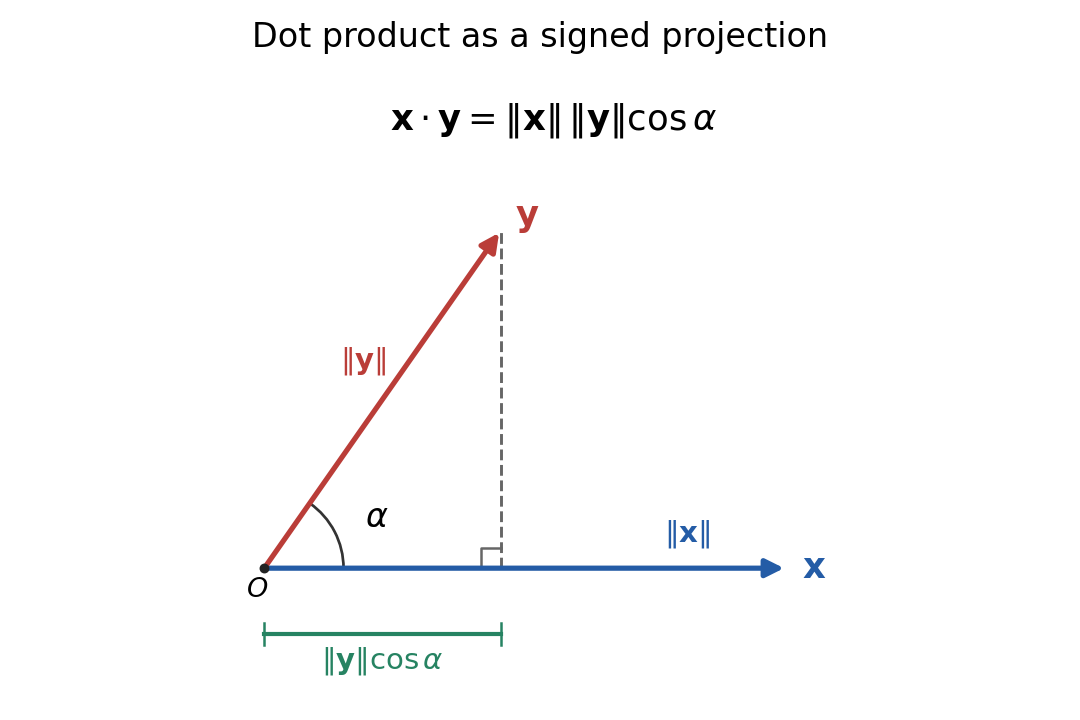

A unit vector is a vector of Euclidean norm one, equivalently . In particular the dot product of two unit vectors is the cosine of their mutual angle.
Put and . The linear independence assumption implies . Since is a unit vector, the Cauchy-Schwarz inequality givesEquality holds exactly when points opposite to . Its required unit length then fixes the scale:Here because both vectors have unit norm. The minimizing vector is unique, and the minimum pairwise dot-product sum of three unit vectors for these fixed is
The triangle inequality for the two unit vectors gives . Taking reciprocals and using the negative sign in yieldsIn fact equality would require , by the equality condition in the Cauchy-Schwarz inequality. Since the two vectors here are linearly independent, the inequality is strict for every admissible pair.
For the stated angle, , so . The minimizing unit vector is therefore , andIndeed all three pairwise dot products equal , so the vectors lie in one plane, separated by degrees. This is also the global minimum pairwise dot-product sum of three unit vectors: for any three unit vectors,so , with equality exactly when .
To prove the Archimedean property, suppose the positive integers were bounded above in . By the least upper bound axiom they would have a finite supremum . Since is not an upper bound, some positive integer satisfies . Then the positive integer , contradicting the definition of . Thus the positive integers are unbounded. Equivalently, for any positive real , some positive integer satisfies , by applying unboundedness to .
For fixed , put . The standard properties needed are , and exactly when . If , then ; for this also follows from the Bernoulli inequality, since . Therefore the inner limit isIf is a rational number, with , then divides the factorial whenever . Hence is an integer for all sufficiently large , and the outer limit is one. This includes the endpoints . If is an irrational number, cannot be an integer for any , since division by would make rational. Then every inner limit is zero. The factorial cosine iterated limit detects rationality result is consequentlyEach inner limit was taken with fixed; the argument does not interchange the two limits or assert a joint limit as both indices grow.
The integral test for convergence applies when for all sufficiently large , where is nonnegative, continuous and nonincreasing on . It states that converges if and only if the improper integral is finite. Its comparison bounds areNo conclusion about an arbitrary nonnegative sequence follows without such a monotone comparison function; finite initial terms do not affect convergence.
For with , all the hypotheses hold. If ,whereas for the integral is . The first expression has a finite limit exactly when . Thus the p-series satisfies
On , is positive, continuous and decreasing, since its denominator has positive derivative . Substituting givesThe integral test for convergence therefore shows that the series is divergent.
Because , each of , and is positive and increasing for . Hence is positive, continuous and decreasing. With , , soThe integral test for convergence implies that the series is convergent.
Compare with the divergent series from part (i). The ratio of its new summand to isFor completeness, , so . The limit comparison test now gives divergence. Although the exponent exceeds one for each summand, it approaches one and does not produce a convergent p-series with a fixed exponent greater than one.
For a partition and tags , form the Riemann sum . The Riemann integral is the unique real number such that for every there is for which every tagged partition with mesh has its sum within of . Then . The stated continuity ensures existence, which need not be proved here.
The properties required are linearity, the integral of a constant, and monotonicity of the Riemann integral. Monotonicity follows directly because a nonnegative function has nonnegative Riemann sums, and therefore a nonnegative integral. Integrating and givesSince , multiplication preserves the pointwise inequalities: . The continuous products are integrable, so the same monotonicity and linearity giveNeither nor needs to be nonnegative for this argument.
For the first limit, set , , and . By continuity at zero, . On this shrinking interval , andApplying the weighted bounds just proved givesBoth bounding expressions tend to , so the squeeze theorem proves the first limit.
For the full interval, continuity on gives a finite bound by the extreme value theorem. The remaining tail has absolute value at mostAdding this to the already evaluated near-end integral provesThese are instances of a one-sided exponential approximate identity: the positive weight has total mass tending to one, concentrated in a shrinking neighborhood of zero. No interchange of limit and integral has been assumed.
For real functions that are continuously differentiable on a closed interval , integration by parts statesIt follows from the product rule and the fundamental theorem of calculus. With the convention , the identity also applies to reversed limits. These regularity assumptions ensure that all the proper integrals exist.
For the smooth in the problem, define the integral remainder in Taylor theorem byThe fundamental theorem of calculus gives . Applying integration by parts to , with and antiderivative of , givesInduction starting from therefore provesThe same calculation holds for negative : all integrals are oriented, and the segment joining and lies in . Thus the proof covers every stated and every positive integer .
Now take . For , differentiation gives , and . With and , the Taylor formula with integral remainder becomesFor , and . Hence after integrating over an interval of length . Thus the logarithmic series from an integral Taylor remainder satisfiesThe explicit vanishing remainder establishes convergence and identifies the sum, without using a pre-existing logarithmic power series.
The direction field has slope , independent of . Its line segments slope upward for , are horizontal at , and slope downward for . Thus is an attracting equilibrium in forward , while is repelling. The two constant solutions must be included separately when separating variables.
The following original sketch shows the slope field and one solution in each requested region. The lower exterior solution ends at a finite pole; it cannot be continued across that pole as a real finite-valued solution.
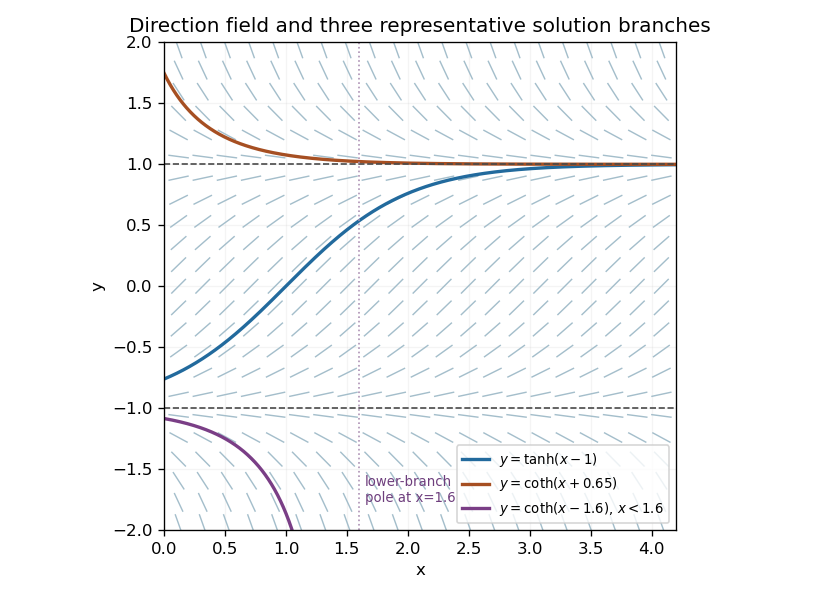
Direction field, equilibrium lines and representative solutions in the three regions of the autonomous scalar equation
. Details. 
Separate variables and integrate on :Hence the general solution in this region isEvery such solution increases from values near towards , remains strictly between the two equilibria, and is defined for all real .
For , the separated integral isInverting givesThe upper branch has , where decreases towards as . The lower branch has , where decreases to as . These are separate maximal intervals: the pole is not part of a solution. For the domain , a lower-branch initial value below necessarily reaches that pole in finite positive . The direction field sketch above displays both exterior branches and a central hyperbolic tangent branch.
With , the central finite difference converts the decay equation toThe continuous ordinary differential equation has the general solution . The discrete linear recurrence is second order and requires two initial values, such as . Trying gives the characteristic equation of a linear recurrence . Its roots aresoThere are no repeated roots, and the same formula extends to negative integer if required.
To demonstrate the continuum limit, put . Then and , with . For ,uniformly, since . More precisely , giving an error on a fixed interval. Thus , selects the physical discrete mode and corresponds to .
The other root is a parasitic amplification root:For fixed , even and odd mesh points approach values differing by . Equivalently successive mesh values have a nonvanishing alternating jump despite their time separation tending to zero. This mode cannot converge uniformly to a continuous ODE solution; its limiting envelope also grows rather than decays.
For step-dependent initial data the precise result is the centered two-step discretization of exponential decay criterion:Sufficiency follows from the two uniformly bounded exponential envelopes on a fixed interval. Necessity follows from convergence at the adjacent points : , , and the coefficient formulas force , . In particular a nonzero but vanishing starting error is not excluded. Starting with the exact value gives and still converges on each fixed interval. The assertion about “remaining” solutions therefore concerns a fixed nonzero parasitic amplitude, not every nonzero step-dependent amplitude. The method is nevertheless not damping-stable for arbitrarily long times because .
For a nonnegative integer-valued random variable , its probability generating function isinitially defined at least for . A general real-valued random variable need not have a probability generating function in this sense. For a binomial distribution, the binomial theorem givesDifferentiating the generating function produces factorial moments:Since , the mean and variance areThese formulas include the degenerate endpoint probabilities and .
For independent random variables, their sum has the product of their probability generating functions:Comparing polynomial coefficients identifies a binomial distribution with parameters :and the probability is zero at all other values. The common success probability is essential to this binomial form; independent binomial counts with different probabilities do not in general add to a binomial count.
The transformation is strictly increasing on , has range , and its inverse is . Therefore the cumulative distribution function isDifferentiation gives the probability density functionIts value at zero may be assigned arbitrarily without changing the distribution. There is no atom at zero or infinity. The expression is undefined at , but that event has probability zero under the continuous uniform distribution, so any convention there leaves the law unchanged. Finally , as required.
An integrating factor for a differential one-form makes the multiplied form exact. If , then and . Equality of the mixed partial derivatives yieldsThis is a local compatibility condition under the usual smoothness assumptions.
For the trigonometric equation, where its coefficients are defined and division is legitimate, the slope is . In the first quadrant it is positive, small near either axis and large near the upper-right corner. The direction field below uses normalized line segments, so steep directions remain visible.
Multiplication by givesThus the multiplying function is an integrating factor, and the implicit general solution isIn the larger square, . The positive- curves have positive and are symmetric about the -axis; the negative- curves are their reflections. For , a graph representation iswith endpoints tending to . The interior curve is . The domain boundaries include singular coefficients or zeros of the integrating factor, so these endpoint limits and smooth continuations through describe the regularized relation; they must not be mistaken for additional solutions of the literal original equation at undefined points.
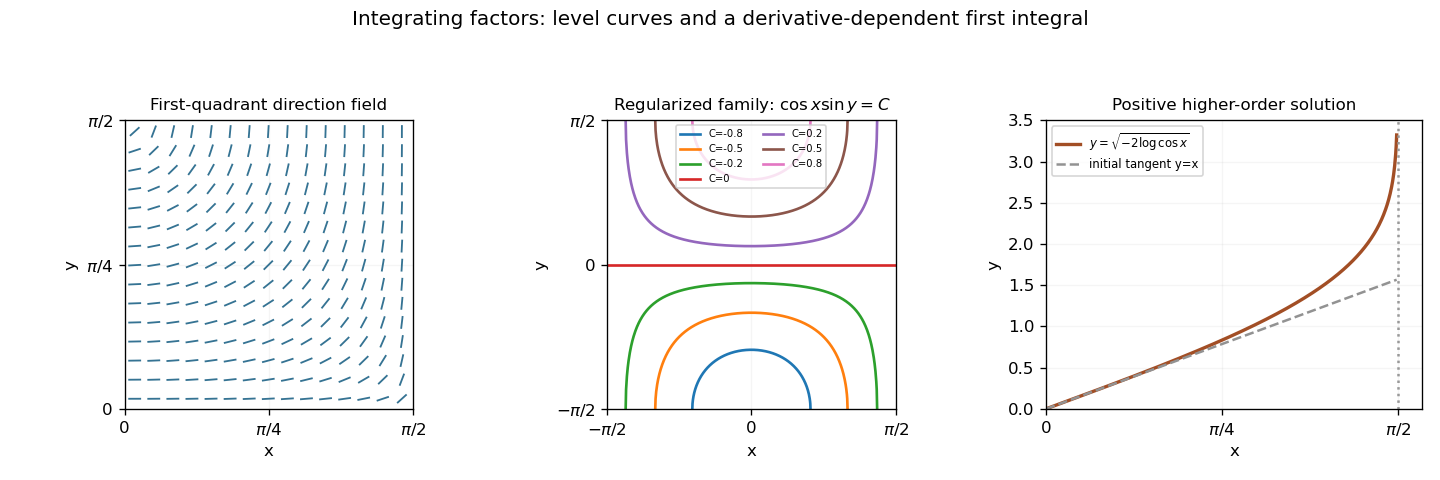
Trigonometric direction field, regularized implicit solution family, and the positive higher-order particular solution
. Details. 
After multiplication by , recognize both sides as derivatives:The nontrivial first integral is thereforeIt necessarily depends on the derivative, correcting the printed notation . A second integration giveson the specified interval. Since , . A finite derivative at zero also implies there, forcing . A positive particular solution is consequentlyThe negative of this function is the other sign choice. Near zero, , so the positive branch has and ; the negative branch has derivative .
For the positive branch, . Its second derivative has numerator , multiplied by a positive factor. This numerator is zero at zero and has derivative , so the curve is convex for positive . It starts tangent to and rises without bound as , with . The third panel of the sketch above shows this branch.
For two solutions , define the WronskianDifferentiate and substitute the second-order linear differential equation:Integration proves the Abel identity, including the identically zero case:For , this is on either interval excluding zero, since the integral uses . The coefficient singularity at zero must not be ignored.
Multiply the particular equation by and substitute the Frobenius solution . With , equating coefficients givesThe leading coefficient is nonzero, so the indicial equation is . Thus only are possible, and the recurrences below construct both.
For , , , and the recurrence reads , leaving free. For all later indices,This is an undetermined coefficient at Frobenius resonance; choosing selects a convenient even basis solution but is not forced by the differential equation.
For , all odd-indexed coefficients vanish andThe factorial denominators show convergence for every finite . Expanding the given hyperbolic functions directly yieldsConsequently the exponent-zero family is , and the normalized exponent-three solution is . This verifies the coefficient formulas and supplies two independent basis functions.
Finally and , soThis agrees with the Abel calculation. Its vanishing at zero does not contradict independence on regular intervals: the original equation is singular there.
For the homogeneous solution, expand in the independent eigenvectors of . Each coefficient obeys , so the complementary function isIf is any particular integral, subtracting it from any other solution gives a homogeneous solution. Hence is the general solution. Complex-conjugate modes can be combined to produce real solutions when the forcing is real.
For a real two-by-two matrix, the characteristic polynomial is . Under the stated distinct-eigenvalue assumption, all nonzero homogeneous modes are purely oscillatory exactly when the eigenvalues are with . Their sum and product imply , . Conversely these trace and determinant conditions force those eigenvalues, so there is no exponential growth, decay or Jordan-block secular growth.
For the final specified initial-value problem, direct multiplication gives . The forcing vector satisfies , so the forcing is resonant and is a particular integral. The matrix exponential isSince the resonant particular integral vanishes initially, the initial-value solution isThis complex solution is appropriate to the complex forcing as written. Taking real parts gives the corresponding solution for the real part of that forcing.
Try a particular integral along each forcing eigenvector. Since ,With both denominators nonzero, add the two responses:Only the forcing component's own eigenvalue enters its denominator; a frequency matching a different eigenmode does not create resonance in this already diagonal forcing component.
The second component is resonant. Differentiating supplies the term missing from the exponential ansatz:Thus a particular integral isThe linearly growing oscillatory envelope is forced resonance in a differential equation; it does not contradict bounded oscillation of the complementary function. The worked initial-value solution in the question's root Solution uses this same resonant mechanism.
Differentiate the proposed first integral along the vector field:At , is conserved and the system is an inverted quartic oscillator phase portrait. Its equilibria are and . The Jacobian matrix isAt the origin its eigenvalues are . Moreover has a strict local minimum there, and its nearby positive contours are closed, so the origin is a genuine center equilibrium, not merely an inconclusive linear centre. The arrows circulate clockwise: on the positive -axis, . At either , the eigenvalues are , giving saddle equilibria. The stable eigendirection is , and the unstable one is .
The special energy level factors asBetween the two saddles, its left arc has and travels upward from to ; its right arc has and travels downward from to . These two heteroclinic orbits bound the central eye. Trajectories inside the eye are closed periodic orbits and do not tend to the centre as .
More explicitly, a level hasFor , its bounded central component is periodic, while its exterior components turn at and then escape. For , never vanishes and the two branches run from one vertical infinity to the other. Levels have only exterior nonconstant components, apart from the origin at .
On the upper outer separatrix, the branch arrives from positive infinity and approaches in forward infinite time; the branch leaves towards positive infinity. On the lower outer separatrix, the branch arrives from negative infinity and approaches , while the branch leaves towards negative infinity. Approaching a saddle along its stable manifold is exponential at rate . A trajectory close to but off a separatrix can spend a long time near the saddle before completing a periodic orbit or escaping.
The escape is finite-time blowup, not an asymptote at . On any escaping level, , so the remaining travel time is bounded by a convergent integral proportional to . Thus an outward upper branch has , ; an outward lower branch has , . The statement about approaching from infinity likewise refers to a finite past endpoint. Only equilibria, periodic trajectories and trajectories tending to saddles have a future defined for all time in this conservative portrait.
For small positive , the equilibria remain in place, but the origin's eigenvalues become , so it becomes a repelling focus. The saddles retain one eigenvalue of each sign, . Since , and its time integral is strictly positive on every nonconstant trajectory, trajectories cross -contours towards larger values. Near the centre this means outward spiralling. No nonconstant periodic orbit can remain, and the former saddle-to-saddle connections at equal are broken. Stable saddle trajectories approach from ; unstable ones depart into . Generic central trajectories eventually escape, while the exceptional stable saddle manifolds still approach their saddles.
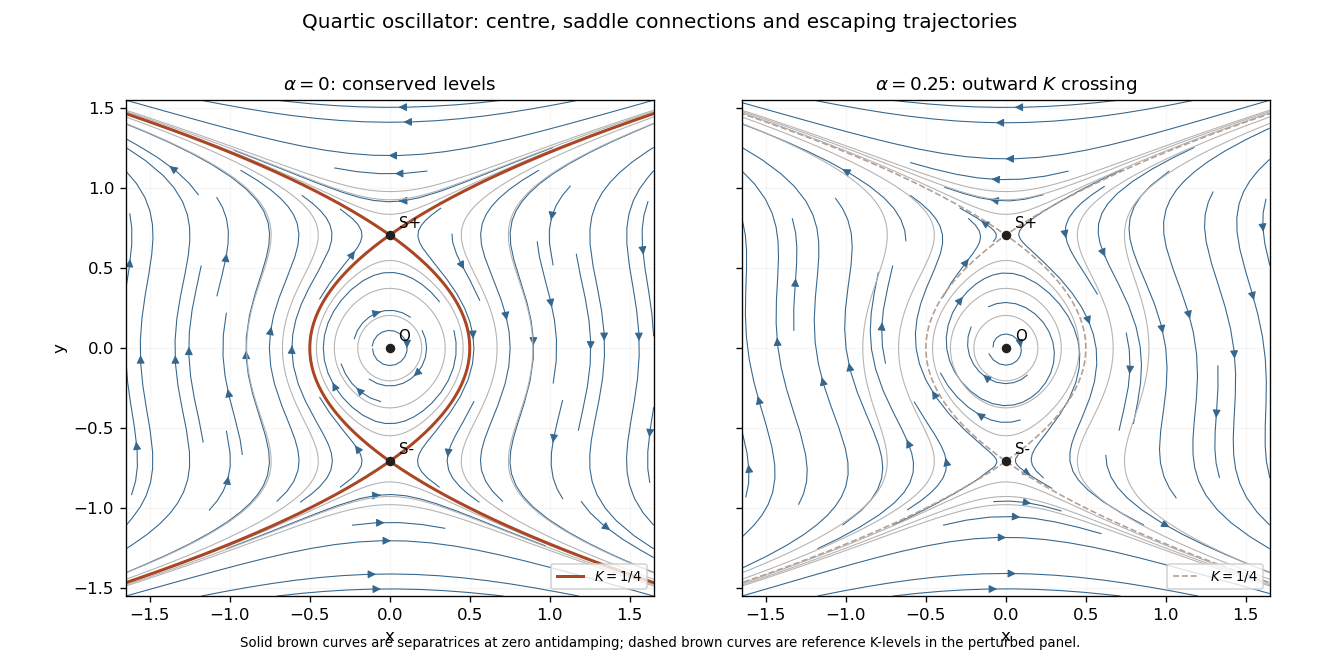
Conservative quartic phase portrait with heteroclinic separatrices, and outward contour crossing under small positive antidamping
. Details. 
The inclusion-exclusion principle givesFor the coat problem, all permutations are equally likely. If a specified set of people gets its own coats, the other coats can be assigned in ways, so that intersection has probability . Taking the complement of the union of correct-coat events gives the derangement probabilityTo have exactly fixed coats, choose their recipients and derange all remaining coats. Thus the fixed point count of a uniform random permutation hasand zero probability outside this range. The empty permutation has , so the formula includes ; it also gives zero for , since a lone remaining coat cannot be misplaced.
For fixed , , and the exponential series givesThese are the probabilities of a Poisson distribution of mean one. The limit is for fixed , not for increasing with .
The probabilities satisfy and . Since the variables are indicators,Their covariance isThus the necessary and sufficient condition for uncorrelated random variables isThis uses zero covariance as the definition. If one variable is constant, a normalized correlation coefficient is undefined, but zero covariance and this criterion remain meaningful.
Independence requires each joint probability to equal the product of the relevant marginals. In particular it implies , equivalent to .
Conversely let and , and assume . The covariance calculation gives . ThenAll four joint probabilities therefore factor, proving independence. HenceThis is Bernoulli independence from zero covariance, including degenerate marginals. It is special to two-point variables and is not a general equivalence for arbitrary random variables.
An uneventful day leaves one aphid, a one-offspring day leaves the parent plus its offspring, and a two-offspring day leaves three aphids. Death leaves none. Thus the daily descendant counts are with probabilities , , , , respectively. The mean and probability generating function areIndependence across individuals and days makes the daily population a Galton-Watson process, with each surviving parent counted as one of the next day's descendants.
The standard Galton-Watson extinction fixed point result states that the eventual extinction probability of a branching process from one ancestor is the smallest root in of . Moreover a nondegenerate offspring law of mean at most one has extinction probability of a branching process one. Here, since , the fixed-point equation reduces towhich contains no . This proves laziness invariance of branching extinction: uneventful days change the timescale, not eventual extinction. The excluded case would keep one aphid forever.
If , the offspring mean is at most one. In this parameter range : if , then would imply . Thus the offspring law is not deterministically one, and the extinction criterion applies. Extinction is certain.
For the specified probabilities, the fixed-point equation factors asIts roots in are and , and the smaller root is the extinction probability of a branching process:
By rotational invariance, fix the first landing point at the north pole of a sphere of radius . A band of central angle and width has area . Dividing by total area gives the central angle between independent uniform sphere points densityand zero outside this range. The radius cancels.
Given the first pair's central angle , the third point can communicate with each of them exactly when it lies in that point's positive hemisphere. Choose their intersection line as a polar axis. Each hemisphere permits an azimuth interval of length , and the intervals' centres are separated by . Their overlap is a spherical lune of opening , with area . ThereforeThe union probability follows from inclusion-exclusion for two hemispheres:Thus the requested conditional answers are“Either” here is inclusive: a third ship linked to both is also linked to at least one.
For network connectivity, if the first pair is already linked, and the third must link to at least one of them. If , the first pair is not linked, and both must link through the third. Consequently the connectivity of three acute-angle sphere points isUsing and givesAngles exactly equal to the threshold have probability zero. Connectivity allows relaying and is weaker than requiring direct links between every pair.
Use the standard ordered basis for both maps. The reflection in a hyperplane interchanges the second and third coordinates, so its matrix isOrient the rotation axis along and use the right-hand convention. The rotation matrix for angle sends to , to , and to . For example, the Rodrigues rotation formula givesMultiplying the rotation matrix by the dilation factor givesDirect multiplication gives , and . Hence . If the opposite axis orientation is chosen, also has cube . Independently of coordinates, two applications of the reflection give the identity, while three applications of the rotation-dilation give a full turn and dilation by . Every basis represents these resulting maps by and . Thus the equality even holds when the two matrices are expressed in different bases.
Articles were limited to the first 100 out of 180 total.
Articles by others on the same topic
There are currently no matching articles.