An integrating factor for a differential one-form makes the multiplied form exact. If , then and . Equality of the mixed partial derivatives yieldsThis is a local compatibility condition under the usual smoothness assumptions.
For the trigonometric equation, where its coefficients are defined and division is legitimate, the slope is . In the first quadrant it is positive, small near either axis and large near the upper-right corner. The direction field below uses normalized line segments, so steep directions remain visible.
Multiplication by givesThus the multiplying function is an integrating factor, and the implicit general solution isIn the larger square, . The positive- curves have positive and are symmetric about the -axis; the negative- curves are their reflections. For , a graph representation iswith endpoints tending to . The interior curve is . The domain boundaries include singular coefficients or zeros of the integrating factor, so these endpoint limits and smooth continuations through describe the regularized relation; they must not be mistaken for additional solutions of the literal original equation at undefined points.
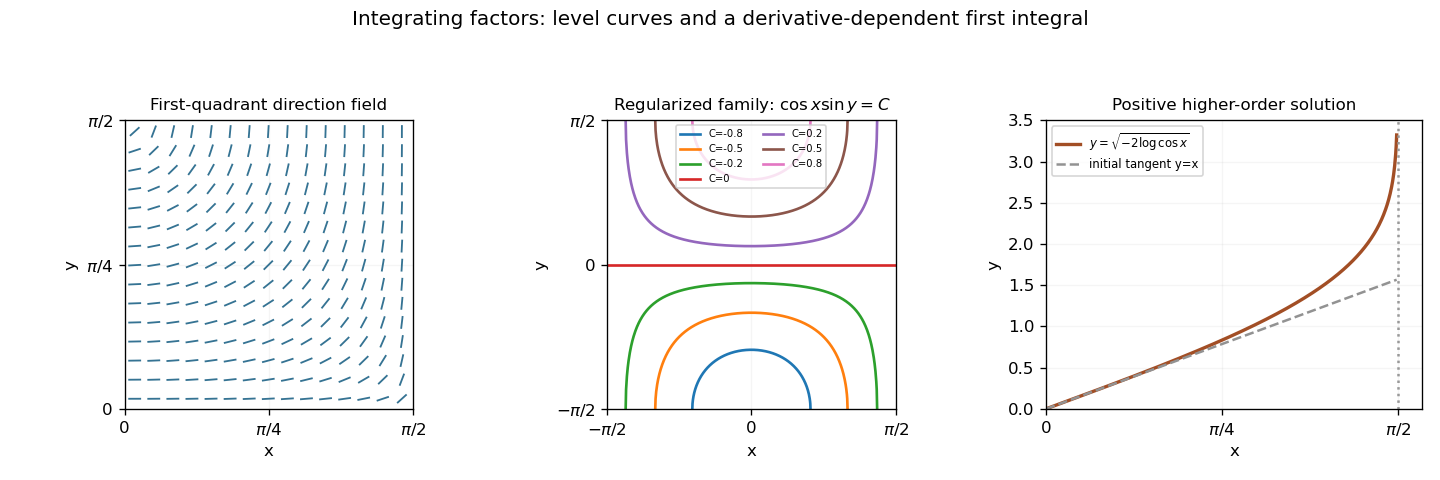
Trigonometric direction field, regularized implicit solution family, and the positive higher-order particular solution
. Details. 
Articles by others on the same topic
There are currently no matching articles.