Use separation of variables, . After multiplying the Laplace equation by , the two separated equations areSingle-valuedness requires -periodicity. Thus the nonconstant angular modes have , , and angular factors . Their radial factors are . The zero mode has constant angular factor and radial solution ; a term proportional to would be multivalued.
Finiteness at the origin removes the logarithm and negative powers. In the disk the general regular harmonic expansion isFor the exterior, regularity at every finite radius allowsCoefficients must give convergent harmonic expansions on the domain and the intended boundary regularity at . If “finite” is intended to mean bounded as , then and only the constant and decaying modes remain. Infinity is not included in the printed interval; moreover part (b)'s uniform background flow necessarily has an unbounded potential. Stating both interpretations avoids discarding that background mode.
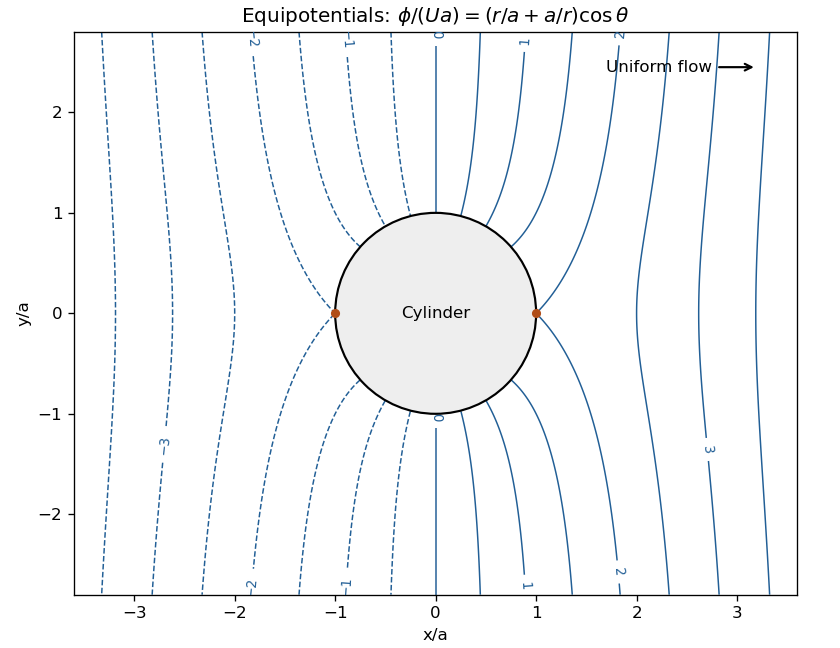
The far-field derivative fixes the growing cosine coefficient to and removes all other growing modes. The possible logarithmic term has derivative at the wall, so the zero wall derivative removes it. For each decaying Fourier mode, the wall condition relates its coefficient to its growing partner: the cosine partner has coefficient , and every other partner vanishes. Thus the potential flow around a circular cylinder hasIndeed, , which is zero at and tends to at infinity. The additive constant does not change the velocity. The equipotential curves satisfy . They approach vertical straight lines far away and meet the cylinder radially wherever the tangential velocity is nonzero. The two stagnation points are at .

Articles by others on the same topic
There are currently no matching articles.