Uniform convergence on an interval means that for every there is such that for every and every . Equivalently, the supremum of this difference tends to zero. A uniform limit of continuous functions is continuous: at a point , choose one uniformly within of , then use continuity of to make . The triangle inequality gives . Thus is integrable on the compact interval, andFor the half-line example, differentiating gives . The maximum is attained at , where . Therefore uniformly on . Nevertheless, the substitution givesThe integral does not tend to zero. This is the phenomenon that uniformly vanishing functions can retain a nonzero integral: the finite-length estimate above has no finite analogue for the entire half-line.
Put . Multiplication of the radial wave equation by gives for . In the characteristic coordinates , , this becomes . Integrating first in and then in gives . ConsequentlyThe two terms are incoming and outgoing radial disturbances. If the field is finite at the origin, their numerators must cancel there; arbitrary independent choices generally produce a singularity.
For the single-frequency response, use separation of variables with . Set and ; then , so . A finite origin value forces , since is singular. Since , the prescribed origin amplitude gives . The regular time-harmonic spherical wave is thereforewith the quotient defined by its limit at zero.
This answers the literal finite-origin condition in the class of regular single-frequency responses. It is a standing combination of inward and outward waves: the numerator is proportional to . A purely outgoing wave from an ideal point source would instead be proportional to , which has no finite prescribed value . Such a source must be specified by a singularity strength, for example . The source's wording supplies neither an initial field nor an outgoing singular-source normalization; without restriction to the stated harmonic response, a general initial-value problem is not uniquely determined by the one origin condition.
Use the Pearson chi-squared goodness-of-fit test. Under the null hypothesis, each count has the specified binomial distribution, and no parameter is estimated from the data. The seven mutually exclusive classes give degrees of freedom. Their expected counts are all at least five, so the usual chi-squared asymptotic approximation does not require pooling. The computed statistic isSince , do not reject fairness at the 5% level. The approximate -value is . This conclusion concerns agreement with the specified independent fair-coin count model; a nonrejection is not proof of fairness.
Morera's theorem states that a continuous complex-valued function on an open set is holomorphic if its integral around every triangle whose closed interior lies in the set is zero. It is enough to impose this condition locally on disks.
Fix a disk contained in the open set and a base point . Define as the integral of along the straight segment from to . The zero triangle integral gives, for sufficiently small ,Continuity makes the quotient by tend to , so is holomorphic and . To justify that its derivative is holomorphic, apply the Cauchy integral formula for on a smaller circle:The right side may be differentiated again inside the circle because its denominator stays uniformly away from zero on the contour. Thus is holomorphic on . Such disks cover the open set, proving the theorem.
The uniform limit theorem first gives continuity of on . For any triangle whose closed interior is in , the Cauchy integral theorem gives . Moreover,Hence , and Morera's theorem proves that is analytic on . In fact, the proof only needs locally uniform convergence on compact subsets, since each triangle is compact; the stated uniform convergence on the entire domain is stronger.
For constrained optimization in minimization form, let , and , and define the LagrangianThe Lagrangian sufficiency theorem says: if is feasible, , for every , and minimizes globally over , then minimizes over the feasible set. Equality multipliers may have either sign.
Indeed, for every feasible ,The first inequality uses the inequality-multiplier signs and the equality constraints; the last equality uses complementary slackness. This proves global optimality without assuming convexity or differentiability. The maximization version reverses the relevant signs, or follows by replacing with .
When is convex and the Lagrangian is differentiable and convex, the first-order condition implies its global minimum, because . Thus feasible stationarity plus complementary slackness is sufficient in that convex setting. Mere stationarity in a general nonconvex problem is not the theorem's global-minimum hypothesis.
For every , write . The first term lies in , since , and the second lies in . If belongs to both spaces, write ; then , whereas membership in the kernel gives . Thus the intersection is zero andIn a basis assembled from bases of these two spaces, the idempotent linear map has matrix , where and . ThereforeThis basis consists entirely of eigenvectors, so is diagonalizable over the reals, including the extreme cases and .
For steady inviscid flow at atmospheric pressure, Bernoulli's equation along a freely falling streamline gives . The downward speed is thereforeFor the incompressible jet, mass conservation fixes its volume flux: . ConsequentlyFar from impact, the inviscid falling jet and radial impact film is thin and nearly horizontal. Let be its radial speed and its thickness. The same volume flux now crosses a cylindrical surface of area , giving . At the free surface, atmospheric pressure and Bernoulli's equation give . Eliminate to obtainThis description assumes a steady incompressible jet, negligible surface tension, and negligible dissipation between the tube and the thin far-field film. It is a free-surface relation, not an assertion that pressure is atmospheric throughout the film or that the impact region itself is thin.
Partial fractions give . In the interior disk, expand both terms as geometric series:Thus the Laurent series is a Taylor series in this region:The nearer pole at determines the radius of convergence.
In the middle annulus, expand the pole at one in negative powers and the pole at two in positive powers:Their geometric series convergence conditions are and , respectively. The required Laurent series is
Outside both poles, the two geometric series use negative powers:HenceThe coefficient of vanishes, as it must since the rational function starts with at infinity.
For a standard collinear Lorentz boost, put and . Its equations are and . Define the rapidity . Since and , and . ThereforeAdding and subtracting, and using , givesA second boost multiplies these factors by , so the combined rapidity is . The hyperbolic tangent addition formula then gives the relativistic velocity addition lawVelocities are signed along the common axis, so this formula also covers oppositely directed boosts.
Fix and . Choose so that , and then choose so that for with . The triangle inequality gives . This proves the uniform limit theorem on the relative topology of , whether or not is open.
The Weierstrass M-test states that if for every and , then converges uniformly and absolutely on . Indeed, the supremum of a tail is at most the corresponding tail of , proving the uniform Cauchy criterion.
For the given secant function terms, a denominator can vanish only at , an integer. Thus every individual term is continuous off the integers. Fix , and choose a closed disk about containing no integer. Let and take . For , ; the permitted cosine inequality givesThe Weierstrass M-test makes the tail uniformly convergent on . The finitely many earlier terms are continuous there, so the uniform limit theorem makes their sum continuous at . Therefore is continuous on . The argument is local; a global M-test on the whole punctured plane would fail near its poles.
Use separation of variables, . After multiplying the Laplace equation by , the two separated equations areSingle-valuedness requires -periodicity. Thus the nonconstant angular modes have , , and angular factors . Their radial factors are . The zero mode has constant angular factor and radial solution ; a term proportional to would be multivalued.
Finiteness at the origin removes the logarithm and negative powers. In the disk the general regular harmonic expansion isFor the exterior, regularity at every finite radius allowsCoefficients must give convergent harmonic expansions on the domain and the intended boundary regularity at . If “finite” is intended to mean bounded as , then and only the constant and decaying modes remain. Infinity is not included in the printed interval; moreover part (b)'s uniform background flow necessarily has an unbounded potential. Stating both interpretations avoids discarding that background mode.
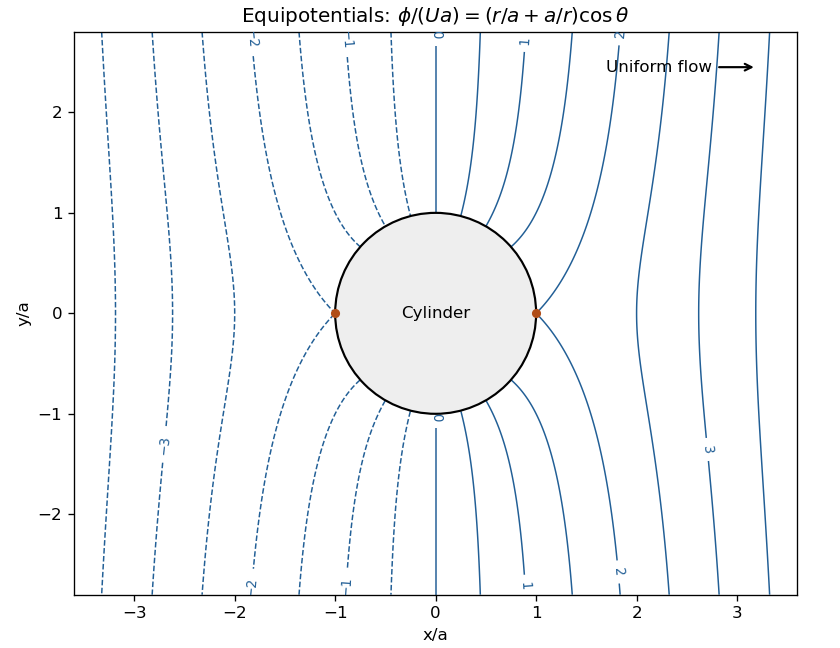
The far-field derivative fixes the growing cosine coefficient to and removes all other growing modes. The possible logarithmic term has derivative at the wall, so the zero wall derivative removes it. For each decaying Fourier mode, the wall condition relates its coefficient to its growing partner: the cosine partner has coefficient , and every other partner vanishes. Thus the potential flow around a circular cylinder hasIndeed, , which is zero at and tends to at infinity. The additive constant does not change the velocity. The equipotential curves satisfy . They approach vertical straight lines far away and meet the cylinder radially wherever the tangential velocity is nonzero. The two stagnation points are at .

The Rao-Blackwell theorem says that, for a sufficient statistic and a finite-second-moment estimator , the conditional estimator can be chosen independently of the unknown parameter and has no greater mean squared error for estimating any specified function . Sufficiency makes the conditional distribution of the data given parameter-independent. Conditional expectation preserves the expectation, hence preserves unbiasedness. Writing , the cross term has expectation zero, because . ThereforeEquality holds exactly when almost surely. This proves the squared-loss form, including the usual unbiased-estimator variance statement.
Here is necessary for the stated uniform interval. Put and . The joint density factors asThe factorization theorem for sufficient statistics shows that is sufficient. Also , so is unbiased and has variance .
For , conditional on distinct extrema , exchangeability gives probability that is each endpoint; with probability it is one of the remaining observations, uniform on . Its conditional mean is consequentlyThus the Rao-Blackwell estimator for a uniform scale interval iswhich is unbiased and has no greater mean squared error. For , and the same formula reduces to the original estimator. As a quantitative check, the covariance of two uniform order statistics givesFor instance, after writing , both extreme uniform variances are and their covariance is . These formulas follow by integrating the joint extreme density on ; they also display strict improvement for .
For a closed piecewise smooth contour in a domain, null-homologous there and avoiding the poles of a meromorphic function , the residue theorem iswhere is the winding number and the sum runs over enclosed poles with their indices. Suppose now is meromorphic and has neither zeros nor poles on . At a zero or pole , write with holomorphic and nonzero, where for a zero and for a pole. Thenso its residue is . Substituting into the residue theorem and changing variables along the image contour gives the argument principle:For a positively oriented simple boundary, this is the number of zeros minus poles inside, counted with multiplicity. The winding-number form also applies to self-intersecting image paths.
Write . The trigonometric sum formulas giveThus the imaginary part is zero either when , , or when , . These two lists are disjoint. At the latter four points . At the former six points the real values, in increasing angular order, areEquivalently, maps to , to , to , to , and the four roots of map to zero. These are all the unit-circle points with real image.
The image contour has polar representation . It is invariant under complex conjugation and under reflection through the origin. As runs from zero to , the successive real-axis visits areat angles . To specify the crossing direction, differentiate:Its imaginary component is at the point , at , at either visit to , and at either visit to . At a visit to zero it is , nonzero for each of the four angles. Therefore all these visits are transverse crossings of the real axis, even though different arcs share the same image point.
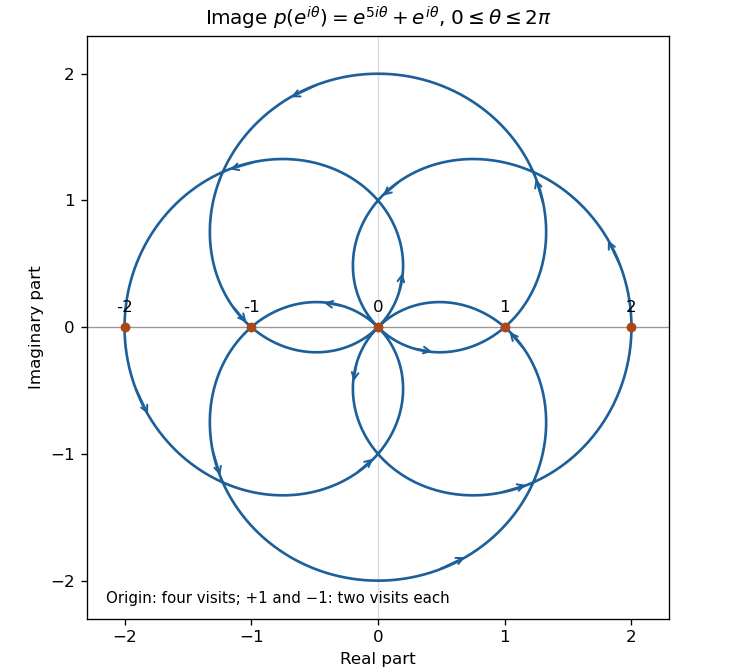
Oriented image of the unit circle under z to the fifth power plus z, showing its real-axis crossings
. Details. 
Let count roots in the open unit disk. A boundary crossing can occur only at the real values found above, so the count is constant between them. Also , because the polynomial is odd. At , has one root inside and four on the circle, giving .
For small positive , the root near zero stays inside. At each boundary root , , so implicit differentiation gives . The radial crossing test for polynomial root counts isThe two roots with positive real part enter and the other two leave. Hence for .
At , the boundary roots are . Since , their radial derivative is . Both leave as increases, so the count becomes one; at itself they are excluded, also leaving one interior root. At , the remaining boundary root has radial derivative and leaves. For no interior root is possible, since in the open disk. Combining these facts and odd symmetry givesThis also gives the corresponding winding numbers of the image contour away from its crossings. Boundary roots are excluded at the crossing values; using a nearby winding number at would incorrectly count two extra roots.
Introduce nonnegative slack variables , a nonnegative surplus variable , and an artificial variable . Phase I of the two-phase simplex method minimizes . The initial simplex dictionary isWith the nonbasic variables zero this is feasible for the artificial problem. Enter ; the minimum ratios are , so leaves. Solving its row for and substituting givesNow enter . The ratios from decreasing basic variables are and , so leaves. The resulting dictionary isSetting the nonbasic variables zero gives , so Phase I has reached its minimum and found feasibility. Remove and reinstate the true objective . Substitution of the basic variables givesEnter . The decreasing rows give ratios for and for , so leaves. Phase II then hasEvery nonbasic variable is nonnegative and every reduced cost is positive. Thus the simplex optimality criterion provesAll three original constraints are active. Positivity of all three reduced costs also proves uniqueness: equality in the objective lower bound forces , which fixes the displayed solution.
The zero-composition subspaces of a linear map are subspaces because the defining equations are homogeneous linear equations in : they hold for the zero map and are preserved by addition and scalar multiplication. A map with vanishes on , so it factors uniquely through the quotient vector space . Conversely every map from that quotient to gives such a . ThereforeThe condition says exactly that the image of lies in . ConsequentlyBoth dimension formulas use the fact that the space of maps between spaces of dimensions has dimension : matrix units in any chosen bases supply a basis.
The dual map is defined by . Suppose . Then for every and every . The dual space separates vectors: a nonzero vector can be included in a basis and a coordinate functional takes value one on it. Thus for every , and . This proves injectivity of .
Its source and target have the same finite dimension:An injective linear map between equal finite dimensions is surjective by the rank-nullity theorem. Therefore is an isomorphism. The inverse is also described by taking the dual again and identifying each space canonically with its double dual.
Here acts on , so it is the same dualization construction with the source and target interchanged: . This is the natural family interpretation of the symbol used in part (b).
If , composition reversal gives , so . Conversely, if , the isomorphism in part (b) writes uniquely. Then implies ; injectivity of dualization gives . ThusSimilarly, is equivalent to , givingEquivalently, the reverse implications follow by taking double duals and using the canonical double-dual identification. The equalities are of subspaces under an isomorphism, not only inclusions.
Let , , and . The isomorphism of part (c) preserves dimensions, so the formulas of part (a), applied also to , giveIf , cancellation proves . If , both maps are zero and the equality remains true. This argument derives dual-rank equality from the requested subspace correspondence without assuming it beforehand.
Irrotational flow means ; incompressible flow means . The given streamfunction automatically satisfies the second condition, since . For an oriented path with unit tangent , choose its right-hand unit normal . ThenThe opposite normal reverses the sign; the source's unspecified normal orientation must be chosen consistently. The volume flux between two streamlines is thus their streamfunction difference. A closed contour has zero net flux, expressing mass conservation for constant-density flow without a source inside.
For the channel, a rigid boundary has zero normal velocity and hence constant streamfunction. Choose zero on the lower wall. Uniform inflow at infinity must have horizontal velocity , so there . The upper wall then has constant . The unbroken left wall connects to it and also has constant . The jump by between the walls at the corner represents the withdrawn flux. Finally the vorticity is , so irrotationality gives .
Write . Then vanishes at and at infinity, while for . Separation of variables gives the harmonic sine mode in a half-strip . The Fourier sine series coefficients of the left boundary areTherefore the corner sink in a semi-infinite channel isFor the series and its differentiated series converge on compact subsets, making the sum harmonic. At , for , so the left-wall value is exactly . The other wall values and far-field limit follow directly.
The plus sign printed in the final series is inconsistent with the printed boundary conditions. It would give on the left wall, not . The negative sign above is required. As a local flux check, near the corner the wall values give ; the radial velocity is and its outward flux across a quarter-circle is , precisely withdrawal.
The sector contains exactly one simple pole, at . All roots of are simple, and its residue issince . For the positively oriented boundary, the residue theorem givesThe vertex at zero is harmless: is analytic there for nonnegative integer , or a small indent may be removed because its integral is .
On the circular arc, , the reverse triangle inequality gives . The arc length is , so the ML inequality givesThe strict assumption is exactly what makes the exponent negative; it also ensures convergence of the positive-real-axis integral at infinity.
Let , which lies strictly between zero and . On the lower ray , the integral is . On the upper ray , the positive boundary orientation runs from down to zero. Since , that contribution is . The circular contribution vanishes by part (b); henceUse to obtainThe result is positive as expected. Convergence near zero follows from , so both endpoint limits used in the contour argument are justified.
In the pion rest frame, conservation of momentum makes the muon and massless neutrino momenta equal and opposite, of magnitude . The neutrino energy is , while the muon satisfies . Energy conservation gives . Squaring after substituting yieldsThe relativistic two-body decay speed is thusChoose moving with velocity along relative to , so the pion has velocity in and speed . With , the four-dimensional Lorentz transformation isThe muon's four-momentum is before the boost. The same matrix givesVelocity and momentum have the same spatial direction. The unsigned deflection angle from the positive axis therefore satisfiesChoosing the opposite boost makes the pion move along positive and reverses , leaving this speed-based angle formula unchanged.
Articles by others on the same topic
There are currently no matching articles.