In the semisimple Lie algebra convention, an abstract root system is a finite subset of a finite-dimensional real Euclidean space with the following properties: it spans , does not contain zero, is reduced, is invariant under each of its root reflections, and satisfies crystallographic integrality. More explicitly, for every ,Here is a positive-definite inner product. The first condition is reducedness, the second gives closure under root reflections, and the last number is a Cartan integer. The rank is . A simple root basis is a basis of consisting of roots such that each root has integral coordinates that are either all nonnegative or all nonpositive. The two signs distinguish positive and negative roots. The diagrams in this problem concern these reduced crystallographic root systems; broader definitions sometimes omit one of these conditions.
The drawn simple roots have , and . Their Cartan integers are therefore and , identifying a B2 root system. The corresponding root reflections act on coordinates byIn particular and , so both new positive roots are forced. Reflection in any root also forces its negative. ThusThese eight roots are drawn below, with the given simple pair highlighted.
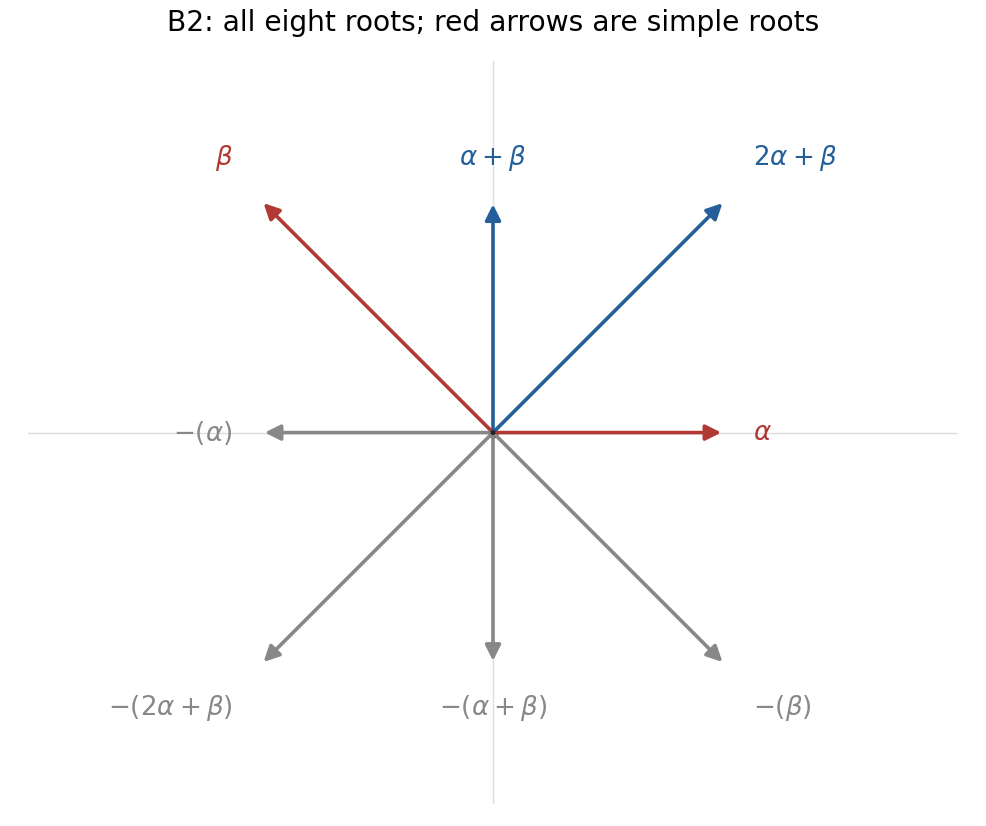

For completeness, no further roots can occur. In a finite reduced root system, every root is a Weyl group translate of a simple root: reflect a nonsimple positive root in a simple root with positive inner product to decrease its height, and iterate. This standard simple-root descent may also be quoted here. The eight-vector set just listed is stable under both generating reflections, and the orbits of the two simple roots already fill it. Hence no simple-root orbit, and therefore no root, lies outside that set. This establishes both the necessity of every drawn root and exhaustion of the root system.
The double-bond arrow points to the middle node in the PDF. Since and , the short root must occupy that middle node and the long root the left node. The right node , joined to by a single bond, is another short root. Thus the diagram is C3 root system type, labelled as follows.
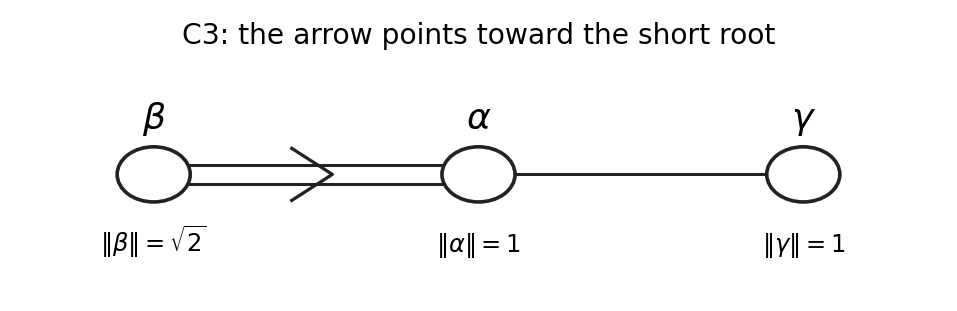
Labelling the C3 Dynkin diagram with the given short and long roots
. Details. 
The bonds require , and . Writing gives , , and . One choice is thereforeThe opposite choice of the last coordinate reflects the entire realization across the first two coordinate axes' plane and is equally valid.
To enumerate exhaustively, set , and . These are orthonormal, andThe complete C3 root system is , with eighteen roots. Its nine roots with nonnegative coefficients in this simple basis are exactlyThere are six short and three long positive roots, and the other nine roots are their negatives.
The single-bond rank-two diagram is A2 root system type. Three suitable positive simple pairs for its root subsystems areEach pair has squared lengths one and inner product , so its angle is degrees. Its plane meets the full root set in , with respectively , and . These exhaust the roots of the plane, and their coordinates in the pair have one sign. Thus each pair is genuinely a simple basis of an subsystem.
The double-bond diagram is rank-two B2 root system type, equivalently . Three suitable pairs, written short root first, areFor each pair , , and . The remaining positive roots in its plane areTogether with their negatives these are precisely the eight plane roots, and all four positive roots have nonnegative integral pair-coordinates. Hence the displayed pairs are simple bases of the required subsystems. The rank-two subsystems of a C3 root system description explains these as the three coordinate-plane subsystems in the orthonormal realization; the chosen pairs lie in three different diagonal planes.
Articles by others on the same topic
There are currently no matching articles.