Use , and in the sl2 Lie algebra, so , , and . On the symmetric power, a monomial has weight . The tensor product of Lie algebra representations adds weights, because acts as .
Put and for . These eight vectors are a basis of ; their weights are and . Thus the weight-space decomposition and a weight basis for each summand areIn particular , with dimensions summing to eight. Here the subscripts are the eigenvalues of the chosen Cartan element .
Write for the irreducible representation of with highest weight , dimension and weights . The weight diagram below records multiplicities at weights .
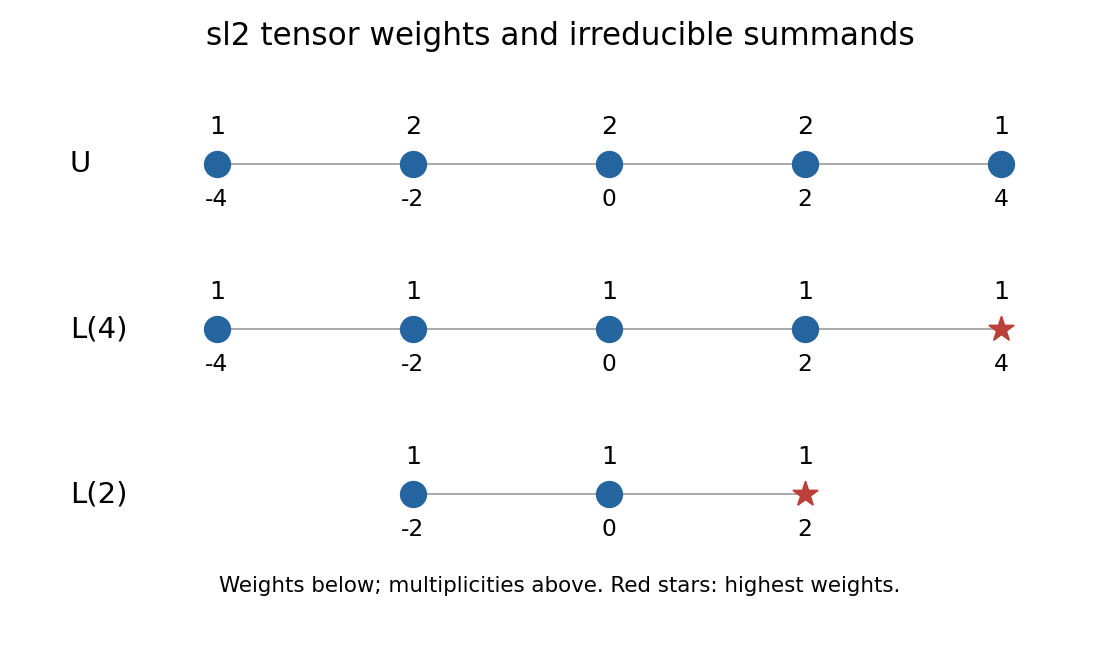
The unique top weight four forces one copy of , by complete reducibility of semisimple Lie algebra representations. Removing its five weights, each with multiplicity one, leaves weights with multiplicity one, exactly the character of . HenceThe two lower rows draw their separate weight diagrams. The explicit invariant copies constructed next establish the Clebsch-Gordan splitting of a defining module and its cubic symmetric power within itself.
In the notation of part (i), the tensor raising operator and lowering operator act bywith terms beyond the stated index range omitted. Both and are killed by , and have respective weights four and two. They are the desired highest-weight vectors.
For , successive lowering givesThus a basis of the five-dimensional summand, in descending weight order, isFor , the successive vectors are , and . HenceThese spans are invariant under . The sl2 highest-weight lowering formula gives , so all interior raising coefficients in either chain are nonzero. Any nonzero submodule therefore contains the highest vector and then the whole chain; each span is irreducible.
At the shared weights , the two displayed summand vectors are independent: their coefficient determinants in the original weight bases are . At weights only the five-dimensional summand occurs. Consequently the eight displayed vectors form a basis of , proving that these are complementary submodules, not only modules with the right dimensions.
Let , and let be the weight of a representation defined by . Since the trace is zero, . The dual representation gives weight to . PutTaking gives an eighteen-vector tensor product basis. Its weight is .
For explicit coordinates use the usual simple coroots and , and write each weight as . Then , and . Collecting equal weights gives every weight space:The first six weights are with ; the next three are ; the last three are the defining weights . Thus there are nine multiplicity-one weights and three multiplicity-three weights, giving total dimension .
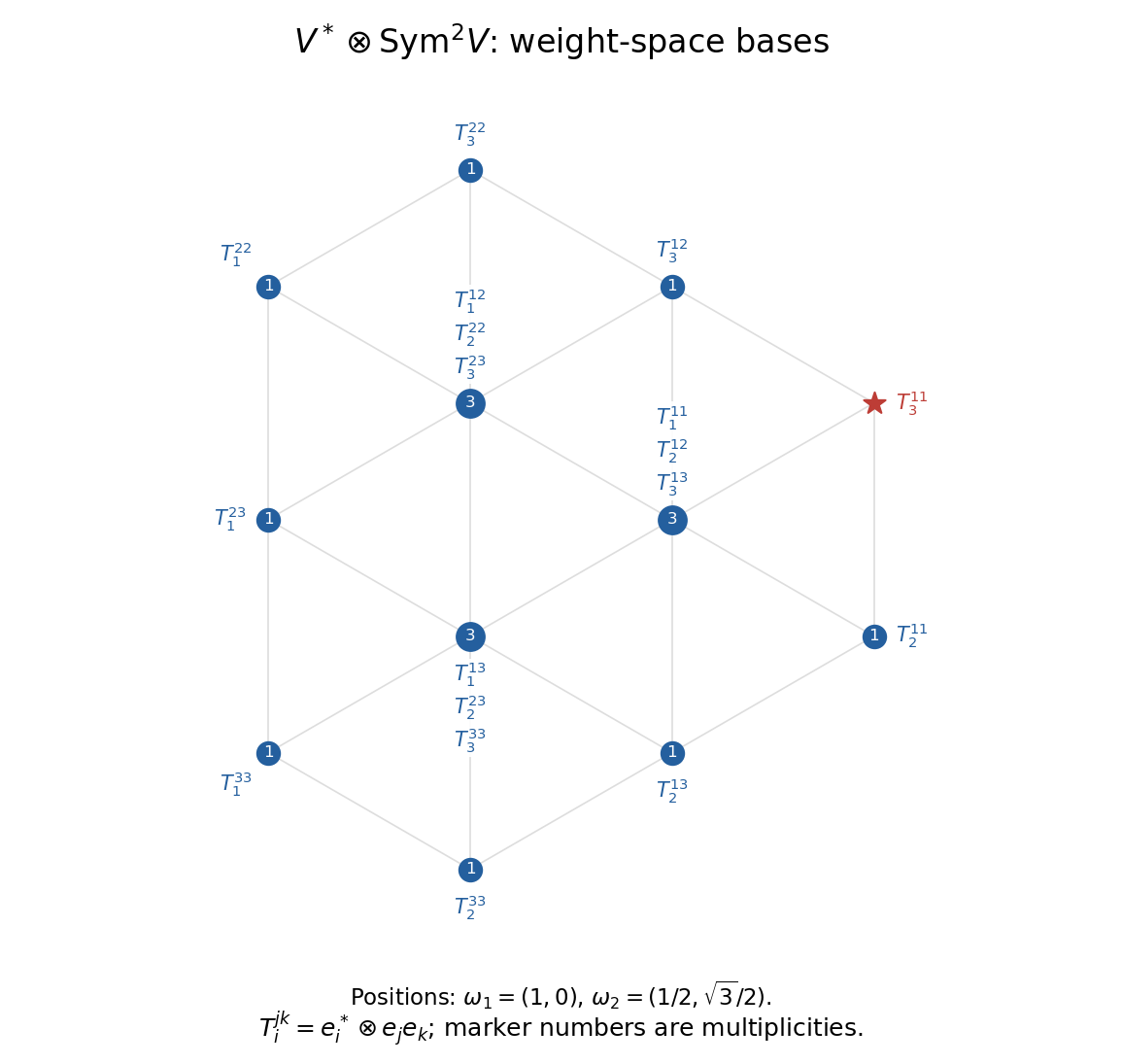
The planar coordinates are with and , so the weight diagram uses an equilateral root geometry rather than orthogonal Dynkin-coordinate axes. Every point is labelled with its complete weight-space basis.
Define an equivariant contraction byThis uses the natural dual pairing, so it commutes with the Lie algebra representation. Also define . The identity tensor is invariant, making equivariant. Direct contraction gives . Thus is injective and is surjective, andis a direct decomposition into and . In particular and is a defining irreducible module of highest weight .
For the usual upper-triangular choice of positive roots, lies in the kernel and is killed by both simple raising operators . Its highest weight is , with Dynkin labels . The highest-weight classification and complete reducibility give an irreducible copy generated by this vector. The Weyl dimension formula for isso . It fills the entire kernel. Therefore the sl3 decomposition of the symmetric-square dual tensor product, with its tensor factors exchanged, isThe weight diagrams below record both summands. Their labels use for and ; these are the weight bases detailed in part (iii).
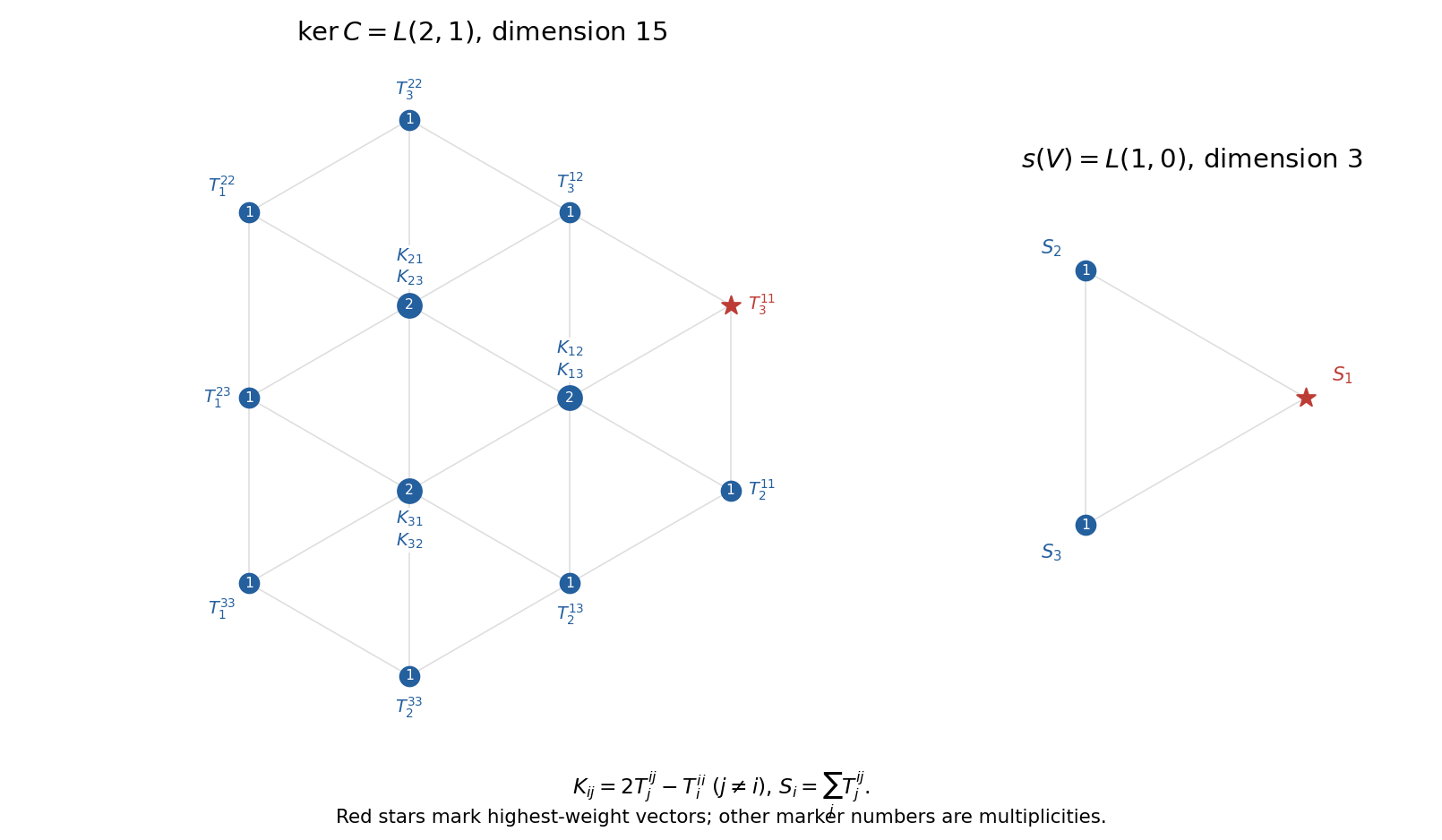
The nine one-dimensional weight spaces from part (i) all lie in , because the dual index differs from every polynomial index. Their bases remain at weight for , and at weight for three distinct indices .
At weight , the full space has basis , where are the two other indices. Their contractions are . Thus the contraction kernel has the independent basis and . Explicitly the weight basis of the trace-free symmetric-square dual tensor module is completed byTogether with the nine single vectors, these give fifteen independent vectors. They are precisely the and labels on the fifteen-dimensional weight diagram.
The defining summand has only the following three weight spaces:Each is nonzero, has its indicated weight and satisfies . These are the labels on the three-dimensional diagram. The highest-weight vectors in the two summands areAt each repeated weight, the two kernel vectors together with span the original three-dimensional weight space, since the kernel has dimension two and . Thus the displayed diagrams specify all submodule weight-space bases.
Here the Cartan subalgebra of a finite-dimensional complex semisimple Lie algebra is a maximal toral subalgebra: it is abelian, its adjoint operators are simultaneously diagonalizable, and its centralizer is itself. These standard properties give the root-space decompositionThe roots of a root system are the nonzero linear functionals in for which ; is their finite set. Each root space is one-dimensional. The zero weight space is the centralizer of , hence exactly . Thus the displayed sum is a direct sum of simultaneous eigenspaces of the Adjoint representation. It is the Cartan root-space decomposition meant here.
The bracket respects weight addition: , where and a missing weight means the zero space. This follows by applying the Jacobi identity with to the bracket of two root vectors. It explains how the vector-space decomposition encodes the Lie algebra structure.
The Killing form is the bilinear formThe Adjoint representation is linear, giving bilinearity, and the cyclic property of trace gives symmetry. To prove invariance, abbreviate the adjoint matrices of by . The Jacobi identity gives , and cyclic trace then givesThus , equivalently . This is infinitesimal invariance of the Killing form, with no choice of basis affecting the trace.
First show that the Cartan subalgebra is orthogonal, for the Killing form, to every nonzero root space. For and , choose with . Invariance and the abelian nature of giveHence .
Now let be in the radical of the restriction to , so for every . The preceding argument also gives for every root. By the root-space decomposition, is orthogonal to all of . The assumed nondegeneracy on forces . Therefore the Killing form restricted to the Cartan subalgebra is nondegenerate.
Take the basis of , where , and is a matrix unit. For , and . Thus the Adjoint representation matrix isSquaring and taking the trace computes the Killing form directly:The independent identity for the special linear Lie algebra also gives .
For the embedded Lie group, the tangent space consists of velocities of smooth curves in satisfying . The ambient coordinates identify these velocities with vectors in , but the tangent space itself is intrinsic. Let . Since this conjugation map fixes , its derivative defines the Adjoint representation of a Lie group:The inverse is , and gives . Thus this is a smooth group homomorphism into the linear automorphisms of .
Differentiate that representation at the identity. The tangent space of at its identity is , so is a linear map from into those endomorphisms. The Lie bracket isEquivalently, if and , this is the mixed derivative at of in ambient coordinates. For a matrix Lie group, conjugation is ordinary matrix conjugation and this formula reduces to .
The checks required are that the derivative is independent of the representing curves, that it is bilinear and alternating, and that it satisfies the Jacobi identity. One must also check that each preserves this bracket. Equivalently identify with its left-invariant vector field ; the bracket above agrees with the Lie bracket of vector fields at . These checks make a Lie algebra and upgrade the adjoint maps to its Lie algebra automorphisms.
The tangent matrices areUse the derivative of conjugation from part (i), rather than assuming antisymmetry. Since , direct multiplication givesDifferentiating at zero yieldsFor the reverse order put , . The other conjugation isIts derivative at zero isBoth computations use actual curves in the special linear group; the opposite off-diagonal signs in ensure its determinant is one.
Use the finite-dimensional complex-module setting of the course. We prove the Weyl complete reducibility theorem by Haar averaging produces invariant complements, defining its constructions rather than invoking complete reducibility itself.
Choose a compact real form : it is a real Lie subalgebra with , and its simply connected Lie group is compact. Existence of this form and compact group is a standard fact for complex semisimple Lie algebras. Restrict the representation to ; integration of a Lie-algebra representation gives a group representation . Since is connected and generated by exponentials, the -invariant subspace is also -invariant.
Choose any positive-definite Hermitian inner product on . With the Haar measure of normalized to mass one, defineThis is a Hermitian inner product, and it is positive-definite: for every is nonzero, so the continuous positive integrand has positive integral. Right invariance of Haar measure gives for .
Let for this averaged inner product. Finite-dimensional inner-product linear algebra gives . If and , thenbecause . Thus is -invariant. Differentiating makes it -invariant, and since it is a complex vector subspace, also preserves it. ThereforeThe zero or whole-space submodule cases are included. This proves the required complement theorem without circularly assuming it.
The finite-dimensional hypothesis is essential to the statement. The nonsplit zero-weight Verma extension for sl2 is a counterexample for unrestricted modules: has basis with , and . Its submodule spanned by for has trivial one-dimensional quotient. A complement would be trivial and contained in the zero-weight line , yet . Hence no such complement exists in that infinite-dimensional case. The paper's finite-dimensional representation setting supplies the necessary hypothesis.
For a finite-dimensional Lie algebra representation , a weight of a representation relative to is a linear functional for which the simultaneous eigenspaceis nonzero. Its elements are weight vectors, and is the weight multiplicity. The set of weights is . For a complex semisimple Lie algebra, the Cartan action on a finite-dimensional module is simultaneously diagonalizable, giving . The set of weights and their multiplicities are distinct information: several basis vectors can occupy the same point of a weight diagram.
Let be the real span of the roots in . The weight lattice iswhere is the coroot in the root's sl2 subalgebra associated with a root, normalized by . It suffices to test the simple coroots. Equivalently, if defines the fundamental weights, then .
To prove integrality of representation weights on coroots, restrict a finite-dimensional module to the root's sl2 Lie algebra. By the classification of finite-dimensional sl2 representations, the eigenvalues of its Cartan element are integers. Thus every has . The simple coroots form a basis of the real Cartan space, so these integral values also put in . Therefore for every finite-dimensional representation in this setting. The weight lattice need not coincide with the smaller root lattice.
Choose a real linear functional nonzero on every root. Its positive system is . The other roots form . Thus exactly one of is positive, and a sum of positive roots that is a root is again positive because is additive.
The simple roots are the positive roots not expressible as a sum of two positive roots. They form a fundamental system of a root system; every positive root is a nonnegative integral combination of them. Positivity is a choice of ordering, rather than a property of a root independent of that choice.
For the chosen simple roots , the open fundamental chamber of a root system isEquivalently for every simple coroot. Since all positive roots are nonnegative combinations of simple roots, requiring the inequality for all positive roots gives the same chamber. It is a connected component of the complement of the root reflection hyperplanes; the Weyl group permutes those chambers simply transitively.
The Closed dominant Weyl chamber is obtained by replacing the inequalities by . It is the cone generated by the fundamental weights. When the fundamental Weyl chamber is taken to include its walls, this closed convention is intended; both conventions determine the same positive system and boundary rays.
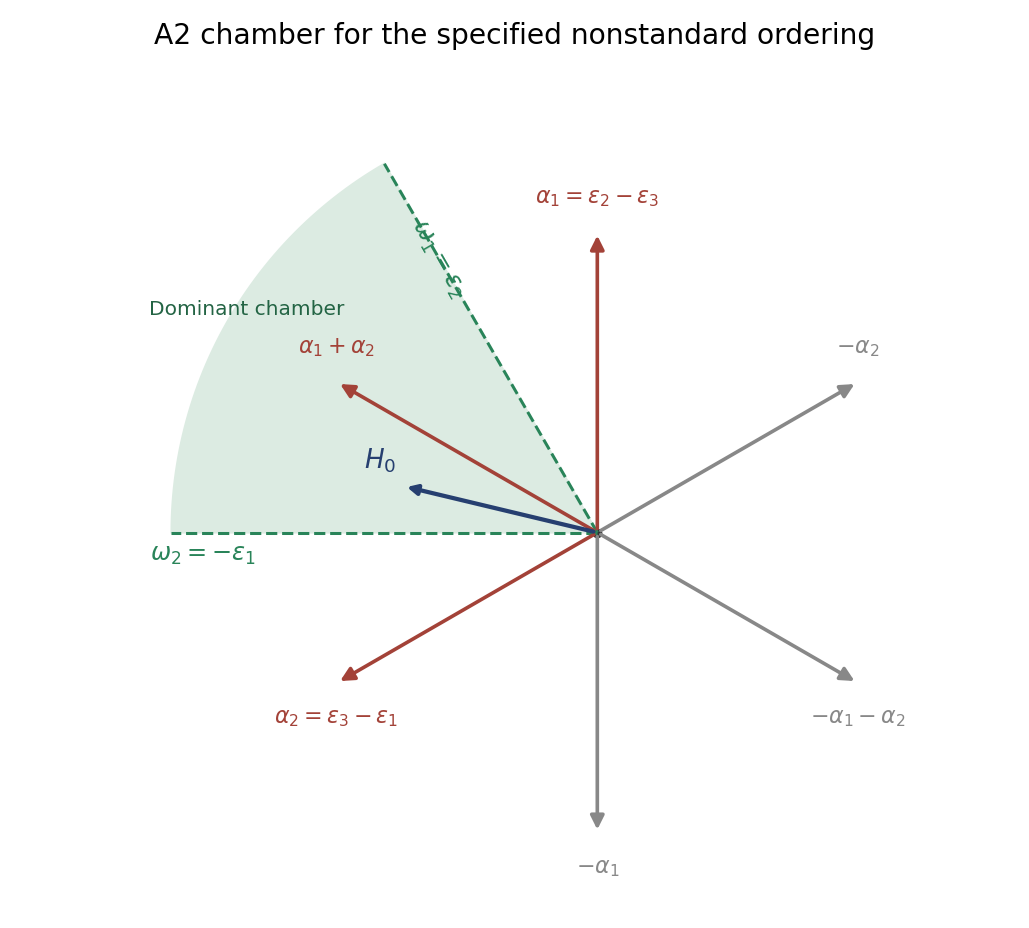
For the usual diagonal Cartan subalgebra, write . The roots are for . The three diagonal entries of the specified have orderingTherefore the positive roots selected by areTheir positive evaluations are respectively , and . For this nonstandard ordering the simple roots are and ; the third positive root is their sum. These simple roots differ from the usual choice used in Question 1.
Identify the real weight plane with triples of sum zero. Pairing with these simple coroots gives the differences and . Consequently the fundamental chamber of a root system isIts closure replaces the inequalities by weak inequalities. The fundamental weights for this ordering are and , represented by and . Their simple-coroot pairings are and , so the two boundary rays areThe sketch uses , and in a Euclidean plane. The shaded sector is the sixty-degree closed chamber; its interior is the open chamber. The ordering vector , identified with its dual direction, lies inside it.
In the semisimple Lie algebra convention, an abstract root system is a finite subset of a finite-dimensional real Euclidean space with the following properties: it spans , does not contain zero, is reduced, is invariant under each of its root reflections, and satisfies crystallographic integrality. More explicitly, for every ,Here is a positive-definite inner product. The first condition is reducedness, the second gives closure under root reflections, and the last number is a Cartan integer. The rank is . A simple root basis is a basis of consisting of roots such that each root has integral coordinates that are either all nonnegative or all nonpositive. The two signs distinguish positive and negative roots. The diagrams in this problem concern these reduced crystallographic root systems; broader definitions sometimes omit one of these conditions.
The drawn simple roots have , and . Their Cartan integers are therefore and , identifying a B2 root system. The corresponding root reflections act on coordinates byIn particular and , so both new positive roots are forced. Reflection in any root also forces its negative. ThusThese eight roots are drawn below, with the given simple pair highlighted.
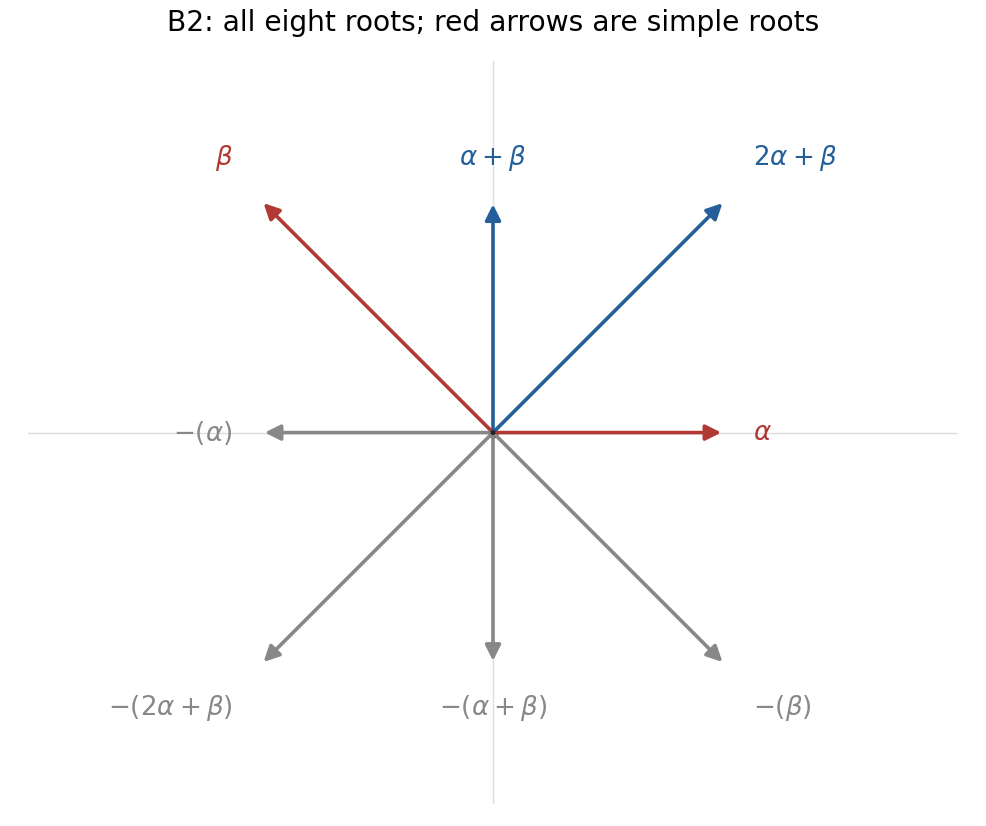


For completeness, no further roots can occur. In a finite reduced root system, every root is a Weyl group translate of a simple root: reflect a nonsimple positive root in a simple root with positive inner product to decrease its height, and iterate. This standard simple-root descent may also be quoted here. The eight-vector set just listed is stable under both generating reflections, and the orbits of the two simple roots already fill it. Hence no simple-root orbit, and therefore no root, lies outside that set. This establishes both the necessity of every drawn root and exhaustion of the root system.
The double-bond arrow points to the middle node in the PDF. Since and , the short root must occupy that middle node and the long root the left node. The right node , joined to by a single bond, is another short root. Thus the diagram is C3 root system type, labelled as follows.
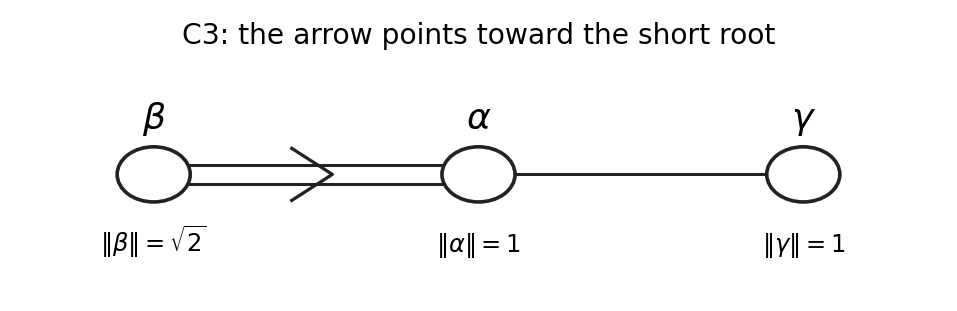
Labelling the C3 Dynkin diagram with the given short and long roots
. Details. 
The bonds require , and . Writing gives , , and . One choice is thereforeThe opposite choice of the last coordinate reflects the entire realization across the first two coordinate axes' plane and is equally valid.
To enumerate exhaustively, set , and . These are orthonormal, andThe complete C3 root system is , with eighteen roots. Its nine roots with nonnegative coefficients in this simple basis are exactlyThere are six short and three long positive roots, and the other nine roots are their negatives.
The single-bond rank-two diagram is A2 root system type. Three suitable positive simple pairs for its root subsystems areEach pair has squared lengths one and inner product , so its angle is degrees. Its plane meets the full root set in , with respectively , and . These exhaust the roots of the plane, and their coordinates in the pair have one sign. Thus each pair is genuinely a simple basis of an subsystem.
The double-bond diagram is rank-two B2 root system type, equivalently . Three suitable pairs, written short root first, areFor each pair , , and . The remaining positive roots in its plane areTogether with their negatives these are precisely the eight plane roots, and all four positive roots have nonnegative integral pair-coordinates. Hence the displayed pairs are simple bases of the required subsystems. The rank-two subsystems of a C3 root system description explains these as the three coordinate-plane subsystems in the orthonormal realization; the chosen pairs lie in three different diagonal planes.
Articles by others on the same topic
There are currently no matching articles.