Treat each row as a set of attributes with response one. The binary option computes the Jaccard distance, rather than counting matches at joint absences. For a pair of rows, let count coordinates equal to one in both, count , count , and count . ThenThe denominator counts coordinates present in at least one row; joint absences do not contribute. If both rows have no presences, use distance zero. This differs from normalized Hamming distance, which would divide by all ten coordinates.
For Philip and Chad, four attributes are present in both and eight in at least one, giving Jaccard distance . Graham and Tim differ in one of eight coordinates present in their union, giving , printed as . Fred and Gbenga have identical profiles, hence distance zero despite being different students. The resulting dissimilarity matrix is symmetric with zero diagonal;
dist2full restores the other half and the diagonal from the stored pairwise entries. The display rounds entries for readability; the agglomerative hierarchical clustering uses the original unrounded distances.The output describes complete-linkage clustering: the distance between two current groups is the largest original Jaccard distance between a member of one and a member of the other. Starting with singleton groups, agglomerative hierarchical clustering merges a closest pair at each step. In the merge array, a negative index denotes the original row of that number, and a positive index denotes the group created at that earlier merge. A printed height is the dissimilarity at which the new group forms.
Reading those references recursively gives the following dendrogram construction, with exact heights recovered from the binary profiles:
- Fred and Gbenga join at ; Graham and Tim join at ; Chad and Nicolas join at .
- Frederic joins Chad–Nicolas at , and John then joins that group at the same height . These tied heights produce successive branches on the same horizontal level.
- Philip and Mark join at ; Garfield joins Fred–Gbenga at .
- Graham–Tim joins Philip–Mark at ; Chad–Nicolas–Frederic–John joins Garfield–Fred–Gbenga at .
- Sauli joins Graham–Tim–Philip–Mark at , and Juliet joins that group at .
- The two remaining groups join at .
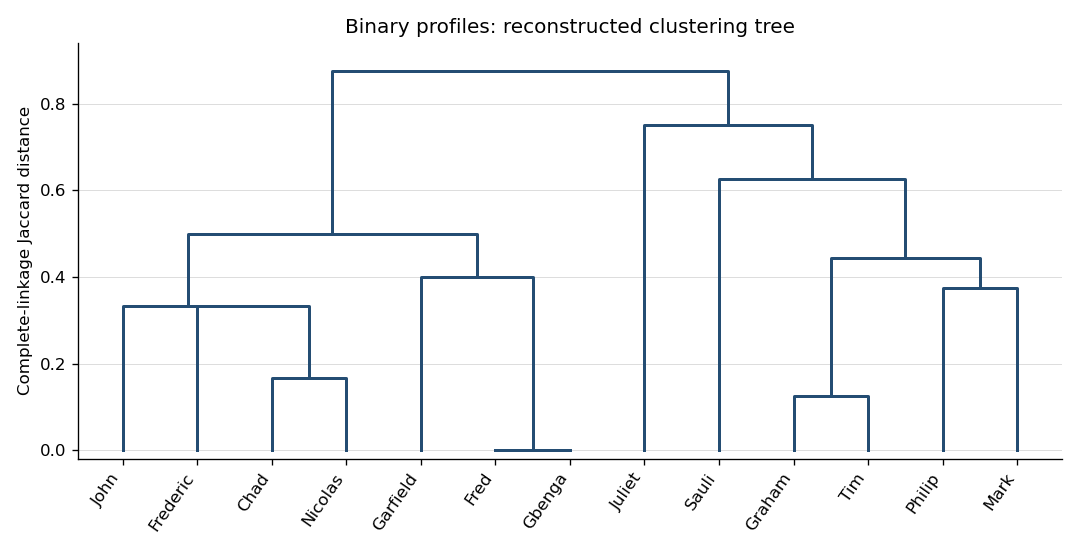
Complete-linkage dendrogram reconstructed from exact binary-profile distances
. Details. 
For example, a cut strictly between and gives four groups: Chad–Nicolas–Frederic–John–Garfield–Fred–Gbenga, Graham–Tim–Philip–Mark, Sauli, and Juliet. A cut strictly between and gives two larger groups. The leaf order is not intrinsic; the merge memberships and heights are. Reflecting branches leaves the dendrogram unchanged in meaning. The zero-height pair indicates identical recorded responses, while high joins indicate comparatively dissimilar profiles. These conclusions depend on the choice of Jaccard distance, which ignores shared negative answers; the dendrogram itself does not establish substantive demographic classes.
Articles by others on the same topic
There are currently no matching articles.