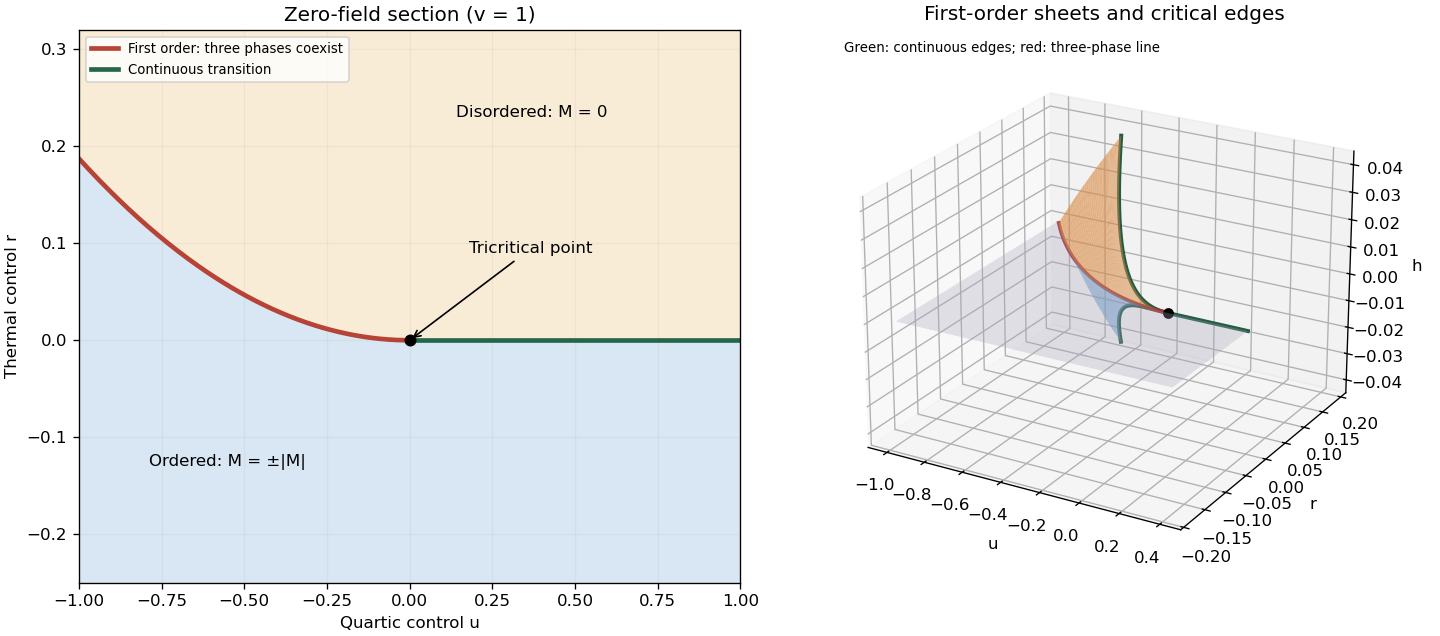
A phase diagram divides a space of control parameters into equilibrium thermodynamic phases, marking phase coexistence boundaries and thermodynamic critical points. Its dimension counts independently variable controls, not spatial dimensions. An explicit three-dimensional example uses the controls of a sextic even Landau potential:Here is a scalar order parameter, its conjugate field, and a thermal control. The equilibrium magnetization minimizes globally. At , , the boundary is a continuous phase transition. At , , the boundary is a first-order phase transition between and . The two boundaries meet at the tricritical point . A fixed strictly positive quartic coupling alone cannot produce this tricritical point; the stabilizing sextic term is essential when the quartic coefficient is tuned through zero.
The full phase diagram also contains the phase coexistence sheet between positive and negative ordered phases. Crossing it changes the sign of discontinuously. For , the three-phase line is the junction of this sheet and two tricritical wings, on which two unequal same-sign equilibrium magnetizations coexist at nonzero . The tricritical wing critical edges are lines of ordinary thermodynamic critical points; they terminate the first-order sheets and meet at the tricritical point. Away from these boundaries, varying produces a smooth crossover.
For an explicit construction of the tricritical wings, write their two coexisting order parameters as and , with and . Equality of their Landau free energies and first derivatives givesIndeed, for these controls the tricritical wing coexistence factorization isThe last factor is , proving that both specified minima are global. The reflected wing has negative and negative . Letting gives the tricritical wing critical edge , , ; there and . Letting recovers the three-phase line. This supplies the first-order sheets and their continuous boundary curves, rather than only a zero-field section.

Articles by others on the same topic
There are currently no matching articles.