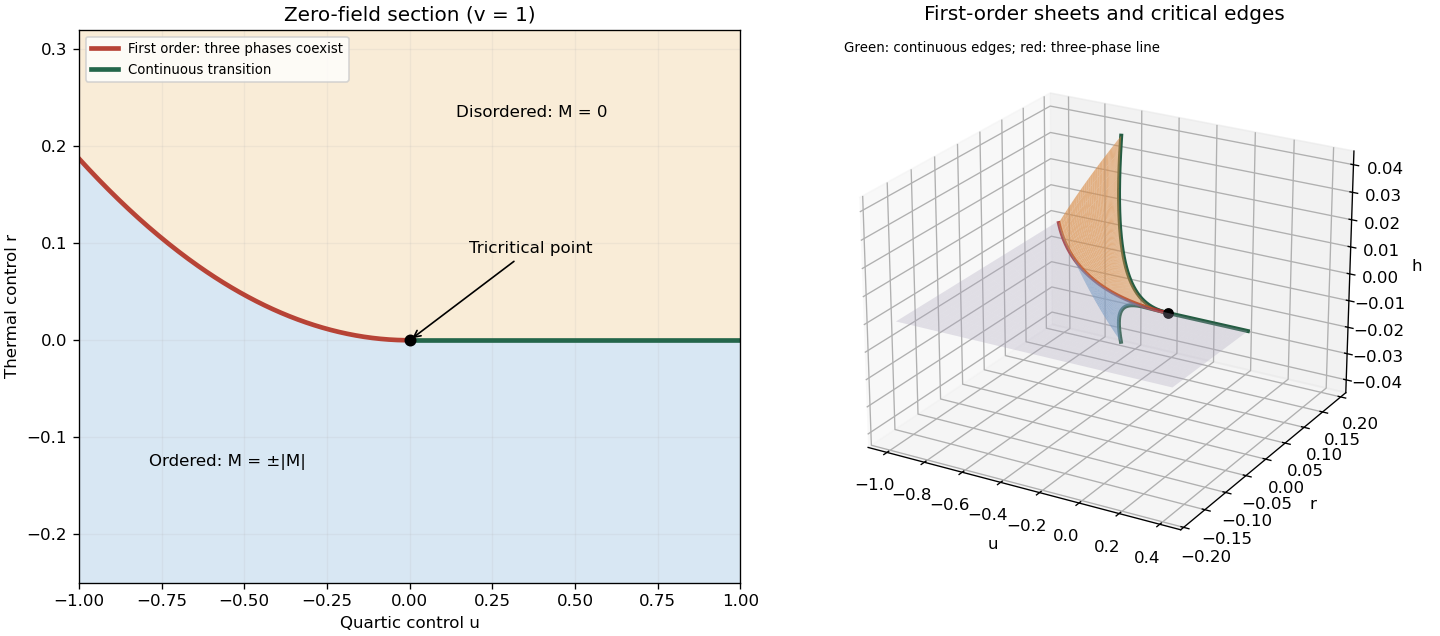
A phase diagram divides a space of control parameters into equilibrium thermodynamic phases, marking phase coexistence boundaries and thermodynamic critical points. Its dimension counts independently variable controls, not spatial dimensions. An explicit three-dimensional example uses the controls of a sextic even Landau potential:Here is a scalar order parameter, its conjugate field, and a thermal control. The equilibrium magnetization minimizes globally. At , , the boundary is a continuous phase transition. At , , the boundary is a first-order phase transition between and . The two boundaries meet at the tricritical point . A fixed strictly positive quartic coupling alone cannot produce this tricritical point; the stabilizing sextic term is essential when the quartic coefficient is tuned through zero.
The full phase diagram also contains the phase coexistence sheet between positive and negative ordered phases. Crossing it changes the sign of discontinuously. For , the three-phase line is the junction of this sheet and two tricritical wings, on which two unequal same-sign equilibrium magnetizations coexist at nonzero . The tricritical wing critical edges are lines of ordinary thermodynamic critical points; they terminate the first-order sheets and meet at the tricritical point. Away from these boundaries, varying produces a smooth crossover.
For an explicit construction of the tricritical wings, write their two coexisting order parameters as and , with and . Equality of their Landau free energies and first derivatives givesIndeed, for these controls the tricritical wing coexistence factorization isThe last factor is , proving that both specified minima are global. The reflected wing has negative and negative . Letting gives the tricritical wing critical edge , , ; there and . Letting recovers the three-phase line. This supplies the first-order sheets and their continuous boundary curves, rather than only a zero-field section.

An order parameter distinguishes equilibrium thermodynamic phases. For a scalar magnetic system, a slowly varying coarse-grained scalar field represents local magnetization, and its uniform expectation is the order parameter. Under spin inversion symmetry, and . The disordered phase has at , while a pure ordered phase has . In a finite symmetric system the average still vanishes at ; spontaneous symmetry breaking means taking the thermodynamic limit before or to select a pure thermodynamic phase.
Landau-Ginzburg theory assigns a local free-energy functionalSpin inversion symmetry forbids odd powers at zero conjugate field; locality and slow variation motivate the gradient expansion. The gradient energy penalizes interfaces and determines long-wavelength response. Integrating over fields includes fluctuations, whereas the Landau approximation replaces that integral by its stable stationary configuration. For a uniform phase this reduces to minimizing . If is the equilibrium free-energy density, then , so the order parameter is also the thermodynamic response to its conjugate field.
The uniform stationarity equation and local stability condition areFor , , and small negative , the stable nonzero solution satisfies . Thus the order parameter vanishes continuously as . The equilibrium Landau free energy has leading singular contribution below the transition and zero above it. Its first thermal derivative is continuous, while its second derivative has a finite jump: the mean-field approximation predicts a continuous phase transition with no latent heat. The magnetic susceptibility follows by differentiating the stationarity equation:It diverges on approaching the ordinary thermodynamic critical point, and the quadratic Landau scalar correlation length behaves as , with a different amplitude on the two sides.
For , a nonzero stationary point at has . Substitution into gives . Setting this to zero yieldsThe finite jump of makes this a first-order phase transition. For a thermal path with and the other coefficients fixed, jumps, giving an entropy discontinuity and nonzero latent heat. The Landau free energy itself remains continuous. The disordered minimum loses stability at ; the two nonzero stationary solutions merge at . These spinodal points bound metastability, but neither replaces the equilibrium phase coexistence condition.
Writing with near an ordinary thermodynamic critical point, the zero-field equation gives . At , small obeys , hence . The ordinary mean-field critical exponents are therefore and . These are Landau theory predictions, not dimension-independent values for an interacting theory below its upper critical dimension.
Let be the zero-field constrained order-parameter free energy. At coexistence in a conjugate field , two global minima obeyThus the same line of slope is tangent to at both endpoints: the common-tangent construction for phase coexistence. Equivalently,This is the Maxwell equal-area construction on the equation-of-state curve : the signed areas on either side of the horizontal coexistence line cancel. Equal slope alone finds stationary phases; the integral additionally enforces equal free energy.
If the mean order parameter is constrained between the endpoints, the system can separate into two macroscopic phases. With , their bulk free-energy density is . The interface contributes subextensively in the thermodynamic limit. The resulting constrained order-parameter free energy is the convex envelope of , with a straight coexistence segment. This explains why a nonconvex uniform Landau free energy must be convexified when describing stable constrained equilibrium, and why a spinodal point is not the Maxwell construction boundary.
At the tricritical point, both the quadratic and quartic even coefficients vanish, while the sextic coefficient remains positive. Two even control parameters must therefore be tuned, in addition to setting the symmetry-breaking conjugate field to zero. The continuous phase transition line and first-order phase transition line meet, the coexistence order parameter jump shrinks to zero, and the tricritical wings end there. The balance governing the equation of state changes from quartic to sextic stabilization.
Along the tricritical thermal path , , , minimizing gives on the ordered side. At , the equation of state is . ConsequentlyThese mean-field critical exponents require the tuned tricritical path; a path with fixed instead has the ordinary exponents derived above. The corresponding equilibrium Landau free energy is below the transition. Its first thermal derivative is continuous but its second derivative diverges, giving the tricritical mean-field approximation a heat-capacity exponent . Fluctuations are negligible asymptotically only above the tricritical upper critical dimension three; at three dimensions logarithmic corrections can accompany these powers.
Articles by others on the same topic
There are currently no matching articles.