The real-wavenumber dispersion relation has the explicit branchIts frequencies are real. A real-axis Fourier transform propagator multiplies every component by , of modulus one, so a square-integrable localized disturbance has constant norm. For sufficiently smooth localized data with an integrable Fourier transform, its pointwise amplitude also has a time-independent upper bound. In particular, there is no exponential growth along a fixed or moving ray.
The Briggs-Bers criterion makes the same conclusion while enforcing causality. Start the temporal inversion line at and the spatial inversion contour on the real axis. The spatial roots can be followed explicitly:Choose the principal logarithm along this upper temporal half-plane. Since , the root lies above the real axis; the root lies below it. Successive roots remain separated by . As is lowered, approaches the real axis when is real. The spatial contour is then indented beneath that root, as required by continuation from positive . No lower root meets it: their separation stays nonzero.
Algebraically,for every finite complex , so there is no finite spatial pinch point. The logarithmic singularity at sends roots to ; it is on the real-frequency boundary, not a positive-growth pinch in the upper temporal half-plane. The continuum of neutral poles is the real curve in the plane. It is reached as a causal boundary value, rather than producing an upper-half-plane singularity.
The figure follows neighboring spatial roots while lowering horizontal temporal contours. It shows why merely finding roots in both spatial half-planes does not establish an instability: those roots never collide across the inversion contour.
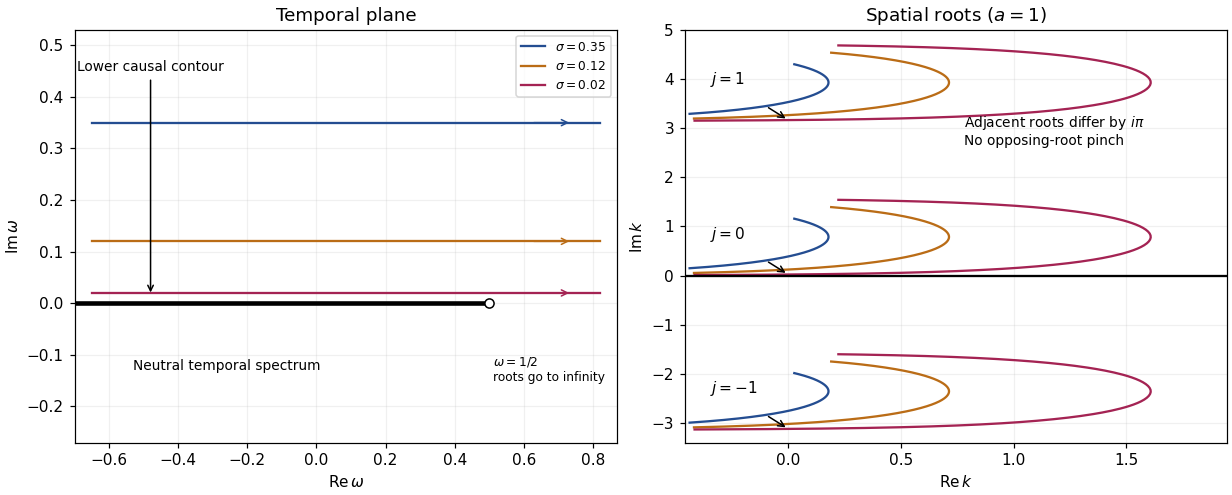
Causal temporal contours and nonpinching spatial roots of the triangular-jet dispersion relation
. Details. 
These modes have neither absolute wave-packet instability nor convective wave-packet instability; they are temporally neutral. Their positive real group velocity transports wave packets downstream. Nonreal spatial roots describe spatial continuation and evanescence, not temporal amplification. The exponential growth criteria concern the causal impulse response, not an unrestricted choice of a complex root.
Articles by others on the same topic
There are currently no matching articles.