Put the broken dam at and let . A dry bed is assumed downstream. The left-family rarefaction wave joins the undisturbed reservoir to the dry front. The other Riemann invariant is fixed at . Within the fan its characteristic speed equals , soThus the dry-bed dam break with cubic wetted area has the fieldsVelocity is not a meaningful fluid quantity in the dry region; its wet-side limiting value is . The upstream head travels at , while the front travels at the stated constant speed in this inviscid model.
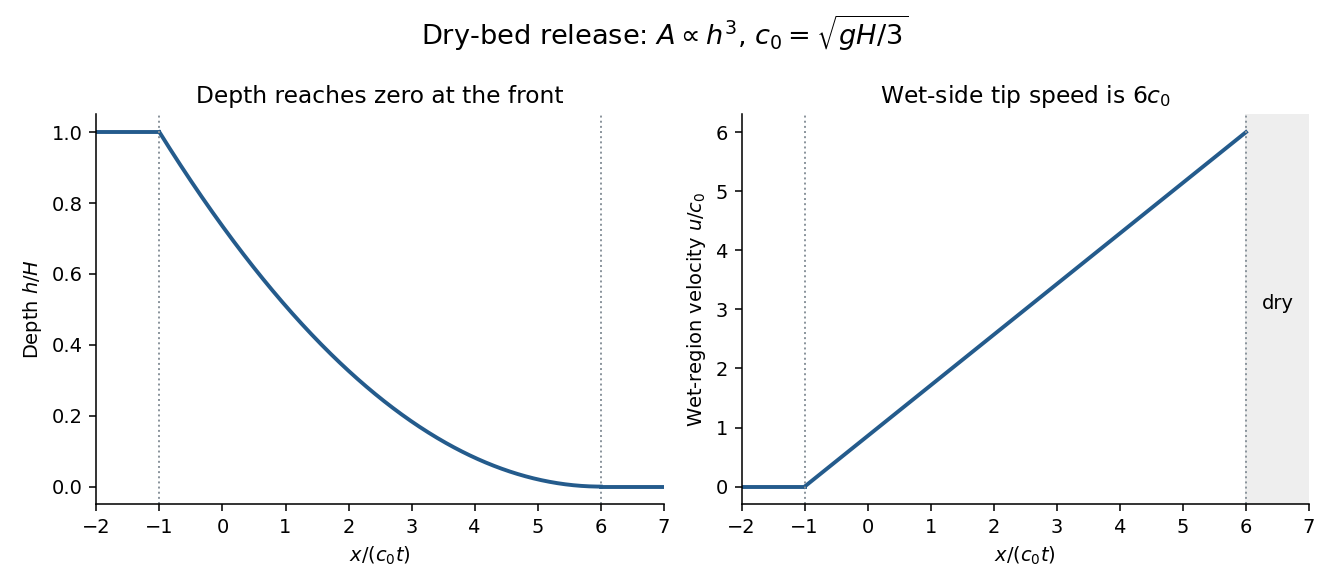

Bottom drag slows the flow and changes the dry-tip structure, where the depth is small and bed stress per unit fluid mass becomes especially important. It can replace the inviscid zero-depth high-speed tail by a drag-controlled nose. An exact altered profile or front speed requires a specified drag law; the inviscid speed should not be extrapolated to a thin real irrigation-channel front without that qualification.
Articles by others on the same topic
There are currently no matching articles.