For an integrand with no explicit dependence, the Euler-Lagrange equation is . Differentiate the proposed first integral:Thus is constant along an extremal, the Beltrami identity.
For the optical path the Fermat principle uses the travel-time integrand , in the stated speed units. Its first integral isSet . Then , and integration gives on a positive arch. The symmetric endpoint conditions require and . For and , the resulting ray in an exponential-speed medium isIt is above zero inside the endpoints. Substitution also verifies the Euler-Lagrange equation , so the first-integral construction does not accidentally select a spurious constant-height path.
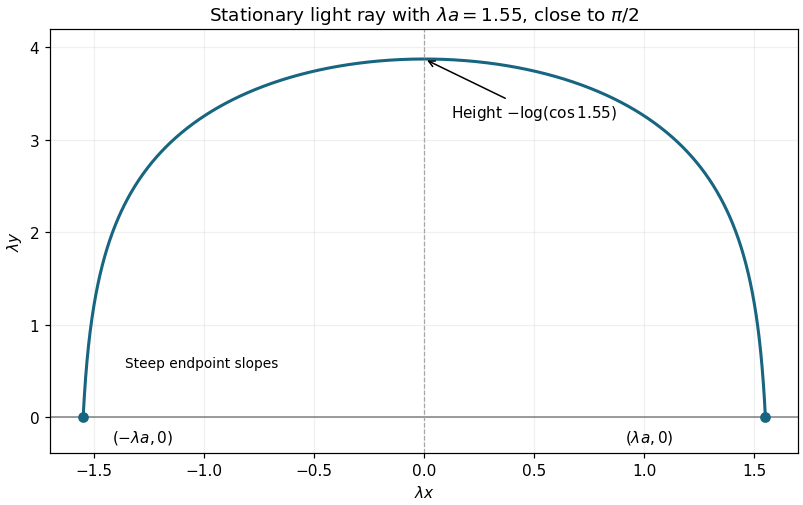

Here . For close to , the endpoint slopes are steep and the central height is large. The travel time evaluates directly toIt tends to as the arch height diverges. Positive is the increasing-speed interpretation needed for a ray arching into ; for the same algebraic expression bends below that region and is not an admissible interior path. At zero the limiting straight boundary path has travel time .
Articles by others on the same topic
There are currently no matching articles.