The dual space is , the vector space of real-valued linear maps on , with pointwise addition and scalar multiplication. Choose a basis of . Every has unique coordinates , so defines a linear functional, with .
If , evaluation on gives , proving linear independence. For any , linearity gives , hence . Thus the dual basis spans the dual space as well, proving
Write . The parity condition gives , since . For any such element,If are even the numerator is divisible by four; if they are odd it is congruent to modulo four. Therefore is a nonnegative integer. It is zero only at zero, and the Eisenstein-integer norm is multiplicative because complex conjugation respects multiplication.
If is a unit, , so . Conversely makes its inverse in . The equation permits exactly or . HenceIndeed and , so this unit group is cyclic of order six.
For the prime-ideal assertion, and the polynomial has distinct roots modulo seven. Consequently evaluation at either root defines a surjective ring map . Its kernelsare distinct maximal ideals, hence prime ideals. If belongs to both, then . Subtraction gives , so both and are divisible by seven. The converse inclusion is immediate, provingEquivalently, the two distinct factors of the reduced polynomial give the Chinese remainder theorem decomposition . This proof does not require the permitted unique-factorization assumption.
The Euler formula for a sphere, applied to the surface of a convex polyhedron, is . In a regular polyhedron let be the common number of edges incident at a vertex. Counting vertex-edge and face-edge incidences, pentagonal faces give and . Hencewhose right-hand side can be positive only if . Thus . Substitution then yields , provingThese are the counts of the dodecahedron. Here regular polyhedron is understood in the convex, ordinary-face sense used by the stated Euler formula; self-intersecting star constructions do not share these hypotheses.
Nonnegativity and symmetry of the maximum product metric follow from those of the two factor metrics. Its value is zero precisely when both coordinates agree. For three points , , , the two triangle inequalities giveAll metric axioms therefore hold.
When the two factors are the same metric space, consider an off-diagonal point and set . A product-metric ball of radius cannot contain any : such membership would imply and then , a contradiction. The complement of the diagonal is thus open, soThis proves the closed diagonal of a metric space. Equality of the factors here means equality as metric spaces, as intended; merely sharing an underlying set while allowing unrelated metrics would be a different assertion.
The contour has winding number one around the single pole at zero. By the Cauchy integral formula, or the residue of ,Rotation by carries each oriented edge to the next oriented edge and leaves unchanged. The four edge integrals are therefore equal, each .
On the right edge use , , soThe real integrand is odd and integrates to zero. Dividing by gives without needing its real antiderivative.
For an endpoint-fixed variation ,The boundary term vanishes. Thus every solution of the harmonic oscillator equation is stationary for this action functional. For , the endpoint-matching solution is the linear combinationwhich directly satisfies , and . This proves stationarity, rather than assuming the explicit path is a minimum.
On that path, , so integration by parts reduces the entire action to an endpoint term. The endpoint derivatives areTherefore the fixed-endpoint harmonic-oscillator action isThe displayed formula assumes nonresonant endpoints. If and , a solution exists only for ; then is a family and its action is zero. For the limiting stationary path is linear, with action .
Choose positive circulation anticlockwise as viewed from positive . The linked magnetic flux is , so Faraday law, including the motional contribution, givesThe conducting circuit consists of two arms of length and two transverse pieces of length . Its resistance is , where is resistance per unit length. Neglecting self-inductance as in the quasistatic circuit model, the current isOn the moving rod this positive current points along , so the Lorentz force is . Its mass is , not the mass of the entire circuit. Newton's equation consequently givesFor constant , the force opposes , as expected from Lenz's law. The prescribed time dependence of the external field can also supply energy to the rod.
Take to move along at velocity , with the origins coincident at zero time. The Lorentz transformation isDifferentiating along the particle trajectory gives the relativistic velocity-addition formulaFor a timelike particle, and . Direct algebra givesso , in particular . Strictness requires a massive, subluminal particle; for a photon with , the transformation preserves instead.
With the proton treated as fixed and electron mass , the classical energy and angular momentum areFor a circular orbit, and Coulomb's law determines its centripetal acceleration:Eliminating gives . Thus the Bohr radius and orbit radii areThe kinetic energy is half the magnitude of the attractive potential energy. HenceThis is the circular-orbit Bohr model; including proton recoil replaces by the reduced mass.
For velocity and a conservative body force , the unsteady Bernoulli equation isIt follows by integrating the inviscid Euler equations in space; a purely time-dependent potential gauge can absorb .
Use a coordinate along the thin U-tube from the left surface to the right, and let the right surface rise by while the left falls by . Incompressibility and uniform area give velocity along the whole fluid column. If its total length is , the velocity-potential difference between the surfaces is ; the column length stays constant as their displacements cancel. Both surfaces have atmospheric pressure and the same speed. Subtracting their Bernoulli balances, with , therefore yieldsIn the long-leg approximation underlying the requested formula, the base bend contributes negligible length and . ConsequentlyIf the horizontal connector or bend has nonnegligible length, it belongs in and the general frequency is ; the stated height alone would then not determine the inertia.
Let denote the zero-diagonal matrix with off-diagonal entries appearing in the iteration, and its iteration matrix. Its row sums are three, so . The other eigenvalues are and , where , namely , both of modulus . Thus the spectral radius is .
For , the infinity-norm estimate already gives a contraction, so the iterates converge from every initial vector to the unique solution of . Conversely, two iterates whose initial difference is a nonzero multiple of retain the difference . This fails to decay when , so convergence cannot be guaranteed for arbitrary starts. ThereforeAt the offending mode oscillates; at it is stationary and the coefficient matrix is singular. A specially chosen starting vector can suppress a bad mode, but that is not guaranteed convergence.
Let be player two's mixed strategy in Rock paper scissors. The respective expected payoffs from choosing rock, scissors and paper are , and . Thus player two solves the linear programming problemA linear objective on this probability simplex is maximized by a largest-payoff pure response, or by any mixture of tied maximizers. Scissors is never a maximizing response: rock exceeds it by one. Comparing the other two gives according as . ThereforeThe optimal expected payoff is below the tie and above it, with value at the tie.
Let be the monic minimal polynomial. The Cayley-Hamilton theorem says . Divide by ; its remainder also annihilates , and a nonzero remainder of smaller degree would contradict minimality. Thus divides .
Every characteristic root is an eigenvalue, with a nonzero eigenvector . Since , it must be a root of the minimal polynomial as well. This proves there are no possibilities beyondEvery such choice really occurs. For each , take one Jordan block of size at , together with scalar blocks at that eigenvalue, and form their direct sum. The characteristic polynomial has the prescribed multiplicities. The nilpotent part of a block of size has its th power zero and its st power nonzero, so this component's minimal exponent is exactly . A polynomial annihilates the direct sum precisely when it annihilates every component, establishing the displayed minimal polynomial without any extra restrictions.
Take a size-three Jordan block at one and a scalar block at three:Triangularity gives . On the first block, is zero but is not; on the last component the eigenvalue is three. Thus both factors with exactly those powers are needed, and their product annihilates . Its minimal polynomial is therefore also .
An example in dimension four isBoth are invertible, so each has rank four. Both have characteristic polynomial , and each has minimal polynomial , since its nonzero nilpotent part squares to zero. However and . If , then , which would preserve these ranks. The contradiction proves that the matrices are not similar, despite all three specified invariants agreeing.
Put the generators into the rows of the integer matrixIts determinant is . A full-rank integer lattice generated by its rows has index equal to the absolute determinant, henceFor a direct verification, form a unimodular basis because their row determinant is , and . In these integer coordinates , visibly leaving eighteen cosets.
A proper finite-index subgroup of a torsion-free group cannot be a direct summand when the complement is a subgroup of that same free abelian group. Indeed, if , every has because the quotient has order eighteen. But also , so by the trivial intersection. The ambient group is torsion-free, forcing and hence . This would give , contrary to index eighteen. Thus is not a direct summand.
The matrix with rows has determinantIts inverse has integer entries by the adjugate formula, so these rows form an integer basis of . The unimodular basis test for an integer direct summand now givesThus is a direct summand, with the displayed complement. This proves integral splitting, not just real or rational linear independence.
In the integer basis , direct substitution gives . ThereforeThe first two basis coordinates disappear in the quotient and the third is taken modulo eighteen. Equivalently the Smith normal form has diagonal entries .
Work on the unit sphere, so side lengths are central angles. Place the right-angle vertex at the north pole and choose perpendicular meridians through it. The other vertices can then be writtenTheir dot product is the cosine of the central angle between them, namely the hypotenuse length . Hence the spherical Pythagorean relation isFor the small triangle let its hypotenuse be . The same formula gives , so . Expanding each cosine about zero yieldsIn particular , and thus . Consequently , the ordinary Pythagorean theorem in the locally flat limit.
The contraction mapping theorem states: if is a nonempty complete metric space and satisfies for a fixed , then it has exactly one fixed point and the iteration from every starting point converges to it.
To prove existence, choose and let . Induction gives . The triangle inequality and geometric sum then imply, for ,The iterates are a Cauchy sequence; completeness supplies their limit . The contraction is continuous, so . If is another fixed point, forces equality of the points. The same estimate gives geometric convergence from every initial point.
For the particular map, the original PDF gives , which is a closed, complete subset of the real line. For positive , the arithmetic-geometric mean inequality gives , proving . FurthermoreThe mean value theorem therefore gives , a genuine contraction. The fixed-point equation is , and only the positive root belongs to , soThe printed square-root endpoint is essential: the TeX transcription loses it.
Let be compact and contained in . For , , hence uniformly on . The tail is therefore absolutely and uniformly convergent by the Weierstrass M-test. Its finitely many remaining summands are holomorphic on a neighborhood of .
The theorem that a locally uniform limit of holomorphic functions is holomorphic now proves that the sum is analytic on . Absolute convergence also permits a shift of the integer index:Thus the function has period one.
Fix and take a small disk about it that avoids zero and one. There is a holomorphic logarithm on this disk. The function cannot be an integer there: if it were an integer, exponentiation would give . Thus is holomorphic on the disk.
Where the prescribed principal logarithm and are both evaluated, they differ by for an integer . By the period-one identity, their compositions with coincide. This remains true on either side of the principal branch cut, and at a point on that cut one may instead choose the logarithm with argument between zero and . The local holomorphic expressions therefore agree with the stated pointwise definition and with each other. This is periodic holomorphic descent through the exponential map, provingThe principal logarithm itself is not analytic across its cut; periodicity of the outer function removes that obstruction.
Near zero the summand supplies the pole and the remaining series is holomorphic, so with holomorphic near zero. Choose the local logarithm with . Writing gives and henceTherefore is a double pole, with leading coefficient . Its residue, if desired, is .
For an integrand with no explicit dependence, the Euler-Lagrange equation is . Differentiate the proposed first integral:Thus is constant along an extremal, the Beltrami identity.
For the optical path the Fermat principle uses the travel-time integrand , in the stated speed units. Its first integral isSet . Then , and integration gives on a positive arch. The symmetric endpoint conditions require and . For and , the resulting ray in an exponential-speed medium isIt is above zero inside the endpoints. Substitution also verifies the Euler-Lagrange equation , so the first-integral construction does not accidentally select a spurious constant-height path.
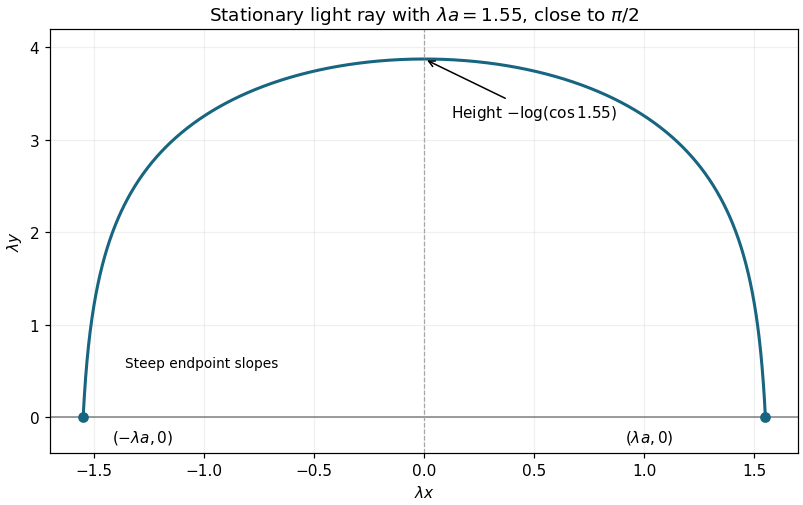

Here . For close to , the endpoint slopes are steep and the central height is large. The travel time evaluates directly toIt tends to as the arch height diverges. Positive is the increasing-speed interpretation needed for a ray arching into ; for the same algebraic expression bends below that region and is not an admissible interior path. At zero the limiting straight boundary path has travel time .
Use the Maxwell curl equationsDot the first with and the second with , then combine them. The identity givesThis proves the Poynting theorem , with the stated energy density and Poynting vector. The last term is work transferred from the electromagnetic field to matter.
For the specified vacuum wave, substitution into the same curl equations gives and . Thus , and for propagation along positive ,Putting ,The equal electric and magnetic contributions account for the factor in . Energy propagates at speed , whose square is ; the reciprocal product is not itself the speed.
The scattering interpretation assumes , so is real and . The incoming amplitudes are from the left and from the right; the outgoing amplitudes are . The conserved probability current iswhich gives on the left and on the right. Equality proves . Equal exterior wavenumbers make the flux weights equal.
Continuity of the wavefunction and its derivative at the finite potential steps yields the four relations, with and ,Set . Substituting , and subtracting the last two relations after dividing the fourth by giveswhere . HenceReflection about the barrier midpoint interchanges the left and right incidence problems and, with the chosen phase origins, exchanges and . ThereforeFor incidence from the left alone, the transmission coefficient is the transmitted-to-incident probability flux ratio, . Since , direct calculation givesFor fixed energy inside the barrier range and , , soThis is the thick-barrier quantum tunnelling limit, not a uniform approximation as energy approaches the barrier top while remains small.
Let the fluid be at rest at infinity, and write its velocity potential as , the angular dependence selected by translation along the polar axis. The separated Laplace equation iswith radial solutions and . Decay at infinity eliminates the former. The no-penetration condition on the moving sphere is , giving . Thus the potential flow around a translating sphere isFor density , integrate its kinetic energy over the exterior. The angular factor satisfies , and . HenceThe added mass of a sphere is consequently . For a heavy sphere, , falling through distance , the net gravitational work after buoyancy is . Its own kinetic energy plus that of the fluid is . Conservation of energy from rest therefore givesThis is the unbounded inviscid-fluid model; walls or viscous dissipation would alter the flow and its energy.
Let . Direct substitution shows , so the functional annihilates all quadratic polynomials. Taylor's integral-remainder formula isApplying and interchanging the finite evaluations and derivative with the continuous integral gives the Peano kernel representation , whereAll three expressions are nonnegative; the middle quadratic has positive leading coefficient and discriminant . Therefore the best possible norm bound has constant . Evaluate that integral particularly simply by using , for which :It follows thatThe same cubic attains equality, so the constant is sharp, not merely sufficient. This is the sharp Peano bound for an interior three-point first derivative.
Use the original PDF: the objective is , and the second constraint has coefficient on . The TeX transcription corrupts both, as well as the nonnegativity condition. Introduce surplus variables , slack variables , and artificial variables , all nonnegative. The two-phase simplex Phase One problem isThe initial basis has values , and its objective dictionary is . Enter : the ratio test makes leave at . The resulting dictionary includeswith . Enter next; leaves at . Nowand . Enter ; the ratio test makes leave at . This produces , , , with both artificial variables zero. Since always, the Phase One minimum is zero, proving feasibility and providing an original-variable basis.
Delete the artificial columns. The starting Phase Two dictionary isEnter , whose reduced gain is positive. Only decreases, and it leaves at step one. Eliminating gives the optimal dictionaryEquivalently, with row equations written as the displayed coefficients times the variables equal to the right-hand side, the optimal simplex tableau isThe objective row represents . Nonnegative nonbasic variables cannot improve the objective, so reading them as zero provesBoth nonbasic reduced costs are strictly unfavorable, so this optimal point is unique.
Articles by others on the same topic
There are currently no matching articles.