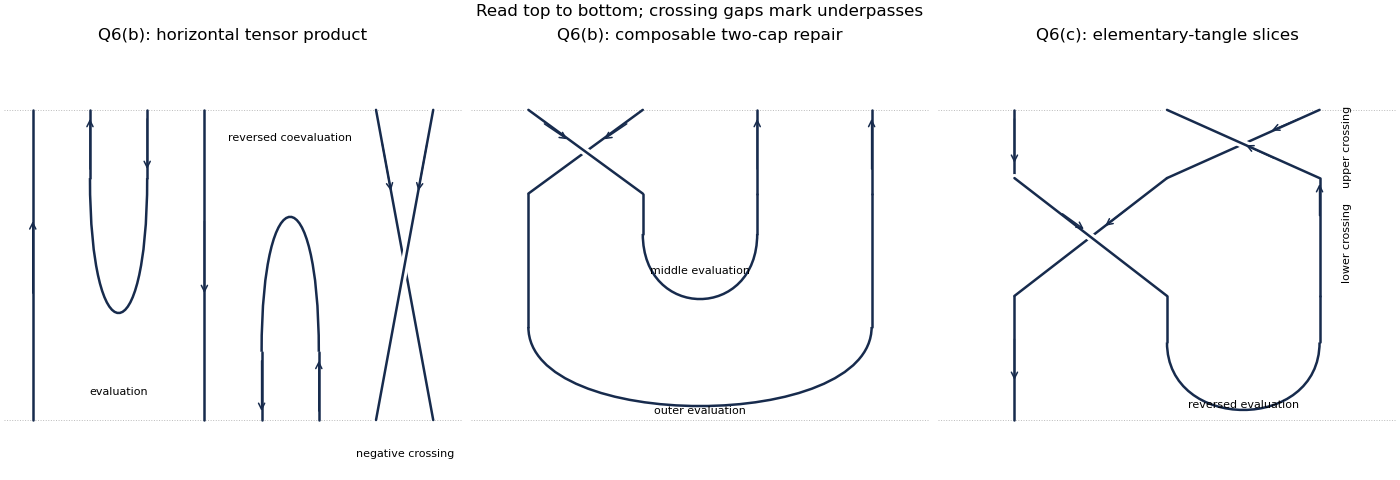
Horizontal juxtaposition is the tensor product in the tangle category. The first panel gives a representative of the first expression: from left to right it consists of the upward identity, the ordinary evaluation morphism, the downward identity, the reversed coevaluation morphism, and the negative crossing. The two arcs are disjoint from the other strands and the crossing is the only over/under intersection in that panel.
The second expression has a boundary-count defect as printed. Under the top-to-bottom convention fixed in part (a), has four input and four output endpoints, whereas has only two input and four output endpoints. Those successive boundary words cannot be glued. Reading bottom-to-top does not fix it: the middle factor then has four inputs and two outputs, but the final has no inputs. Thus there is no representative of that literal composite in the tangle category.
An explicit composable correction replaces the middle arch by an evaluation morphism and orients both evaluations to match the strands. Write . One such corrected morphism isIts input word is . The crossing exchanges the first two downward strands, the middle evaluation removes strands two and three, and the outer evaluation removes the remaining downward/upward pair. The second panel is its original drawing. It has four top endpoints and no bottom endpoints. This is a qualified correction, not a claim that the ill-typed printed composite defines a morphism.

Articles by others on the same topic
There are currently no matching articles.