The initial table of content was limited to the first level because it is larger than 1000 articles. There are 1911 articles in total. Expand a branch to load its children.
Interpret the map as the action on . A smooth representation requires every vector to have an open stabilizer in the locally profinite group . Take the first standard basis vector . Every identity neighbourhood contains matrices with sufficiently small in the local field. We may require , so . Injectivity of the field embedding givesThus no identity neighbourhood fixes , and its stabilizer is not open. Consequently the representation is not smooth for any . This includes , when a nonzero vector's stabilizer is just the identity. The field embedding need not be continuous, but no continuity assumption would repair this stabilizer obstruction. The existence of the stated embedding itself forces characteristic zero; in positive characteristic no field embedding into exists.
An -group here means a locally profinite group, so identity neighbourhoods contain compact-open subgroups. The right action is a group representation because .
Let be a compactly supported locally constant function with support . For every , local constancy supplies a compact-open subgroup with constant on , and this coset lies in . Compactness gives a finite cover . Put . Each coset in this cover is right -invariant, so is right -invariant. Within the support, and lie in the same chosen and have the same function value; outside the support, right -invariance of ensures that both values remain zero. Hence for all . The zero function is fixed by every subgroup. This proves that the smooth right regular representation is smooth.
For a fixed compact-open subgroup , right-invariant functions are functions on the discrete coset space . Compact support becomes finite support there, since the image of a compact set in a discrete space is finite. Conversely every finitely supported function on lifts to a compactly supported locally constant function on . Thuswhere the superscript indicates finite support. Its basis is the set of characteristic functions , and its dimension is finite exactly when is finite.
If is compact, the discrete quotient is compact and therefore finite for every such ; hence the representation is admissible. Conversely, admissibility gives finite index for any one compact-open subgroup. Then is a finite union of compact cosets, so is compact. Therefore the representation is admissible if and only if is compact.
Write , , for the principal-unit filtration of a local field. Each linear character is a smooth character, since its kernel contains . A vector in the algebraic direct sum has only finitely many nonzero coordinates. Taking larger than all their indices gives a common subgroup fixing the vector, so the direct sum is smooth.
If , then , so is fixed by . If , the subgroup lies inside , and is nontrivial on ; hence . It follows thatEvery compact-open subgroup of contains some , because it is an identity neighbourhood. Therefore is finite-dimensional. The direct sum is an admissible representation, despite its infinite total dimension.
The algebraic dual of a direct sum is a product, rather than another direct sum. The mapis injective, since the summands span . Given any family , define . This sum is finite for each vector, regardless of whether the family of functionals has finite support. It defines a linear functional and is inverse to . Hence this is a natural vector-space isomorphism.
The algebraic contragredient representation is . On the th coordinate,Thus intertwines the actions and givesNo smoothness restriction has yet been imposed on that product.
Let be a smooth vector in the product description of the algebraic contragredient representation. Its open stabilizer contains for some . For every , choose with . Invariance of at its th coordinate givesforcing . Hence a smooth functional has finite support, contained among .
Conversely a finitely supported family has indices bounded by some . Each inverse linear character has the same kernel as its original linear character, and all those kernels contain . Thus this subgroup fixes the family. The smooth dual is thereforeThis is the principle that conductors force finite support in a smooth dual. For instance a product vector with every coordinate nonzero is a perfectly valid algebraic functional on the original direct sum, but is not smooth.
Write for the diagonal matrix called in this question. If and , thenThus maps the fixed-vector space into . Its inverse gives the reverse map, so
For an upper-unipotent matrix , inverse conjugation changes each entry above the diagonal byEvery such factor tends to zero as . Because is compact, its finitely many coordinate functions are uniformly bounded; because it is open, it contains a neighbourhood of the identity in . Therefore this contraction is uniform on and gives for every sufficiently large . The diagonal group commutes with , soConjugating this inclusion gives for all sufficiently large . This is an eventual inclusion; arbitrary need not give a monotone sequence at every earlier step.
Consequently eventually. Admissibility makes these spaces finite-dimensional, while the isomorphism above makes their dimensions equal. HenceThis proves contraction and admissible fixed spaces by both inclusion and dimension, not by an assumption that conjugate fixed spaces are literally equal from the outset.
Take any . A smooth representation has an open stabilizer, so some sufficiently small congruence subgroup of fixes . It can be written , where the diagonal entries in belong to and all entries above the diagonal in belong to , with . These are compact-open in their respective groups, normalizes , and their product is compact-open in .
By part (a), this vector lies in for every sufficiently large . Given any , the coordinate contraction eventually puts it in . Choose large enough for both properties. Then , so . Since and were arbitrary,Thus every admissible representation of this upper-triangular group factors through its diagonal quotient. The argument uses finite-dimensional fixed spaces essentially; smoothness alone does not force the unipotent action to be trivial.
Use unnormalized parabolic induction, the convention fixed by the supplied sequence and by the occurrence of constants in . Its functions satisfy , and acts by right translation. Characters in this smooth category are smooth characters. Put , retaining the question's modulus .
First derive the evaluation adjunction for unnormalized induction. A -intertwiner gives a functional . Since intertwines and induced functions have left covariance, . Conversely such a functional definesThis function has the required left covariance. Any compact-open subgroup fixing fixes it on the right, so it is a smooth induced function; compactness of removes any additional support issue. The construction is -equivariant, and the two operations are inverse. Since is trivial on , these functionals factor precisely through the Jacquet module, givingNow use the given exact sequence , where has dimension two.
If , choose on which their values differ. Its operator on is upper triangular with distinct eigenvalues, so has two one-dimensional eigenspaces. Since is abelian, all its operators commute with this operator and preserve the eigenspaces. They are the linear character lines and . This proves that distinct-character extensions of an abelian group split, so . A map between one-dimensional linear character spaces is zero unless the linear characters agree, and otherwise is one-dimensional. Therefore the required dimension is one for or , and zero for any other linear character.
The case needs an extra argument: the exact sequence alone would also permit a split self-extension with two quotient functionals. Write . Equality with forces , so , where and . Multiplication of induced functions by identifies this with a determinant-character twist of . Twisting is invertible, so it is enough to prove nonsplitting for .
Use the open Bruhat decomposition coordinateFor the matrix factorizationshows that for all sufficiently large : the lower-unipotent matrix approaches the identity, where is locally constant. The coordinate map is injective, since this open cell is dense in the projective-line quotient and induced functions are locally constant sections.
For , direct multiplication givesThere exists a section with and coordinate functionIndeed the displayed factorization changes to the lower chart near infinity, where this tail corresponds to the constant function one. Thus it extends smoothly across the missing point. With and , the difference is the compactly supported functionNormalize additive Haar measure by . ThenThis difference survives in the Jacquet module. To prove that assertion, the unipotent action translates coordinates: . Any such translation difference is compactly supported because the tail is and when is sufficiently large. Its integral is zero: integrate over a sufficiently large additive ball, invariant under translation by , and change variables. A finite sum of unipotent translation differences also has integral zero. Hence , whose integral is nonzero, cannot be a coinvariant relation. In particular, on the operator is nonzero. This proves the equal-character Jacquet self-extension for GL2 is nonsplit.
Any -equivariant functional must kill the nonzero image of that operator. Since has dimension two, its space of such functionals has dimension at most one; the quotient in the supplied exact sequence already provides one. Twisting back gives the same conclusion for the common linear character . For any different , a surjection is impossible because both composition factors of are . Combining the two cases givesWhen the two listed linear characters coincide, the dimension remains one; they are not two independent contributions.
Apply part (a) with . It gives , so every endomorphism is a scalar multiple of the identity. The local Steinberg representation of GL2 in the supplied sequence is nonzero: is the space of locally constant functions on , and the characteristic function of the compact-open affine set is not constant. Its class in the quotient by constants is therefore nonzero.
If the sequence split, would be with both summands nonzero. Projection onto either summand would be a -endomorphism. These two projections are linearly independent: restrict a proposed linear dependence first to one summand and then to the other. This contradicts the one-dimensional endomorphism space. Equivalently the projection onto the trivial summand would be a nonzero idempotent different from the identity, whereas a scalar idempotent can only be zero or the identity. The principle that scalar endomorphisms obstruct a split extension givesNo assertion of irreducibility of is needed; this representation has a proper invariant line of constants.
Use and the quantum plane convention . In this convention is the coordinate Hopf algebra of quantum SL2 with the catalog parameter replaced by . It is generated by , subject toEquivalently the last determinant relation is . The quantum determinant convention is essential: these relations use the inverse of the parameter in the catalog's convention.
Writing , the comultiplication is matrix multiplication, . Explicitly,The counit is , . Extend and as unital algebra homomorphisms over a field. Matrix multiplication is associative, giving coassociativity; multiplication by the identity matrix gives the counit laws. The antipode isFor example and , while the off-diagonal entries vanish by the commutation relations. Thus this is a Hopf algebra, not merely an algebra presentation.
Take the right coaction of the coordinate Hopf algebra of quantum SL2 on the quantum plane to beIt is extended multiplicatively and sends to . The matrix comultiplication and counit verify the coaction identities on . To check that it descends to the quantum plane, expandThe last bracket vanishes because and .
For the requested calculation, and giveMultiply by , put all monomials into the order , and use . The answer isA left-coaction convention transposes where the matrix coefficients occur; the displayed answer fixes the right coaction throughout.
An -point means a unital algebra homomorphism over a field , as in points of a noncommutative algebra. It is specified by and satisfying . For and not a root of unity, , so scalar commutativity gives . Hence the scalar points are the union of the two coordinate axes:
For matrix-valued points of a noncommutative algebra, put and let be a generalized eigenspace. From ,Therefore , interpreting a missing eigenvalue as the zero space. In particular the linear subspaces and are invariant under both matrices. If , the numbers are distinct. A nonzero vector with would force all intervening generalized eigenspaces to be nonzero, impossible in dimension . Thus : is nilpotent on , although is invertible there.
Apply the same argument with exchanged, using . The sum of the nonzero generalized eigenspaces is invariant under both matrices, and is nilpotent on it. Consequently . Conversely, since is nilpotent on , its nonzero generalized eigenspaces all lie in . Decompose the restriction of to that invariant space into its nonzero and zero generalized eigenspaces:The zero generalized eigenspace of is -invariant by the scaling identity, so is invariant under both matrices. On , both matrices have only zero eigenvalues, hence are nilpotent matrices. This proves the spectral decomposition of a quantum-plane point:Here mean sums of generalized eigenspaces, not merely ordinary eigenspaces; that distinction is necessary for non-diagonalizable points.
Fix the quantum enveloping algebra of sl2 conventionThe printed pair of matrices contains an error. On its first basis vector, the printed matrices give , whereas the defining commutator gives . Since is not a root of unity, : would give , and would give . Thus the two printed matrices cannot represent this algebra. Keeping the printed matrix requires exchanging the two nonzero entries of the printed matrix. We derive that corrected pair rather than assume a classification theorem.
As is not a root of unity, successive applications of multiply eigenvalues by . Finiteness of the spectrum therefore makes a nilpotent operator. Start from a eigenvector and apply until the last nonzero vector ; then and , with . The defining commutator gives the highest-weight string for quantum sl2For completeness, at this is the commutator applied to . To advance from to , write , use , and combine the two coefficients; their sum is the displayed coefficient at .
Let be the first index with . Such an index exists because nonzero have distinct eigenvalues . The linear span of is stable under , so simplicity makes it all of . The distinct eigenvalues make these vectors independent; hence . Applying the string formula to givesAs and , , so with .
Choose the basis , , . Then , , and . The correct matrices in this basis areAlternatively, preserving the printed instead requires , . Both corrected pairs are related by a diagonal change of basis.
Use the comultiplication , , of the quantum enveloping algebra of sl2. Choose a basis for with , , and . Choose a basis for withand all terminal raising or lowering actions zero. This is one of the corrected bases from part (a).
In the tensor product of modules, putThe vector is killed by and has eigenvalue . Direct application of the comultiplication givesand the string formula gives , , . Also . Thus is a submodule isomorphic to .
The other highest vector and its lowered partner areIndeed , , , and . Therefore is a submodule isomorphic to .
To verify that this is a direct sum, in the weight space the determinant of the coefficients of is . In the weight space, the coefficient determinant of is . The extreme weight spaces are spanned by . Hence these six vectors form a basis of the entire tensor product of modules. Each summand is a simple module: projecting a nonzero vector onto one of its distinct weight spaces and applying the nonzero raising and lowering coefficients recovers its entire basis. Consequently
A cobraided bialgebra is a bialgebra equipped with a convolution-invertible bilinear form satisfying the following identities, in Sweedler notation:Convolution invertibility means there is with , and likewise with interchanged. This is a coquasitriangular structure. On right comodules it induces the braidingThe third identity makes this a comodule map, the first two give its two hexagon identities, and the convolution inverse gives the inverse braiding.
For an invertible braiding satisfying the braid equation on , begin with the free associative algebra over a field on matrix coefficients , with and . Impose precisely the coefficients ofThis quotient is the FRT bialgebra, or Faddeev-Reshetikhin-Takhtajan construction. The relations form a coideal because composing two coactions that preserve again preserves ; the trivial coaction also preserves it, so the counit descends. Universality follows because any such coaction must satisfy exactly these coefficient relations.
For the given , take , , , . Thus and . The coefficient relations, after cancellation of , areThese are exactly the defining relations of in the inverse-parameter convention of Question 1, without setting the quantum determinant equal to one. They therefore define mutually inverse algebra homomorphisms: each named generator maps to the corresponding , and conversely. The matrix comultiplication and counit are the same, so the isomorphism is also one of bialgebras.
Here is the requested check of directly from . Apply colinearity to and compare the coefficient of . On the left, , giving . On the right, the corresponding term of is , and . Hence , proving the relation. The other coefficient comparisons give the remaining displayed relations; no additional determinant relation is imposed in an FRT bialgebra.
With the right-comodule braiding convention in part (a), the defining formula isConsequently the scalar form on generators is the following table, with row the first argument and column the second:For example, the extra component of is . The other off-diagonal component gives .
For arbitrary elements of the FRT bialgebra, extend this table by bilinearity, the unit rule , andThese are an explicit recursive algorithm for any two words in the generators, so the table determines the entire cobraiding. The braid equation for ensures the algorithm annihilates the defining coefficient relations in either argument: moving one crossing past two successive crossings gives precisely the two reductions of a quadratic colinearity relation. Thus it descends from the free algebra over a field to the FRT bialgebra. For the convolution inverse, use the inverse of , where flips the tensor factors: its coefficients are . Equivalently, in the flipped coefficient formula use , not alone. This gives , , , and all other generator values zero. This specifies the coquasitriangular structure completely, not just its values on degree-one elements.
Use the multiplicativity rule for the cobraided bialgebra and :The generator table has , soHere the tensor notation means the value of the scalar form on the two displayed arguments, not multiplication within .
Use the quantum plane and the quantum enveloping algebra of sl2 comultiplication from Question 2. The generator actions are , , , , , . Extend them by the module algebra rulesThese descend to : and , while preserves . For the ordered monomial basis, induction with gives the quantum enveloping algebra action on the quantum planeTerms with a negative exponent have zero coefficients and are interpreted as zero.
We now verify the defining relations explicitly on every basis vector, rather than infer them merely from the generator actions. The weight changes by under and under , so and . AlsoThe middle identity follows by inserting and cancelling the terms and ; the remaining numerator is . Finally . Thus all the rank-one defining relations hold. The phrase “Serre relations” here refers to these rank-one presentation relations; there are no additional relations involving distinct simple roots for .
Every ordered monomial in the degree- homogeneous component has the form , . The formulas in part (a) showEach nonzero image still has total degree ; does too. Since generate the quantum enveloping algebra of sl2, the degree- component is a submodule, with basis and dimension .
The root-of-unity specialization requires : we take to be a primitive cube root of unity. The displayed presentation contains , so substituting literally is undefined. Its classical limit instead has simple finite-dimensional modules of arbitrarily large dimension. This is why the primitive-root qualification matters.
First consider simple modules occurring in the quantum plane. Here , , andwith the analogous formula . Thus the action factors through the finite-dimensional quotient with , , spanned by with . Any simple module over this quotient is finite-dimensional, since it is generated by one vector. In a nonzero simple submodule choose a eigenvector in . This is possible because is nilpotent and its kernel is -invariant. Then the highest-weight string for quantum sl2 shows thatis invariant under , and makes it -invariant. Simplicity gives , proving .
The same bound holds even for arbitrary finite-dimensional simple modules over the unrestricted quantum enveloping algebra of sl2. Indeed are central: the string commutation identity has a factor , and the commutation factors satisfy . By Schur lemma, they act as scalars , with . The elementis also central. For example , while ; the commutator cancels in the same way. Let act as .
If , choose the highest vector as above. Its three-vector string is invariant, now using , so again its dimension is at most three. If , choose a eigenvector . The space is stable under because , and it is stable under becauseIt therefore equals the simple module and has dimension at most three.
Over this also excludes infinite-dimensional simple modules of the unrestricted algebra. It is a finite module over the central finitely generated commutative algebra over a field , using the same 27 ordered spanning elements. A simple module , generated by one vector, is consequently finite over . Choose a maximal ideal in its support. Nakayama lemma makes ; since is a submodule, simplicity gives . The Hilbert Nullstellensatz gives , so is finite-dimensional and the preceding argument applies. Thus the usual complex, primitive-root interpretation yields
At a primitive cube root of unity, , , . In the degree-three quantum plane module, put , , , . The complete actions areHence is a two-dimensional trivial submodule; every line in is a simple module. The quotient by is a two-dimensional simple module, with distinct eigenvalues and nonzero maps connecting its two weight spaces.
Let be a simple module that is a submodule of this cubic component. If , simplicity makes , so is one of its lines. If , the quotient map injects into the simple quotient. Its nonzero image is the entire quotient, so . Since is diagonalizable, such an must contain the unique weight space . But , which then belongs to , a contradiction. Therefore the cubic-root quantum-plane socle gives the complete answer:All simple submodules lie in the two-dimensional , so their sum cannot equal the four-dimensional cubic component. It is not a direct sum of simple modules. The obstruction is the nonzero extension to the simple two-dimensional quotient, not a failure of that quotient to be simple.
For unital algebras over a field , a measuring coalgebra is a coalgebra together with a linear map such that, in Sweedler notation,Thus a group-like element acts by a unital algebra homomorphism over a field, while skew-primitive elements give twisted product rules.
The universal measuring coalgebra has a universal measuring map with this property: for every measuring map from a coalgebra , there is a unique coalgebra homomorphism satisfying . The uniqueness is among coalgebra homomorphisms; itself need not be an injective map of vector spaces.
The printed input is a genuine typo in the PDF as well as in the TeX: annihilates every power of , whereas the displayed right-hand side is generally nonzero. The intended input is , and the calculation below proves that corrected identity.
The given comultiplications make a coalgebra, with counit one on and zero on . Write , and , and similarly for . The measuring coalgebra identities areThe group-like elements act multiplicatively. Although the statement omits an explicit specification of , its identity action follows from the other data and the quantum plane relation. Applying to gives , so cancellation in the noncommutative domain gives . Applying to the same relation gives , so . Thus is the identity on the entire quantum plane.
Now by induction. Suppose . The measuring rule and giveThe induction starts with and . A final product rule givesFor the answer is zero. By contrast the literal printed input has ; it cannot satisfy the printed right-hand side for .
Put . First describe the multiplication of the universal measuring coalgebra . If measure into itself through , then their tensor product coalgebra measures it byIndeed applying both measuring product rules gives the product rule for the tensor comultiplication, and the unit condition follows likewise. Apply universality with : composition induces a coalgebra homomorphism . The identity endomorphism induces the unit . Associativity and the unit laws follow by uniqueness because both candidate coalgebra homomorphisms evaluate as the same compositions of endomorphisms. Thus is a bialgebra.
The generator actions from Question 4 satisfy all defining relations of the quantum enveloping algebra of sl2, so they define an action of on . Its skew product rules are exactly the rules from and . Products of elements satisfying the module algebra rule satisfy it as well: apply the two successive actions and use that is multiplicative. Since the generators and unit satisfy it, the full action is a measuring of into itself.
Universality therefore gives a unique coalgebra homomorphism inducing this action. To prove multiplicativity, compare the two coalgebra homomorphisms from given by and . Both induce , so uniqueness makes them equal. The unit comparison is identical. ConsequentlyThis avoids assuming the universal measuring map is injective: equality is justified by its universal property for coalgebra maps.
The tangle category has objects finite words in the two orientations , including the empty word. A morphism is an oriented compact one-dimensional manifold, embedded in a three-dimensional slab, whose boundary is the prescribed ordered set of top and bottom endpoints. Closed components are allowed. Two such embeddings represent the same morphism when they are ambient-isotopic relative to the boundary.
Read diagrams from top to bottom here, matching the maps drawn in part (d). Composition stacks diagrams with exactly matching intermediate boundary words; horizontal juxtaposition is the tensor product. The empty word is its unit, and straight oriented strands are identities. Crossings, the two oriented evaluations and the two oriented coevaluations generate all morphisms: place an embedding in generic position and slice between its crossings and local extrema. The Reidemeister moves and the cup/cap isotopies describe changes of diagrams without changing the underlying tangle. This is the ordinary unframed version; a framed tangle category instead retains framing data and has a modified first-move rule.
In this reading convention an arch is a coevaluation morphism , and a valley is an evaluation morphism . An overleft arrow reverses these strand orientations. We use for the crossing whose upper-left-to-lower-right strand passes over the other, and for its inverse; this geometric specification avoids ambiguity in sign conventions.
Horizontal juxtaposition is the tensor product in the tangle category. The first panel gives a representative of the first expression: from left to right it consists of the upward identity, the ordinary evaluation morphism, the downward identity, the reversed coevaluation morphism, and the negative crossing. The two arcs are disjoint from the other strands and the crossing is the only over/under intersection in that panel.
The second expression has a boundary-count defect as printed. Under the top-to-bottom convention fixed in part (a), has four input and four output endpoints, whereas has only two input and four output endpoints. Those successive boundary words cannot be glued. Reading bottom-to-top does not fix it: the middle factor then has four inputs and two outputs, but the final has no inputs. Thus there is no representative of that literal composite in the tangle category.
An explicit composable correction replaces the middle arch by an evaluation morphism and orients both evaluations to match the strands. Write . One such corrected morphism isIts input word is . The crossing exchanges the first two downward strands, the middle evaluation removes strands two and three, and the outer evaluation removes the remaining downward/upward pair. The second panel is its original drawing. It has four top endpoints and no bottom endpoints. This is a qualified correction, not a claim that the ill-typed printed composite defines a morphism.
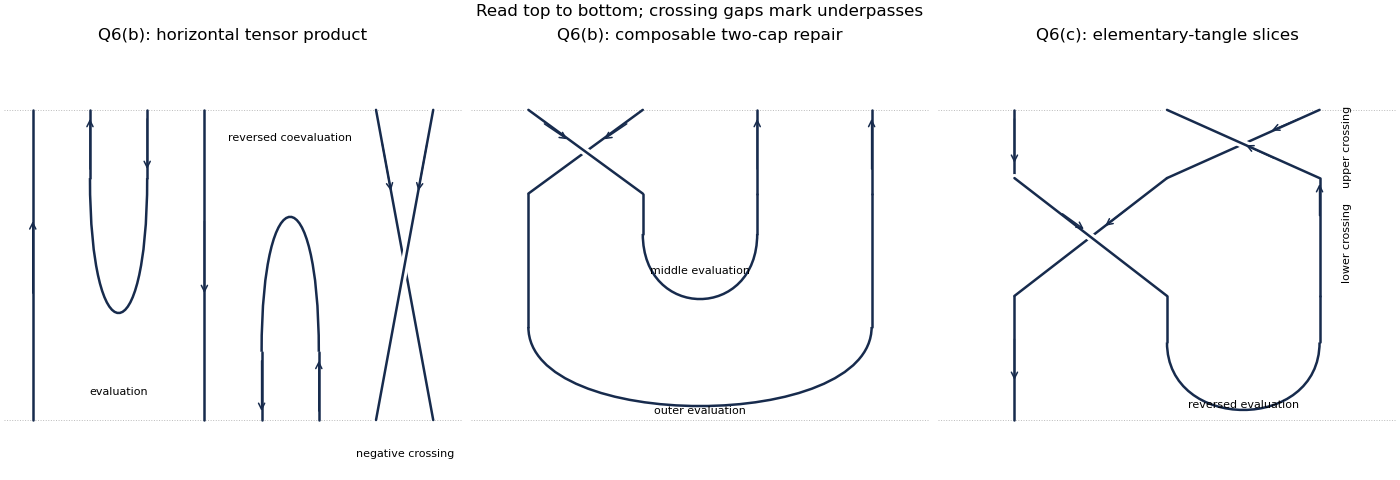
Oriented tangle representatives, a composable correction of the printed composite, and elementary slices of the supplied tangle
. Details. Read the supplied tangle from top to bottom. Its input word is , and its output word is . There are three successive events: the upper crossing of the rightmost two strands, the lower crossing of the leftmost two strands, and the right-hand oriented evaluation. At both crossings, the upper-left-to-lower-right strand passes over; both are therefore in the geometric convention of part (a). The evaluation joins a downward strand to an upward strand, so it is .
The elementary factorization is consequentlyIts boundary words give an explicit composition check:The third panel in part (b) draws these slices. Sliding the right-hand evaluation downwards and straightening the identity portions gives the PDF diagram without changing either crossing's overpass. If the names are interchanged in another crossing convention, both displayed crossings must be renamed together; the stated overpasses determine the actual tangle independently of those names.
Let be the supplied coevaluation morphism, , and let be the supplied evaluation morphism with diagonal coefficients . The tangle obtained by inserting the given crossing between the created strand and a through strand, then evaluating, is a removable curl. The first Reidemeister move gives the identityWe calculate this map on both basis vectors. The crossing matrix givesFor input , applying , then , then givesFor input , the off-diagonal evaluation vanishes and the result is . Therefore the removable-curl identity requiresSolve the first equation to obtain ; substitution in the second gives . HenceFinally the closed identity strand is represented by . Its value is , so the quantum dimension isIt is a weighted categorical contraction, rather than the ordinary vector space dimension . Using a framed category without imposing the removable-curl identity would require additional twist data; the ordinary tangle category and the specified crossing normalization determine these coefficients.
Throughout, modules are finite-dimensional over , or finitely generated -free lattices when the coefficient ring is . The p-modular system has a complete discrete valuation ring , maximal ideal , fraction field of characteristic zero and residue field of characteristic .
A block of a group algebra is a nonzero, indecomposable two-sided ideal direct summand of . Equivalently it is for a primitive central idempotent . To see the equivalence, suppose as two-sided ideals and write with , . Products between and vanish because they lie in their zero intersection. Thus is the identity on , zero on , and is a central idempotent, with . Conversely . Splitting further is equivalent to splitting into orthogonal nonzero central idempotents; indecomposability is exactly primitivity. If is the block decomposition, . A nonzero indecomposable module therefore belongs to exactly one block of a group algebra, namely the one with .
For modular reduction of block idempotents, the conjugacy class sums are an -basis of . Hence . In the complete commutative algebra , idempotent lifting gives a unique lift of each idempotent of ; uniqueness follows because commuting idempotents congruent modulo the Jacobson radical are equal. Orthogonal decompositions lift too, so primitivity is preserved. Reduction gives a bijection between the integral and modular blocks.
Here is a definition of defect groups of a block which also proves the required relative-projectivity assertion. Give its conjugation action and, for , define the relative trace and its transfer ideal of conjugation-fixed elements byA defect group of a block is a -subgroup minimal with . Such a subgroup exists: for a Sylow subgroup , is a unit in and . The defect of a block is where .
For completeness, this definition is independent of a choice up to conjugacy. Multiplying two relative traces and grouping the pairs of cosets by double cosets givesThis identity follows by writing each pair of cosets as a simultaneous -orbit; its stabilizer is , and its contribution is a trace from that stabilizer. If are both minimal for , then belongs to the displayed sum. The commutative block center is a local ring: in the field case it is a commutative Artinian ring with no nontrivial idempotents; in the integral case its reduction has this property and completeness detects units. A sum of proper ideals cannot contain its identity. Consequently for some , forcing by minimality. The same argument with an arbitrary shows that precisely when contains a conjugate of . This is the trace criterion for defect groups.
To relate this to the usual modular definition, the Brauer morphism deletes the coefficients outside the centralizer:It is an algebra homomorphism: in the coefficient of an element centralizing in a product, acts on the contributing pairs; nonfixed orbits have size divisible by , while fixed pairs have both entries in . Its kernel is the sum of proper-subgroup transfers, because the nonfixed conjugation orbit sums form a basis of that kernel. If is minimal for and , replace by . The kernel description gives , contradicting the local-center argument. Also unless is conjugate into : group the cosets of into -orbits, which have no fixed point otherwise. Thus the minimal transfer subgroups are exactly the maximal -subgroups with nonzero Brauer morphism of .
Now take and write . Multiplication by is a -linear endomorphism of , andHere is the splitting behind the D. Higman criterion. The natural map , , has a -linear sectionChanging a representative by an element of leaves this tensor unchanged, permutes the terms, and . HenceThis is relative projectivity for , proving the Green relative projectivity theorem; indecomposability was needed only to speak of a single block of a group algebra or vertex of an indecomposable module.
Finally let lift . A trace expression for reduces to one for , so a modular defect group of a block is contained, up to conjugacy, in an integral one. Conversely choose a modular defect group and with . Conjugation orbit sums lift to . The elementreduces to its block identity, hence is a unit in that block center. Its inverse there is central, soThe integral defect is therefore contained in the modular one. The corresponding blocks have the same conjugacy class of defect groups and the same defect.
The Brauer first main theorem says that, for a fixed p-subgroup and , there is a bijection between blocks of a group algebra of with defect group of a block and blocks of with that defect group. Correspondents have the same nonzero image under . The integral version follows by modular reduction of block idempotents.
Here is a proof using relative traces. Put andThe latter ambient algebra is commutative because invariance under includes invariance under . The Brauer morphism and relative trace identity isIndeed acts on . Its fixed cosets are exactly . On a nonfixed orbit the terms have the same Brauer image, so the orbit contributes zero in characteristic . The fixed cosets give the right-hand side. Since every element of is -fixed, this proves that is a surjective algebra homomorphism of commutative ideals. The same argument for has exactly the same target.
We use the following elementary fact about primitive idempotents under a surjection of commutative Artinian ideals. Under a surjection of ideals in finite-dimensional commutative algebras, the primitive ambient idempotents lying in and having nonzero image correspond bijectively to the primitive idempotents in . To prove it, decompose the source ambient algebra into Artinian local rings . Either , or it is a proper, hence nilpotent, ideal. Proper components contribute no idempotents to the image. A surviving identity has corner , a local quotient of , so is primitive. The surviving identities are orthogonal and exhaust the idempotents of the target. Notice that this proof does not assert that the whole kernel is nilpotent: it can kill entire block components.
By the trace criterion for defect groups proved above, primitive block idempotents in have defect conjugate into . Among them, the Brauer morphism is nonzero precisely for defect , again by that criterion and its Brauer characterization. The identical reasoning applies to . Thus both sets are identified with the primitive idempotents of , proving the bijection and its uniqueness.
For the more general subgroup, is understood to be a defect group of a block of . This is the implicit hypothesis needed to apply the theorem; it is not repeated in the printed sentence. Without it the printed uniqueness assertion is false: take , , and . The centralizer of in is , but the unique three-dimensional defect-zero block of is the bimodule restriction of each of the two three-dimensional defect-zero blocks of . The two ordinary degree-three characters both restrict to the degree-three character of , with values on its identity, involutions and elements of order three. Defect-zero reduction gives the same simple projective -module, so both restricted block bimodules are this same matrix block. This illustrates why block induction requires the block's defect centralizer. Write for its block idempotent and . Since , we have . Apply the theorem inside to obtain the unique corresponding block of . Its center of an associative algebra has a residue field , and the quotient map is its central character of a block . No assumption that is algebraically closed is needed here. DefineThe Brauer image is in , so this is a unital algebra homomorphism. Among the orthogonal primitive central idempotents of , exactly one has image . The block it selects is . If contains this is the inverse of the bijection just proved. For arbitrary , the resulting block can have a strictly larger defect group. Block induction is transitive on admissible intermediate subgroups. For the normalizer chain used in the proof below, the required transitivity will be verified directly with Brauer images.
To prove the bimodule characterization, we explicitly state the standard permutation-module fact used here. For a permutation module, the Brauer quotient of a module at has as basis the permutation-basis points fixed by . An indecomposable summand has nonzero quotient at exactly when its vertex of an indecomposable module contains a conjugate of . For summands with vertex exactly , taking this quotient, with its -action, detects the summand and detects which orthogonal idempotent projection acts as its identity. These facts hold for trivial source modules; the fixed-basis description follows by deleting proper transfers, and the detection assertion is the permutation form of the first-main-theorem argument, applied to their endomorphism algebra.
As an permutation module, with , the group algebra decomposes asThe block bimodule is an indecomposable module with vertex of an indecomposable module . None of the other double-coset modules can contain : a basis element fixed by centralizes , hence lies in , whereas those double cosets lie outside . Thus occurs exactly once as an indecomposable summand of this restriction, in the term. Decomposing into its global block bimodules therefore puts this occurrence in precisely one of them, say .
Under the fixed-basis description, the quotient of at is , and multiplication by induces multiplication by . The quotient of is . Consequently the detecting projection for this occurrence of satisfieswhich is equivalent to . Thus , proving the requested unique-block direct-summand characterization. Here the restriction is to ; the extra subscript in the converted TeX is a transcription error, not a different subgroup.
The block statement is Green correspondence for blocks: if , blocks of and with defect group correspond, and their block bimodules are Green correspondents for the diagonal vertex . We prove the module correspondence underlying this statement, then specialize it to the block bimodules. This also gives the requested direct proof in the trivial-intersection situation.
Here are the elementary ingredients, including their proofs. Mackey decomposition is obtained by partitioning the tensor basis of by the double cosets ; the term for is induction from of the suitably conjugated restriction of . The D. Higman criterion follows from the section constructed in Question 1. Conversely, take a splitting of the induction counit and its coefficient at the identity coset: equivariance reconstructs the section from that -linear coefficient, and the splitting identity is exactly that its relative trace is . Thus the trace criterion is an equivalence.
An indecomposable module here has a local endomorphism ring. Over this follows from the Fitting lemma: an endomorphism eventually splits its kernel from its image, and indecomposability makes it invertible or nilpotent. Over , the endomorphism ring is finite over a complete discrete valuation ring; lift orthogonal idempotents from its finite-dimensional residue algebra to see that an indecomposable lattice has a local endomorphism ring too. The Krull–Schmidt theorem follows by the usual exchange argument: composing the inclusion and projection of one indecomposable summand across a second decomposition writes its identity as a sum of endomorphisms; one is a unit in the local endomorphism ring and pairs that summand with a summand of the second decomposition. Remove the pair and continue. Existence follows by successively splitting nontrivial idempotents, which decreases dimension or rank.
A vertex of an indecomposable module is a subgroup minimal for relative projectivity. It can be taken to be a -subgroup because averaging over the index of a Sylow subgroup of any candidate subgroup is invertible. If an indecomposable module is relatively projective for and , the Mackey decomposition and its induction splittings make it a summand of a sum of modules induced from . In its local endomorphism ring one splitting component must be invertible, so it is relatively projective for one of these intersections. This proves conjugacy of minimal vertices and the useful criterion that a module with vertex can be relatively projective for only when is conjugate into . A source of an indecomposable module with vertex is an indecomposable summand of its restriction to from which the original module is an induced summand. Such a summand exists by the induction splitting and Krull–Schmidt theorem; its vertex is , since a proper vertex would make the original module relatively projective for a proper subgroup of .
SetWhen saying a module is - or -projective, allow conjugates in the relevant ambient group and finite sums of modules relatively projective for members of that family. No conjugate of inside belongs to : if , equality of orders gives , so , contradicting . Every member of is a proper subgroup of .
The two key assertions can now be proved rather than assumed. First, if is an indecomposable -projective -module, thenChoose with . Mackey decomposition gives , with -projective. Write and apply induction and restriction. Both and contain their original modules, by the identity double coset. Comparing multiplicities of every indecomposable which is not -projective, their extra multiplicities are nonnegative and have sum zero. Therefore neither has such an extra summand, proving the assertion.
Second, suppose has vertex , and choose an indecomposable whose restriction contains ; such a exists by the first assertion. Write . Its restriction has just one summand isomorphic to and all other summands are -projective, so is -projective. Any indecomposable has a vertex after conjugacy. A source with vertex is a summand of . Restricting a -projective decomposition of to and using Mackey decomposition forces to lie in an -conjugate of some , . Since , this puts in . Thus is -projective. Moreover has vertex , since it is -projective and its restriction contains with vertex . We have provedIn particular is unique.
Conversely, let be an indecomposable -module with vertex and source . Decompose and choose whose induction contains . Its vertex is contained in and cannot be proper, since induction would then make relatively projective for a smaller subgroup. Thus has vertex , and the previous assertion makes its unique vertex- induced summand. Restriction of an -projective module is -projective: in a Mackey term a conjugating element inside preserves the containment in an -conjugate of , and one outside gives a subgroup of . Comparing the two decompositions of now givesThese assignments are mutually inverse. To check sources, restrict back to . Its terms of full vertex are conjugates of by ; the other terms are induced from proper intersections. Applying the source criterion and Krull–Schmidt theorem shows that the source of is one of those conjugates. The same argument in , and the uniqueness just proved, matches the source classes on the two sides. Thus Green correspondence preserves sources up to normalizer conjugacy.
To pass to blocks of a group algebra, regard as the permutation module . A summand of a permutation module has trivial source. Here is why: over a finite p-group, every transitive permutation module is indecomposable, since its socle is the one-dimensional fixed line and every nonzero module has nonzero fixed points. The latter follows by induction on the group order, using a central element of order and the nilpotence of its difference from . Over indecomposability follows by reduction. Restrict a permutation summand to a vertex and apply Krull–Schmidt theorem; a source must be a transitive permutation module . Its vertex is contained in , so minimality forces , and its source is the trivial module.
For a permutation module, its Brauer quotient of a module at has the fixed permutation points as basis: every nontrivial orbit sum is a proper transfer. An indecomposable trivial-source summand with vertex has nonzero quotient only at subgroups conjugate into , by its induced-permutation realization, and its quotient at is nonzero because its restriction contains its trivial source. Applied to a block , the quotient at is . Together with the maximal-subgroup characterization of defect from Question 1, this proves that its bimodule vertices are precisely for its defect groups . The integral conclusion follows by orbit-sum reduction and idempotent lifting.
FinallyApply the just-proved Green correspondence with ambient group . Its unique vertex- summand of lies in : outside there is no -fixed group-basis point, as in Question 2. Since the indecomposable summands of are exactly its block ideals, this summand is a block with defect group . Conversely induction of has as its unique vertex- summand. The block bijection is the Brauer correspondence of Question 2, giving the claimed block form over either coefficient ring.
For the final special case put with a trivial-intersection Sylow subgroup. For , the intersection has order prime to . Indeed every -subgroup of it lies both in the normal Sylow subgroup of and in , whose intersection is trivial. Mackey decomposition therefore giveswhere every other double-coset term is induced from a group of order prime to . By Maschke's theorem such modules are projective, and induction preserves projectivity, so is projective.
Every nonprojective -module has nonprojective restriction to : is prime to , so averaging makes the module a summand of the induction of its restriction. A projective restriction would therefore make the original module projective. Decompose into indecomposables. Each nonprojective summand contributes a nonprojective summand on restriction, whereas the displayed Mackey formula and Krull–Schmidt theorem have exactly one nonprojective summand, , with multiplicity one. There must be one, since is nonprojective. Hence
The Nagao version of Brauer second main theorem is the following module statement. Let be a central idempotent of , let be a p-subgroup, and suppose . If , put , which is central in . Thenand every indecomposable summand of the second term has vertex not containing . More precisely it is relatively projective for some -subgroup of not containing . In particular the vertex- Green correspondent lies in the block selected by the Brauer morphism. This is the precise restriction statement needed below.
Let have defect group of a block , and let be its Brauer correspondent in . We first build a trivial-source module in . The exact functoris nonzero on the trivial -module. Otherwise it would vanish on every -module, since a group algebra of a p-group in characteristic p is local and all composition factors are trivial; but . Choose an indecomposable summand of . Since , its restriction to is a nonzero direct sum of trivial modules. It is -projective. It cannot have a proper vertex : restriction would make a trivial -module relatively -projective, whereas on its endomorphisms the trace from is multiplication by in , contrary to the D. Higman criterion. Hence has vertex and trivial source.
Take its Green correspondent in . To verify that is in the intended block rather than just some block with a large defect, let be the global block idempotent acting on . Nagao's theorem puts the vertex- summand of in . Thus . The first main theorem already gives ; orthogonality of Brauer images of different global block idempotents forces . Green correspondence preserves sources, so contains an indecomposable module with vertex and trivial source. The same argument proves the same-block compatibility of Green correspondence for every vertex- module used below.
For finite representation type, first suppose is cyclic of order . Write and . Then , and the indecomposable modules for a cyclic p-group are , , by Jordan normal form. Every indecomposable module in is -projective by Question 1, so is a summand of an induction of one of these finitely many indecomposable -modules. Each induction has finitely many indecomposable summands. Therefore has finite representation type.
For the converse it is important to obtain infinitely many modules of full vertex , and not silently assume that the field is infinite. If is noncyclic, its quotient by the Frattini subgroup is elementary abelian of rank at least two, so maps onto . A rank-one Frattini quotient would make any lift of its generator generate , since every proper subgroup is contained in a maximal subgroup. Here is an explicit family of full-vertex modules for a noncyclic p-group valid over every field . Set , for the two quotient generators. Onput , for , for , , and . All products of are zero, so the relations and hold, including when .
These modules are indecomposable. Their common kernel and radical are . An endomorphism preserves ; let be its induced matrix on and its matrix on . The equations , for the two displayed shift maps force and to be the same scalar: the first and last columns give the boundary zeroes, and the recurrence forces all off-diagonal entries to vanish and all diagonal entries to agree. The remaining endomorphisms map the top into and vanish on , so form a square-zero ideal. Thus the endomorphism ring is local. Inflate to and choose the infinitely many for which . Such an has vertex : if for a proper , taking ordinary matrix traces would givea contradiction. Their distinct dimensions ensure distinct isomorphism classes.
Each is nonzero, by exactness and the already proved . Its restriction to is a summand of a sum of conjugates of , by normality of and Mackey decomposition. Consequently every indecomposable summand chosen from has vertex , and has a source conjugate to . If contained only finitely many indecomposables, their restrictions to would contain only finitely many possible sources, contradicting this family. Green correspondence and Nagao's theorem then transfer infinitely many vertex- indecomposables in to distinct indecomposables in . We have proved
Finally, for , the algebra has precisely the indecomposablesOn , acts as a single size- Jordan block with eigenvalue . Its submodules are exactly its ideals, hence the powers of : an ideal has a generator of least degree, and multiplying that generator by a unit makes it a power of . Therefore its unique composition series of a module iswith trivial one-dimensional composition factors. This is uniqueness of the actual chain, stronger than uniqueness of the multiset of factors. The algebra is local, so its sole principal indecomposable module is its regular module , of dimension and composition length .
The principal block is the unique block of a group algebra containing the trivial -module. Its central character of a block is augmentation , and its block idempotent is the unique primitive central idempotent with . Its defect groups of a block are Sylow subgroups: if , augmentation gives , so .
The Brauer third main theorem states that, if is a block of with defect group and , thenWe give a proof, including the normal-subgroup ingredient needed for the difficult implication.
First, block idempotents centralize a normal p-subgroup. If is a p-subgroup, the ideal is nilpotent: conjugation preserves , so its powers are , eventually zero. For a central idempotent of , the difference is a sum of nonfixed -conjugation orbit sums. Such an orbit maps to a single element of multiplied by its size, which is zero in . Thus the difference belongs to . Since is normal, its centralizer is normal too, and the Brauer image is -invariant; consequently it is itself a central idempotent of . Commuting central idempotents congruent modulo a nilpotent ideal coincide: their off-diagonal products are nilpotent idempotents, hence zero. ThereforeIt follows that central block idempotents of are exactly the sums over -orbits of primitive central idempotents of . The principal block idempotent of is invariant under every automorphism preserving augmentation, so its singleton orbit is the principal block idempotent of .
In particular, if , the groups have the same centralizer . Their principal block idempotents are both the principal block idempotent of . By the definition using the central character of a block of block induction, a block of inducing to the principal block of must be principal: its idempotent, a sum of centralizer block idempotents, has nonzero overlap with this single principal idempotent, and is therefore precisely that idempotent. The forward implication also holds, by the same observation.
For an arbitrary subgroup in the theorem, use the Brauer first main theorem inside to replace by its correspondent in . This preserves principalness. Indeed a Brauer image preserves augmentation on central elements, since nonfixed -orbits have sizes divisible by ; hence the principal block of , when it has defect , corresponds to the principal block of . Conversely, if is principal, its induced central character of a block isso is principal. Transitivity gives . Thus we may work with and a block of defect .
The forward implication is already proved by this augmentation calculation, now with replaced by . For the converse, fix and suppose there is a counterexample with nonprincipal but principal. Choose one whose defect group has maximal order. Put and . To verify the transitivity needed here, write . Its defining character gives . The image is -invariant and central in , so the definition of gives . If is a defect group of , applying gives , since . The character defining therefore selects . Thus . The normal-subgroup observation shows that is nonprincipal, since otherwise would be principal. Every defect group of contains the normal -subgroup up to conjugacy: . Choose a defect group of . Then , so is another admissible counterexample, now with defect group . Maximality forces .
The first main theorem applied to therefore implies that the principal block has defect . Thus is a Sylow subgroup of , and also of . The principal block of then has defect and, by the forward implication, induces to the principal block of . Injectivity in the first main theorem gives , contradicting the established nonprincipalness of . This proves the third main theorem.
A useful equivalent consequence, with its justification, isLet be a block idempotent of occurring in the left side, and let be a defect group of containing the central -subgroup . Then , so is defined. Applying to shows that the central character of a block defining selects : deleting coefficients outside can be done after deleting those outside . Hence , and the theorem makes principal. The image is nonzero because its augmentation is , so it is exactly the principal centralizer idempotent.
Now put and , the p-core of a finite group. The hypothesis , using the p-prime core of a finite group, and the definition of a p-constrained group say . The normal-subgroup observation puts every block idempotent of inside . A group algebra of a p-group in characteristic p is local, so its only idempotents are . Thus has a single block, its principal block.
Write . By the trace and Brauer characterization of defect in Question 1,For the forward direction one can conjugate into ; the nonzero image at then ensures the image at is nonzero. The reverse direction follows because every subgroup with nonzero image is conjugate into a defect group. Since has only one block, a nonzero image must equal . The preceding local-block argument then gives by the third main theorem. Conversely, if is principal, its defect group is a Sylow subgroup and every -element is conjugate into it. ThereforeThis includes : in that case the hypotheses force itself to have only its principal block.
Choose a maximal Brauer pair for , and let be the subgroup normalizing and stabilizing the local block . The inertial quotient of a block and its order, the inertial index of a block, areThe Brauer extended first main theorem says that maximal local blocks of defect are parametrized by the normalizer orbits of defect- blocks of , with stabilizer quotient of order prime to . For abelian , conjugation embeds in . When , its prime-to- subgroups are cyclic of order dividing , so .
We use two precise structural results for a block with cyclic defect group, with an algebraically closed field. First, the basic algebra is a Brauer tree algebra with edges and exceptional multiplicity ; its simple modules are indexed by its edges. Second, its stable Auslander–Reiten quiver has shapeThe vertices are the isomorphism classes of nonprojective indecomposable modules. These are the cyclic-defect structure and indecomposable-classification results, rather than a claim that all Brauer trees are Morita equivalent to a star. The tube description is also recorded in Hiss–Lassueur, Section 1.
The first result gives . In the second, there are positions in each slice and slices modulo the translation. Thus there are nonprojective indecomposables. A finite-dimensional split algebra has one principal indecomposable module that is a projective cover for each simple module, so there are another projective indecomposables. ThereforeThe total includes projectives; it is different from the count of ordinary irreducible characters. This is the indecomposable count for a cyclic defect block.
Now let and , the Klein four-group. The extended theorem makes a subgroup of order prime to of . Its order divides and is odd, soFor the remaining conclusion we use the central-defect quotient fact: if is a central -subgroup, blocks of correspond to blocks of under the quotient, and their defect groups quotient by . Central block idempotents lift uniquely here because the kernel is generated by central nilpotent elements; an off-diagonal corner lies in its own product with that nilpotent ideal and is therefore zero. Defect groups quotient by by the relative-trace, or equivalently Brauer-pair, characterization. In particular a block with central defect group has a defect-zero block as its quotient by .
First suppose , and write . Since is an algebraically closed field, the defect-zero quotient is for some . The algebra is a direct summand of as a -module, hence is projective and therefore free over the local ring . Its rank is , since reduction modulo gives the -dimensional quotient. Lift a primitive idempotent of to . The corner is a -linear direct summand of and is free over . Its quotient by is , so its rank is one. The central mapis surjective by Nakayama's lemma, since generates its reduction, and is injective because both sides have dimension . Thus as algebras. Orthogonal primitive idempotents and their equivalences in the matrix quotient lift modulo the nilpotent ideal; lifting the equivalence maps and correcting their products by units lifts the matrix units. ConsequentlyThis proves the actual algebra isomorphism of central defect blocks are matrix algebras, as an algebra.
Finally suppose but is not central. Put , which is normal in and contains since is abelian. The normal-subgroup argument in Question 5 puts the block idempotent in . It is therefore the sum of the -conjugates of a block idempotent of . The extended first main theorem chooses such a with defect group ; since is normal, its pair stabilizer is exactly . Nowso . Within , the defect group is central, and the first case gives .
We can see the Fong–Reynolds matrix decomposition explicitly in this case. Choose representatives for , where , and putDifferent conjugates of are orthogonal, so and . Moreover : a term vanishes unless stabilizes , and that stabilizer is . These matrix units therefore identify with , whenceThe inertial index condition concerns the stabilizer of the local block; it does not require every element of to centralize . That distinction is why the second case is necessary.
All brackets belong to the line , and shows this line is exactly the first derived algebra. Since is central, the derived series of a Lie algebra isThe lower central series of a Lie algebra is likewiseFor completeness, the center of a Lie algebra is : an element commutes with only if , and with only if . The upper central series of a Lie algebra is therefore , because the quotient by is abelian. Thus the Heisenberg Lie algebra is nilpotent of class two and solvable of derived length two. These properties are not mutually exclusive.
Let be a nonzero finite-dimensional Irreducible Lie algebra representation. Since is central, its action is a scalar by the Schur lemma. Taking the trace of gives , so .
The actions of now commute. Choose an eigenvalue of . Its nonzero eigenspace is preserved by , which has an eigenvector there, with some eigenvalue . The span of this common eigenvector is invariant under all of . Irreducibility forces it to be the whole representation. ConsequentlyConversely each such assignment is a one-dimensional Lie algebra representation and hence irreducible. Distinct pairs give nonisomorphic representations. This classifies all finite-dimensional irreducible representations; none is faithful because all annihilate .
Use the Polynomial representation of the Heisenberg Lie algebra on :The product rule gives , verifying the required bracket, and the identity commutes with both operators.
For irreducibility, let be a nonzero invariant subspace and choose a nonzero polynomial of degree in it. Its th derivative is a nonzero constant, so . Repeated multiplication by then puts every monomial in , giving .
For faithfulness, suppose . Applying this operator to gives , so . Applying what remains to gives . The representation is therefore faithful and irreducible. It is necessarily infinite-dimensional, by the finite-dimensional classification just proved.
On take the matrix unitsTheir products give , while commutes with each of the other two. Thus this is a Lie algebra representation. The three images are linearly independent, so its kernel is zero: it is faithful and finite-dimensional. It is reducible, as expected from the classification in part ii; for example, the first coordinate line is invariant.
Put and . A Cartan subalgebra isThe defining matrix condition says . Using the matrix units, the nonzero root spaces have the following generators:Commuting each generator with gives its stated weight. Together with , these matrices span the Special orthogonal Lie algebra; there are independent generators. Thus its decomposition as a Cartan subalgebra module isThis is the Bn root system. The upper-triangular generators select the positive rootsIts simple roots and highest root, for , areTo see the simplicity assertion, , while and . The coefficient pattern for dominates those of every positive root.
Normalize the inner product so the are orthonormal. The simple coroots are for and . Solving gives the fundamental weightsIn the half-sum of positive roots, the coordinate occurs with total coefficient . Hence the Weyl vector is
The Dynkin diagram is a chain , with single bonds up to and a double last bond pointing towards the short root . In the Extended Dynkin diagram, add . For , and its inner product with every other simple root is zero, so it attaches to by a single bond. For , both long nodes attach by double bonds to short node . These rules give the Bn Dynkin diagram and affine extension drawn below.
For rank one, , , , and . The finite diagram is one node; its affine extension has two equal-length nodes joined by a double bond, without a short-root arrow.
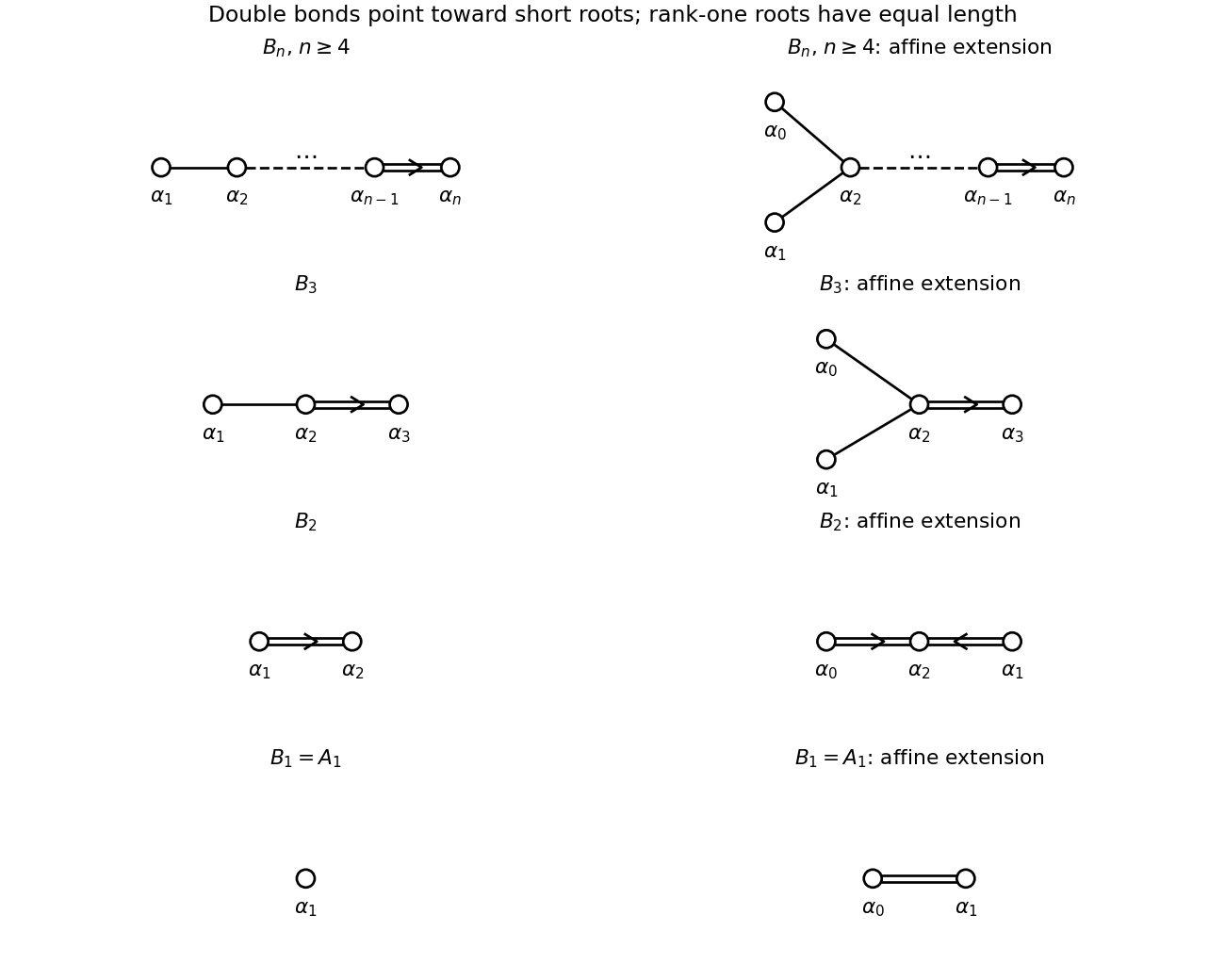


We construct the exceptional isomorphism between sp4 and so5. Let have a nondegenerate alternating form and symplectic basis . Define the symplectic contraction of an exterior squareIt is equivariant for the symplectic Lie algebra, and . Identify with using . Wedge product then gives a symmetric bilinear form on . It is nondegenerate, as the wedge-basis vectors pair with their complementary pairs.
The bivector is invariant under , satisfies , and has . Consequently and is nondegenerate. The exterior-power Lie algebra representation preserves wedge product and the volume form, so restriction gives a homomorphismWe check injectivity directly. If acts trivially on , it also annihilates the invariant line , hence acts trivially on all of . In any basis , the equation forces every off-diagonal coefficient to vanish: choose distinct from and inspect the coefficient of . Thus is diagonal. Its diagonal entries satisfy for every pair, which forces them all to be zero. Therefore is injective.
A symplectic matrix has infinitesimal block form with symmetric, so . Also . Injectivity and equal dimensions make an isomorphism. Every nondegenerate complex symmetric form in dimension five is equivalent by a change of basis to the given antidiagonal form, so
Identify the Cartan subalgebra with its coordinate vector using the invariant inner product. A root reflection isFor every root of the Bn root system, the explicit formulas areAll unlisted coordinates stay fixed, and opposite roots define the same reflection. These reflections give all coordinate permutations and independent sign changes. Therefore the Weyl group isIts action on is the group of signed permutation matrices.
Articles were limited to the first 100 out of 1911 total.
Articles by others on the same topic
There are currently no matching articles.