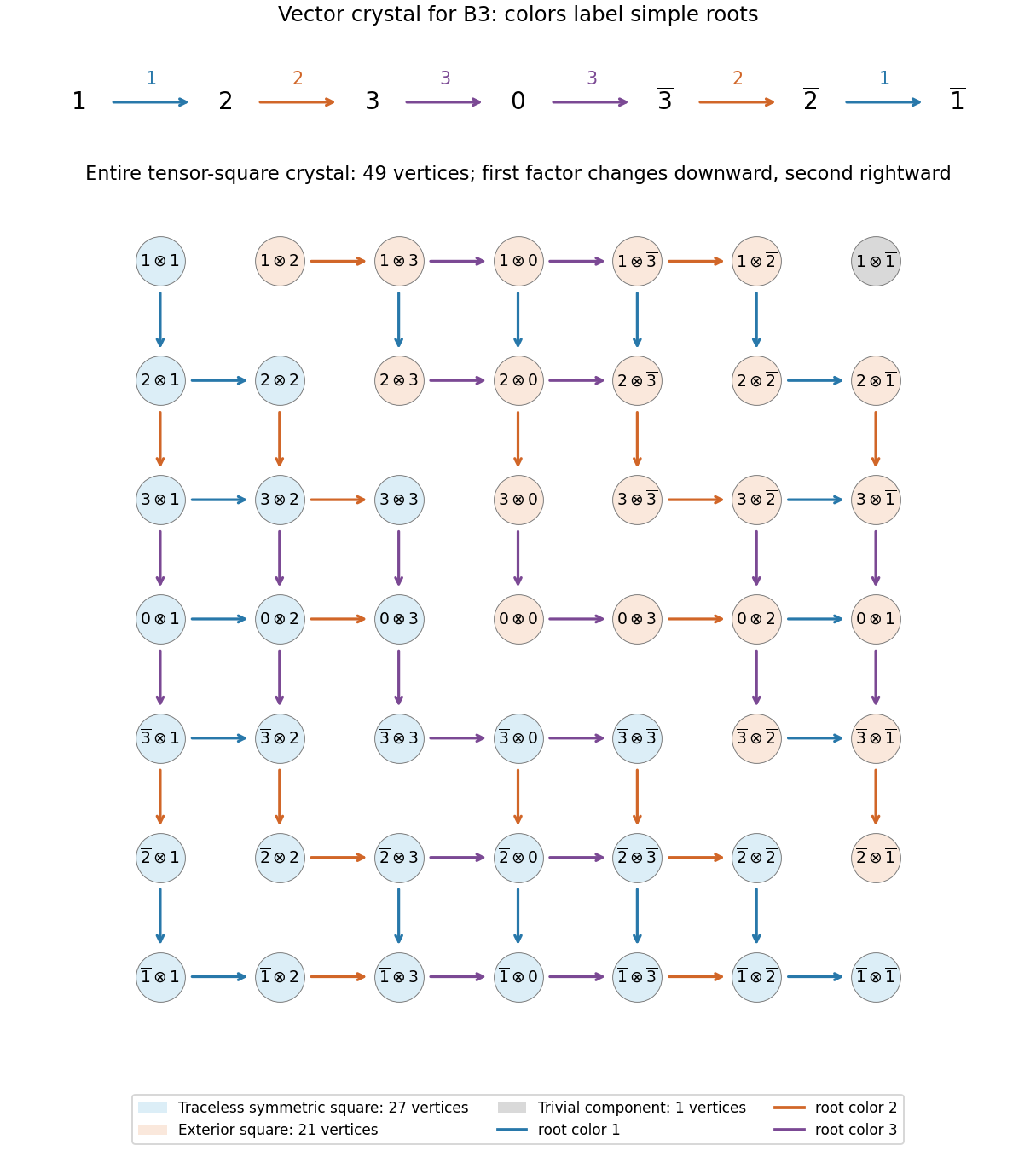
Label the weight vertices by , with weights . The crystal of the defining odd-orthogonal representation is the chainEach arrow of color subtracts the simple root . The two arrows through zero form the length-two short-root string.
Here is a complete grid description of the tensor product of crystals, valid for arbitrary . Place the vertex in row , column , in the above chain order; there are vertices. Let and count incoming and outgoing steps along the color- string. For , the two strings are and , each of length one. For , the string is , with pairs equal to . Other vertices have both counts zero.
Using the crystal tensor-product rule, draw every color- edge byThe first case is a downward arrow to the next row and the second a rightward arrow to the next column; omit an arrow when its indicated factor has no outgoing edge. Thus the rule specifies every vertex and every arrow of the general tensor-square diagram, including the boundary nodes. The figure displays the resulting entire grid for , alongside the vector crystal; the generator can draw any positive rank.
The raising rule chooses the first factor when and the second otherwise. For , its only highest vertices areIndeed a highest tensor must have highest first factor, hence . For colors , the second factor cannot have an incoming edge. For color one, its incoming count must be at most . Inspecting the strings leaves precisely .
These three connected components encode the Irreducible Lie algebra representationsHere is the traceless symmetric square, is the Adjoint representation, and the invariant symmetric form supplies the trivial summand. Their dimensions are , , and one, summing to . In fundamental-weight notation the highest weights are for , but for .

Articles by others on the same topic
There are currently no matching articles.