All brackets belong to the line , and shows this line is exactly the first derived algebra. Since is central, the derived series of a Lie algebra isThe lower central series of a Lie algebra is likewiseFor completeness, the center of a Lie algebra is : an element commutes with only if , and with only if . The upper central series of a Lie algebra is therefore , because the quotient by is abelian. Thus the Heisenberg Lie algebra is nilpotent of class two and solvable of derived length two. These properties are not mutually exclusive.
Let be a nonzero finite-dimensional Irreducible Lie algebra representation. Since is central, its action is a scalar by the Schur lemma. Taking the trace of gives , so .
The actions of now commute. Choose an eigenvalue of . Its nonzero eigenspace is preserved by , which has an eigenvector there, with some eigenvalue . The span of this common eigenvector is invariant under all of . Irreducibility forces it to be the whole representation. ConsequentlyConversely each such assignment is a one-dimensional Lie algebra representation and hence irreducible. Distinct pairs give nonisomorphic representations. This classifies all finite-dimensional irreducible representations; none is faithful because all annihilate .
Use the Polynomial representation of the Heisenberg Lie algebra on :The product rule gives , verifying the required bracket, and the identity commutes with both operators.
For irreducibility, let be a nonzero invariant subspace and choose a nonzero polynomial of degree in it. Its th derivative is a nonzero constant, so . Repeated multiplication by then puts every monomial in , giving .
For faithfulness, suppose . Applying this operator to gives , so . Applying what remains to gives . The representation is therefore faithful and irreducible. It is necessarily infinite-dimensional, by the finite-dimensional classification just proved.
On take the matrix unitsTheir products give , while commutes with each of the other two. Thus this is a Lie algebra representation. The three images are linearly independent, so its kernel is zero: it is faithful and finite-dimensional. It is reducible, as expected from the classification in part ii; for example, the first coordinate line is invariant.
Put and . A Cartan subalgebra isThe defining matrix condition says . Using the matrix units, the nonzero root spaces have the following generators:Commuting each generator with gives its stated weight. Together with , these matrices span the Special orthogonal Lie algebra; there are independent generators. Thus its decomposition as a Cartan subalgebra module isThis is the Bn root system. The upper-triangular generators select the positive rootsIts simple roots and highest root, for , areTo see the simplicity assertion, , while and . The coefficient pattern for dominates those of every positive root.
Normalize the inner product so the are orthonormal. The simple coroots are for and . Solving gives the fundamental weightsIn the half-sum of positive roots, the coordinate occurs with total coefficient . Hence the Weyl vector is
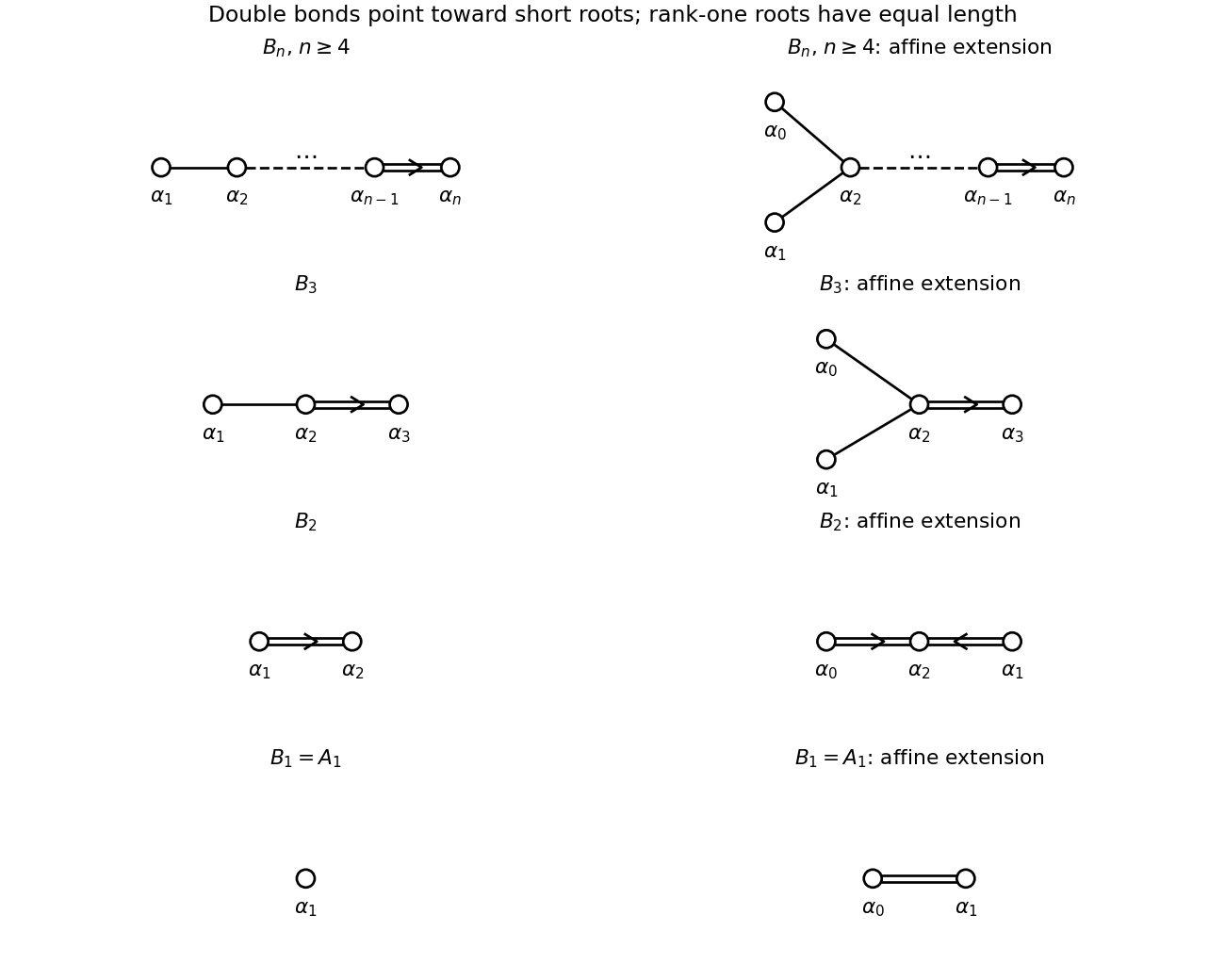
The Dynkin diagram is a chain , with single bonds up to and a double last bond pointing towards the short root . In the Extended Dynkin diagram, add . For , and its inner product with every other simple root is zero, so it attaches to by a single bond. For , both long nodes attach by double bonds to short node . These rules give the Bn Dynkin diagram and affine extension drawn below.
For rank one, , , , and . The finite diagram is one node; its affine extension has two equal-length nodes joined by a double bond, without a short-root arrow.
We construct the exceptional isomorphism between sp4 and so5. Let have a nondegenerate alternating form and symplectic basis . Define the symplectic contraction of an exterior squareIt is equivariant for the symplectic Lie algebra, and . Identify with using . Wedge product then gives a symmetric bilinear form on . It is nondegenerate, as the wedge-basis vectors pair with their complementary pairs.
The bivector is invariant under , satisfies , and has . Consequently and is nondegenerate. The exterior-power Lie algebra representation preserves wedge product and the volume form, so restriction gives a homomorphismWe check injectivity directly. If acts trivially on , it also annihilates the invariant line , hence acts trivially on all of . In any basis , the equation forces every off-diagonal coefficient to vanish: choose distinct from and inspect the coefficient of . Thus is diagonal. Its diagonal entries satisfy for every pair, which forces them all to be zero. Therefore is injective.
A symplectic matrix has infinitesimal block form with symmetric, so . Also . Injectivity and equal dimensions make an isomorphism. Every nondegenerate complex symmetric form in dimension five is equivalent by a change of basis to the given antidiagonal form, so
Identify the Cartan subalgebra with its coordinate vector using the invariant inner product. A root reflection isFor every root of the Bn root system, the explicit formulas areAll unlisted coordinates stay fixed, and opposite roots define the same reflection. These reflections give all coordinate permutations and independent sign changes. Therefore the Weyl group isIts action on is the group of signed permutation matrices.
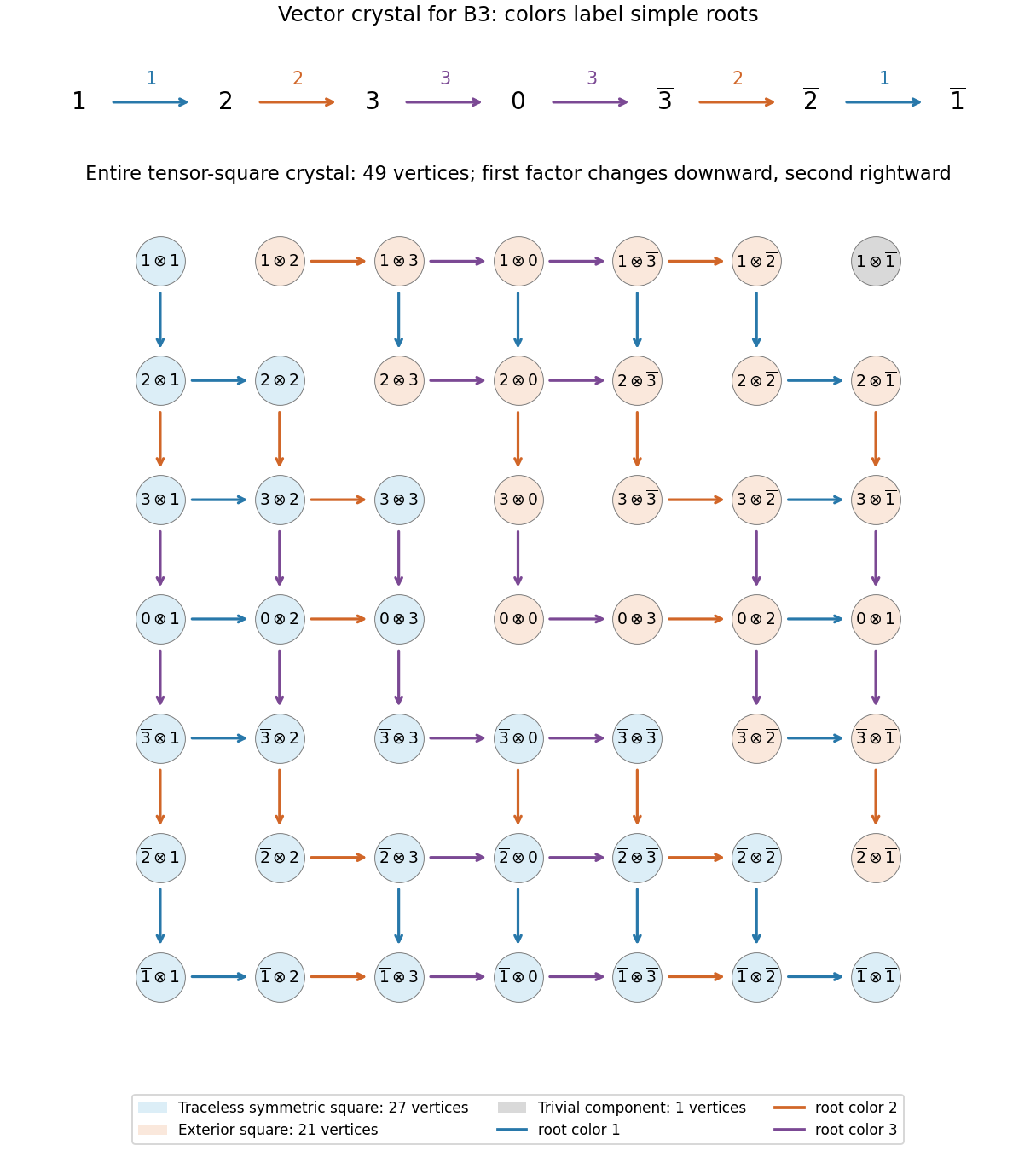
Label the weight vertices by , with weights . The crystal of the defining odd-orthogonal representation is the chainEach arrow of color subtracts the simple root . The two arrows through zero form the length-two short-root string.
Here is a complete grid description of the tensor product of crystals, valid for arbitrary . Place the vertex in row , column , in the above chain order; there are vertices. Let and count incoming and outgoing steps along the color- string. For , the two strings are and , each of length one. For , the string is , with pairs equal to . Other vertices have both counts zero.
Using the crystal tensor-product rule, draw every color- edge byThe first case is a downward arrow to the next row and the second a rightward arrow to the next column; omit an arrow when its indicated factor has no outgoing edge. Thus the rule specifies every vertex and every arrow of the general tensor-square diagram, including the boundary nodes. The figure displays the resulting entire grid for , alongside the vector crystal; the generator can draw any positive rank.
The raising rule chooses the first factor when and the second otherwise. For , its only highest vertices areIndeed a highest tensor must have highest first factor, hence . For colors , the second factor cannot have an incoming edge. For color one, its incoming count must be at most . Inspecting the strings leaves precisely .
These three connected components encode the Irreducible Lie algebra representationsHere is the traceless symmetric square, is the Adjoint representation, and the invariant symmetric form supplies the trivial summand. Their dimensions are , , and one, summing to . In fundamental-weight notation the highest weights are for , but for .
For the vector crystal is . The same tensor rule gives highest vertices , of weights , or , respectively. Its summand dimensions are .
Let be a complex semisimple Lie algebra, choose a Cartan subalgebra and a positive root system , and let be a dominant integral highest weight. Write for the corresponding finite-dimensional irreducible representation, for a coroot, and for the Weyl vector. The Weyl dimension formula isThe bracket denotes the natural pairing of weights with coroots. The normalization of an invariant inner product cancels from each ratio, so the formula can equivalently use roots instead of coroots in both numerator and denominator.
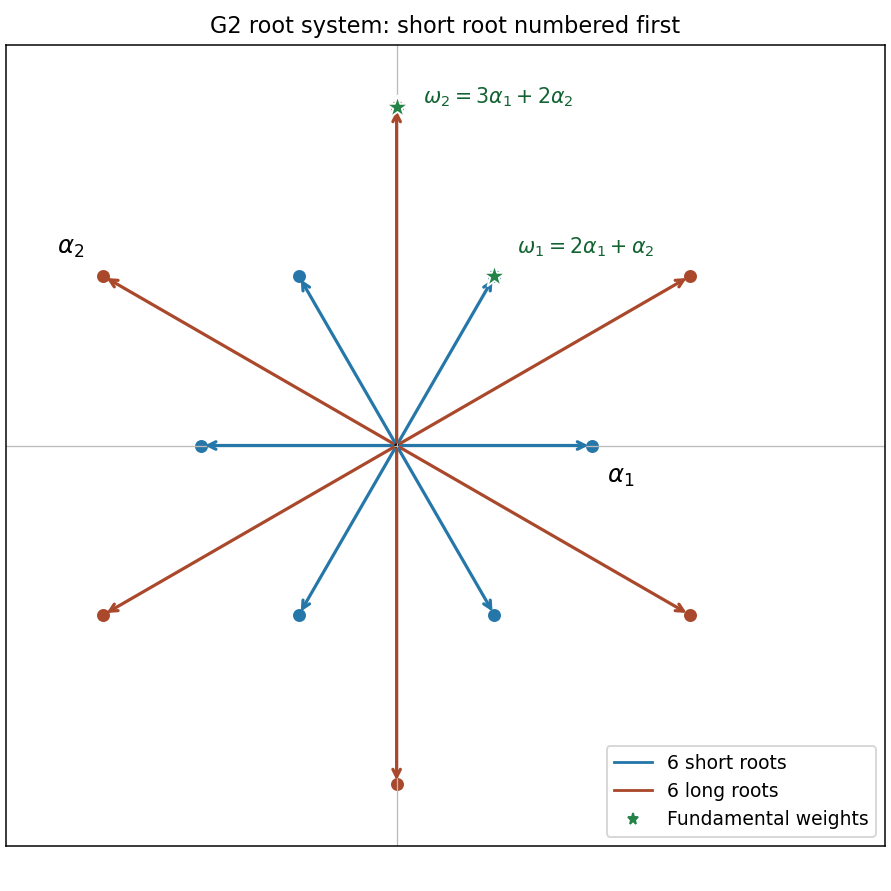
Number the simple roots of the G2 root system so that is short and is long. In the Euclidean plane chooseTheir squared lengths are one and three, and their angle is degrees. The six positive roots areTogether with their negatives these form the twelve-root diagram: two regular hexagons of radii one and , rotated by degrees relative to one another. Solving the fundamental weight equations givesIn particular is the highest short root and the highest long root. The root diagram below marks both weights.
To evaluate the Weyl dimension formula, put , and . The Weyl vector is . In the order of positive roots listed above, their coroots have simple-coroot coefficient pairsFor example the short root has coroot , while the long root has coroot . Pairing with and dividing by the same factors at gives the G2 dimension polynomialThe denominator is . As checks, the fundamental representations have dimensions seven and fourteen, and gives the trivial representation of dimension one.


Give its Adjoint representation and use the tensor product of Lie algebra representations. Define the action map of a Lie algebra representationFor , the action on the source is . The defining representation identity then givesThus is a Lie algebra representation homomorphism.
If is nontrivial and simple, the action is not identically zero, so the image of is a nonzero submodule. Simplicity forces to be surjective. For a finite-dimensional and a semisimple Lie algebra, the Weyl complete reducibility theorem provides an invariant complement to in . The restriction is then an isomorphism onto , givingThis proves the requested summand assertion in the finite-dimensional setting.
If finite dimensionality is not implicit, the final assertion needs that hypothesis: the action summand can fail for an infinite-dimensional simple module. Here is an explicit counterexample. Take with , , , and the Verma module of highest weight :The lowering coefficient never vanishes for , so an invariant subspace, using the distinct -weights to isolate a basis vector and then raising, contains and hence all of . Thus is simple.
In , a vector of weight is . Applying gives , so its highest vectors are precisely the multiples of . But , and has weight zero, absent from . Every homomorphism therefore kills this vector and then kills . Any embedded copy of would send its highest vector to a nonzero multiple of , so it cannot admit a projection back to . This rules out a direct summand, not merely a splitting of the particular action map.
Let be the standard Cartan element of the sl2 Lie algebra, with and . For a finite-dimensional representation, its formal character records its weight multiplicities:The classification of finite-dimensional sl2 representations and the Weyl complete reducibility theorem give , with finitely many nonzero . Each has weights , each of multiplicity one. ThereforeIn particular , and for one has . This proves parity unimodality of an sl2 character: within each parity, the coefficients increase towards zero and decrease away from zero. For a representation whose weights have a single parity, deleting the intervening zero coefficients gives a symmetric unimodal sequence.
The parity convention is necessary for the printed assertion. If unimodality means the full coefficient sequence at every consecutive integer exponent, it is false: the standard two-dimensional representation has character , whose coefficients at exponents are . The statement established above is unimodality on cosets of the root lattice for , and is the version needed in part ii. Infinite-dimensional representations need not even have Laurent-polynomial characters.
Assume with integers, as required for the quantum binomial expression. Let be the -dimensional irreducible sl2 Lie algebra representation, with one-dimensional weight spaces of weights , . The exterior-power Lie algebra representation on has characterThis is already a Laurent polynomial with nonnegative integer coefficients.
To identify it with the requested quotient, introduce and the Gaussian binomial coefficientSplitting the subsets according to whether is included provesThe product satisfies the same recurrence: after factoring common numerator and denominator terms, the needed identity is . Induction on therefore proves the product identity, including its polynomiality.
Since the quantum integer is , taking the quotient of the products givesThus this is the symmetric quantum binomial coefficient. All its weights have parity , because the exponent in the exterior-power sum differs from by an even integer. Applying part i to this finite-dimensional representation proves symmetric unimodality in steps of two. Equivalently, the ordinary polynomial has a unimodal coefficient sequence at consecutive powers of .
Again, the full integer-exponent coefficient sequence in , including the absent parity, need not be unimodal: for the answer is . This counterexample makes precise the convention under which the claimed quantum unimodality holds. The cases or give the constant one.
Articles by others on the same topic
There are currently no matching articles.