In a spatially flat FLRW metric, a radial null geodesic satisfies . Normalize . The comoving particle horizon at time is therefore , using the initial singularity as the time origin. The cosmological redshift relation givesFor matter and a cosmological constant in a spatially flat model, the Friedmann equation gives . The initial singularity corresponds to , so reversing the integration limits yieldsThis is a comoving particle horizon, not a distance to the source currently observed at redshift , and not a future-directed cosmological event horizon. The corresponding proper horizon radius at that epoch is .
For an Einstein-de Sitter universe, the Hubble parameter is . The comoving particle horizon becomesThusIt tends to zero towards the initial singularity and increases without bound as in the infinite future. At the present time it is , since the Einstein-de Sitter universe has age .
Use the stipulated common normalization and plot . The Einstein-de Sitter universe has , whereas the model has . Their comoving particle horizons are thereforeBoth decrease with increasing , or increase with cosmic time. The Einstein-de Sitter universe curve diverges at and has , . The matter-plus-vacuum curve remains finite at : the integrand approaches a constant there, and its high-redshift tail is integrable. Moreover it lies below the Einstein-de Sitter curve for this particular normalization, since, with ,The high-redshift ratio of the two curves tends to , not one. Holding fixed would give a different comparison; it is that the original question specifies.
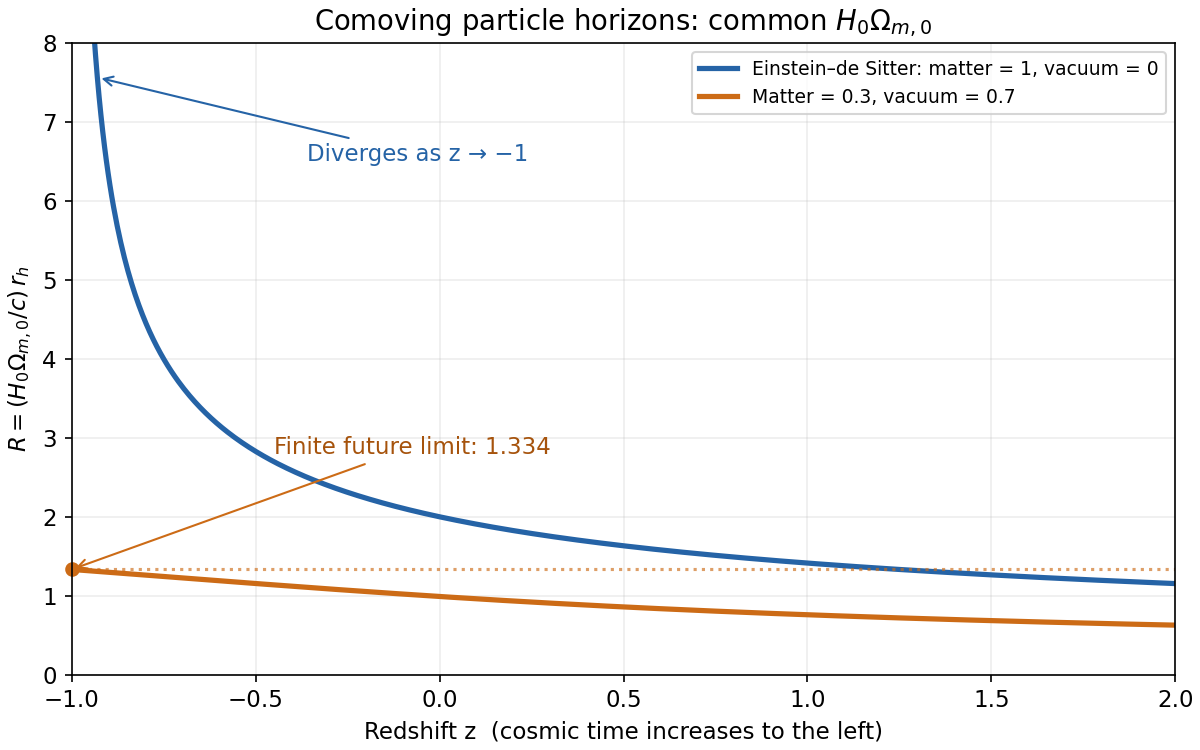

A positive cosmological constant eventually makes the scale factor grow exponentially. The future integral then converges, so the remaining conformal time is finite. The comoving particle horizon approaches a finite limiting visibility radius; it does not shrink. The remaining distance to that limit is the comoving radius of the cosmological event horizon. Thus a signal emitted sufficiently far away today can never reach us, even though the proper particle-horizon radius continues to grow. This is the total conformal lifetime of a flat matter-Lambda universe.
Normalize the Einstein-de Sitter universe by , giving . A photon emitted inward today at the current comoving particle horizon starts at . By time it has traversed the comoving distanceAt arrival at Earth this equals , hence andThe emitting point is at the horizon location today, not a photon already arriving today from the initial singularity. The calculation of photon arrival from an Einstein-de Sitter particle horizon follows the future inward null geodesic from that event.
Articles by others on the same topic
There are currently no matching articles.