For spatially homogeneous solutions, the bistable cubic reaction-diffusion equation reduces to . Its equilibria are , andThus and are asymptotically stable, while is unstable. Small spatial Fourier perturbations have growth rates , so diffusion also leaves the two outer uniform states linearly stable.
At , write , so . Multiplying the stationary equation by gives . The endpoint values and vanishing endpoint derivatives make . For the decreasing connection,Separate variables and absorb the integration constant into a translation . The logistic front of a bistable cubic equation isIt approaches on the left and on the right and satisfies the stationary differential equation directly.
A travelling wave obeys , so the mechanical potential in the requested form is , up to an additive constant. HereIts stationary points are maxima at and a minimum at . Since and , the two maxima have equal height at ; the maximum at is lower for and higher for .
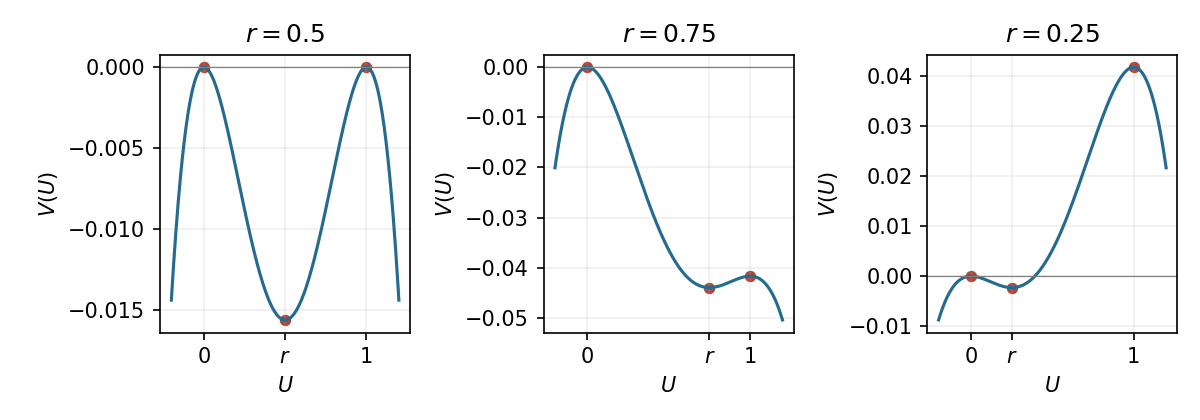

Multiply the wave equation by and integrate along the heteroclinic orbit. The endpoint derivatives vanish, and , , soConsequentlyThe integral is positive for a nonconstant front. In fact substitution of the same logistic shape from part (b) gives the exact velocity . Thus the phase invades rightwards when , the zero phase invades leftwards when , and the balanced front is stationary.
Articles by others on the same topic
There are currently no matching articles.