For an integral binary quadratic form with and , the reduced positive definite binary quadratic form convention is , with on either boundary or . Since , the enumeration of reduced binary quadratic forms for has . The integer is odd. For , only is retained and ; for , both give . Thus the complete list isA proper representation of a prime uses a primitive representing vector. Completing that vector to a matrix in transforms a representing form to , so its discriminant of a binary quadratic form gives . Conversely, choose an odd satisfying this congruence and put . This is integral, and is positive definite and represents at . This proves the discriminant criterion for prime representation by a binary quadratic form here.
For , quadratic reciprocity gives . Including the ramified prime, the answer is thereforeFor example supplies a proper representation of . Reduction transfers every such representation to one of the three displayed forms.
The planar Brouwer fixed-point theorem says that every continuous map from the closed disk to itself has a fixed point. If a retraction existed, would be a continuous self-map of . At a fixed point , lies on the boundary, where ; this would give , impossible on the unit circle.
Conversely, suppose a continuous self-map has no fixed point. For each , take the ray starting at through , and let be its exit point on . The denominator never vanishes, and solving the quadratic intersection with the circle shows that the exit point depends continuously on . More explicitly, with ,The ray exits beyond or at , so , and when its exit point is . Hence is a retraction. Nonexistence of a boundary retraction and the planar fixed-point theorem are equivalent.
Define the continuous map . For , the triangle inequality gives . Thus maps the closed unit disk into itself. By the Brouwer fixed-point theorem, some has , which rearranges toThis supplies the requested existence and even places a root strictly inside the unit disk.
Every discrete additive subgroup of has the form for linearly independent vectors, with or . A full translation lattice has , and conversely every such integer span is a discrete cocompact subgroup. This classifies planar lattices up to a choice of basis.
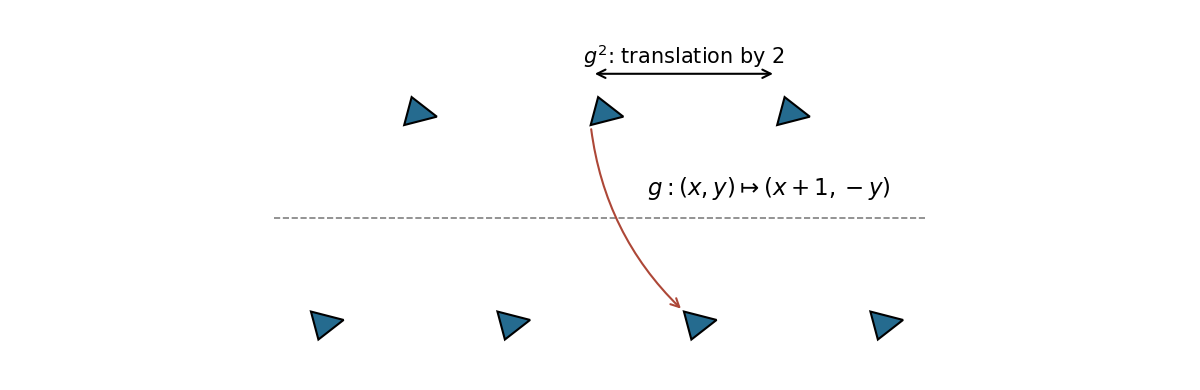
A frieze group is a discrete group of planar Euclidean isometries whose translation subgroup is infinite cyclic and has finite index. Consider the glide reflection . Its square is translation by , whereas every odd power reverses orientation. Therefore , but none of its translation elements generates the whole group: they form the index-two subgroup .
To realize exactly this frieze group, repeat a small scalene triangular motif at the points , reflecting the motif when is odd. Choose the motif with three distinct side lengths and no internal symmetry. The displayed pattern has glide reflection symmetry and translation period , but no pure horizontal reflection or vertical mirror. Distinct side lengths force any symmetry to preserve corresponding vertices, which rules out extra motif permutations; the sequence of heights then leaves exactly the powers of .
For Shannon-Fano coding, order the symbols by decreasing probability and recursively split each current list into two contiguous groups with total probabilities as close as possible. Label the two branches and ; the path to a symbol is its prefix code word. Here the first split is of weight against of weight . The latter splits into and , each of weight . One answer isFor Huffman coding, repeatedly merge the two least-probable nodes and then read the resulting binary tree from the root. Merge to weight , merge this node with to weight , and merge with . The same displayed prefix code results. Its mean length is . Choices at ties and exchange of binary labels yield other equivalent codes. Huffman coding minimizes mean length among binary prefix codes; the top-down Shannon-Fano construction does not have that general optimality guarantee.
Under independent normal distributions, maximum likelihood estimation minimizes subject to . A Lagrange multiplier gives the same correction at every corner. Writing , the interior estimates areThe result is unchanged if the common variance is unknown, since profiling it still minimizes the residual sum of squares. If physical positivity of the three angles is imposed and this projection gives a negative component, the constrained estimate over the closed simplex is instead , with chosen to make the components sum to . If only strictly nondegenerate triangles are admitted, a boundary optimum is merely an unattained likelihood supremum.
The normal-error model is a useful small-error approximation, but its unbounded tails assign positive probability to impossible measured angles. Periodicity or a measurement convention may matter for large errors, and equal variance and independence require experimental justification. The exact sum constraint on the true angles does not itself invalidate independence of three raw measurement errors. After imposing that constraint, however, the fitted-angle errors are correlated: the covariance of the interior estimator is .
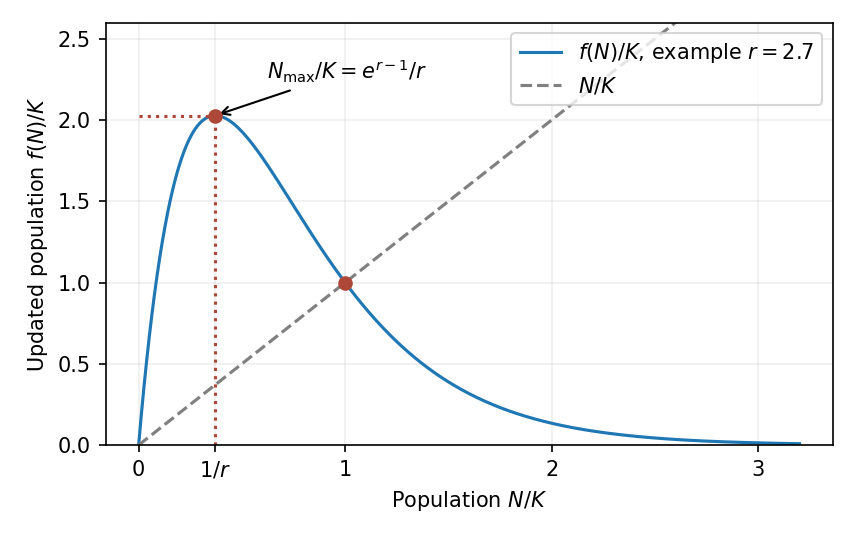
The Ricker population map has equilibria and . Since , their linearization multipliers areThus extinction is unstable and the positive equilibrium is locally asymptotically stable for , becoming unstable for .
To verify an actual period-doubling bifurcation, rather than only a multiplier crossing, put and . The centered map isIts second iterate minus is to leading order. After rescaling , the limiting nonzero roots are simple, so the implicit function theorem continues them. Besides , two nearby points therefore appear for , with . The map exchanges these points, and the derivative of its second iterate there is , so the emerging two-cycle is attracting. The bifurcation at is supercritical period doubling.
For nonnegative populations, increases up to and decreases thereafter to zero. Hence every update after the initial time satisfiesThe bound is attained by choosing ; it is not a bound on an arbitrary initial population.
At a stationary bifurcation, a real eigenvalue of the equilibrium linearization crosses zero; the critical motion has zero frequency. At a Hopf bifurcation, a conjugate pair crosses the imaginary axis at with , permitting a nearby limit cycle.
The Hopf normal form has a small cycle when . Its radial multiplier exponent is , while the origin's radial exponent is . Thus: for , there is an attracting spiral and no small cycle; for , a repelling spiral is surrounded by an attracting cycle; for , an attracting spiral is surrounded by a repelling cycle; for , there is a repelling spiral and no small cycle. Outside the repelling cycle in the third case the local radial flow points outward; a cubic normal form makes no global prediction about where it goes.
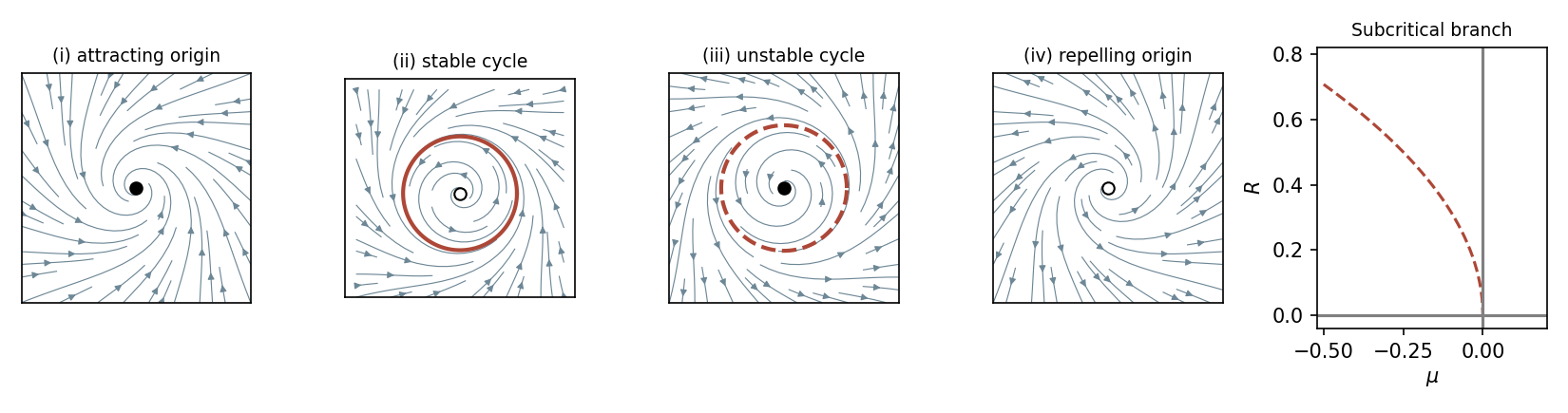
Four local Hopf phase portraits and the unstable subcritical radius branch
. Details. The subcritical bifurcation has and the unstable radius branch on , meeting the origin at . On either existing branch, the angular speed is , so
For the beta function, split inside the integral to obtain . Integrating the derivative of over gives , since both endpoint terms vanish in the initial domain. Combining these identities yieldsRepeatedly apply this recurrence until . Each resulting expression agrees with the original integral on overlap, so it gives its unique analytic continuation. Possible singularities are only .
Near , . Continuing the recurrence downwards giveswhere the empty product is . The recurrence shows that each singularity is at most a simple pole. If is not a positive integer, all these residues are nonzero and all the listed points are poles. If is a positive integer, poles occur only for ; the later candidates are removable, as is also clear from . This qualification matters when claiming a pole at every nonpositive integer.
Varying the Lagrangian gives, with the cyclic angle conventions,All successive angular gaps are in equilibrium, so their two contributions cancel. Because the potential depends only on gaps, a uniform change of all angles costs no energy. Its Hessian therefore annihilates , giving a zero-frequency normal mode. The corresponding motion is rigid rotation, , including a constant common angular shift.
For two particles write . Both cyclic gaps contribute, so the quadratic potential is . With the specified masses, the mass matrix is and the stiffness matrix is . The generalized eigenvalue problem givesThe finite-frequency normal mode keeps the mass-weighted mean angle fixed and changes the angular separation sinusoidally. Together with the two rigid-rotation constants, it spans all small motions about equilibrium.
For a regular spherical star, mass conservation gives . Multiplying the hydrostatic equilibrium equation by and differentiating therefore yieldsAt the center, finite density implies , so a regular pressure satisfies and . At a free outer boundary in vacuum, ; a surrounding medium would instead prescribe its external pressure.
Differentiate the auxiliary function, using both equations:where enclosed mass is nonzero. Since at the regular center, , whereas . Integrating the strictly negative derivative givesWith nonzero external pressure, the corresponding bound is .
Let be the constant function and define . Positivity gives . Fix any and any continuous . The function vanishes at , so the zero-preserving assumption gives . By linearity this is . Since was arbitrary,This proves the zero-preserving linear operator on continuous functions representation. Zero preservation and linearity determine the multiplication operator; positivity is needed only for the multiplier's sign. The three numbered conditions in the source are hypotheses of this one request, rather than three separate subquestions.
In the Rabin cryptosystem, choose distinct large odd primes , publish , and encrypt as . Usually , so a square root modulo each prime is obtained by exponentiating to or . Combine the two independent choices of signs by the Chinese remainder theorem to obtain the four roots modulo for a message coprime to . Redundancy or a specified encoding distinguishes the intended message. Factoring makes decryption easy; a general square-root oracle conversely factors by obtaining two roots not congruent up to sign and taking their greatest common divisor with .
For the Repeated-message attack on the Rabin cryptosystem, first compute . If , use the two ciphertexts to reconstruct with and . Since , we have , so this reconstruction is the ordinary integer . ThereforeIf distinct semiprime moduli have , they share a prime; the gcd instead exposes their factors, allowing ordinary Rabin decryption with the usual encoding check. The two cases cover the stated protocol with distinct standard moduli.
In the coprime case, learning this message does not normally reveal the factors or a decryption key, so other messages encrypted only once remain protected by the square-root problem. Exceptional messages with do reveal a factor, and the shared-prime-modulus case compromises other messages too. Repetition under fresh coprime moduli is the vulnerability used here, rather than a universal attack on every ciphertext.
For spatially homogeneous solutions, the bistable cubic reaction-diffusion equation reduces to . Its equilibria are , andThus and are asymptotically stable, while is unstable. Small spatial Fourier perturbations have growth rates , so diffusion also leaves the two outer uniform states linearly stable.
At , write , so . Multiplying the stationary equation by gives . The endpoint values and vanishing endpoint derivatives make . For the decreasing connection,Separate variables and absorb the integration constant into a translation . The logistic front of a bistable cubic equation isIt approaches on the left and on the right and satisfies the stationary differential equation directly.
A travelling wave obeys , so the mechanical potential in the requested form is , up to an additive constant. HereIts stationary points are maxima at and a minimum at . Since and , the two maxima have equal height at ; the maximum at is lower for and higher for .
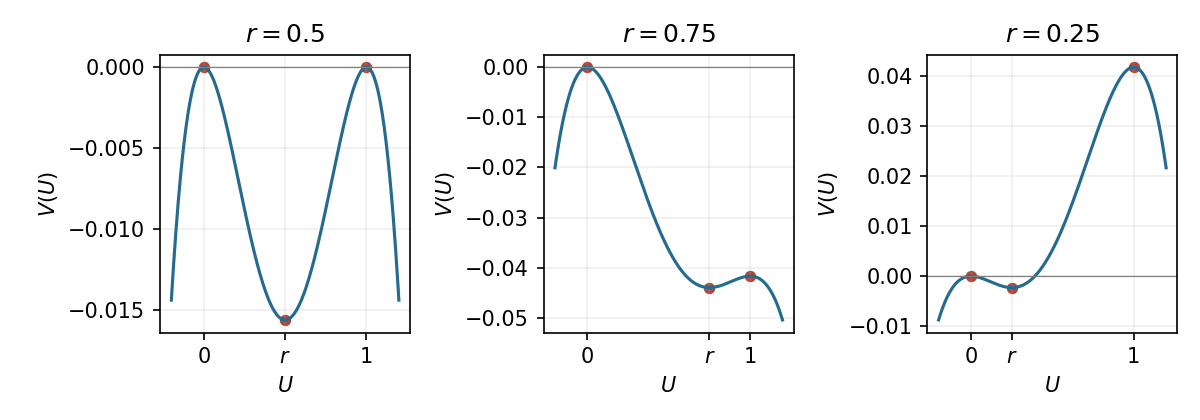


Multiply the wave equation by and integrate along the heteroclinic orbit. The endpoint derivatives vanish, and , , soConsequentlyThe integral is positive for a nonconstant front. In fact substitution of the same logistic shape from part (b) gives the exact velocity . Thus the phase invades rightwards when , the zero phase invades leftwards when , and the balanced front is stationary.
Parametrize the continued branch by , . Then , givingThe apparent singularity at zero is removable, so is an entire function. The factor shows its dependence on the contour radius; for instance . The integrand is continued along the contour and generally returns on a different branch, so this is not an ordinary integral of a single-valued holomorphic function around a closed loop.
There is a branch-phase discrepancy in the printed identity. Set using the positive real base. Shrink the anticlockwise loop at . The outward interval carries phase and its return phase ; their difference gives . The clockwise loop at starts with phase and returns with , giving the same coefficient on . Small endpoint circles vanish for . Thus the branch phase in a figure-eight analytic continuation integral isIf the printed interval integral uses the prescribed argument , then , and the corrected formula is insteadFor example at , , and ; the printed right side without the phase would be the real number . Interpreting its interval integrand as restores the intended identity.
On the fixed contour away from its branch points, the continued logarithm is bounded and is entire in , uniformly on compact sets. Hence is an entire function. Division by the sine gives a meromorphic continuation of , and multiplication by gives the continuation of the specified . The only candidate singularities are integers, at most simple. All are removable because the interval integral is already holomorphic on .
The negative integers , , are genuine simple poles. At such a point the contour integrand is single-valued andThe first residue is times a rational number. The second is times a nonzero rational number: expand at , whose degree- coefficient has sign and nonzero magnitude. They cannot be equal because is irrational. Therefore , and the simple sine zero creates a simple pole. In particular .
A circle enclosing both branch points has total logarithmic change , rather than zero as for the figure eight. For a circle based at with initial real logarithm, shrinking it leaves a connector from to as well as the two banks of the interval. Explicitly its integral isThus it is not just a known sine factor times : an additional endpoint-singular integral remains. The figure-eight contour eliminates precisely that connector term. This explains why replacing it by the large circle does not give the same direct continuation method.
Put . From Hamilton's equations,For the stated time-independent vector potential, differentiating gives , orUse the Poisson bracket convention . Then direct differentiation givesFor with , the Hamiltonian is independent of , so . The radial force in the horizontal plane is . For circular motion the radial acceleration is , and is the mechanical radial momentum because the horizontal vector potential vanishes. ThusA circular orbit at that radius is possible when the right side is nonnegative; positive values give either sense of horizontal rotation, and the longitudinal velocity is the constant along that orbit.
The Godel completeness theorem for first-order logic states that implies ; together with soundness, semantic consequence and derivability coincide. Equivalently, every syntactically consistent first-order theory has a model. The compactness theorem states that a set of first-order sentences has a model if and only if every finite subset has a model. These statements use nonempty first-order structures.
For each , let assert the existence of distinct elements. If a theory has arbitrarily large finite models, every finite subset of has a model. By the compactness theorem, this extended theory has a model, necessarily infinite. Since fields of size are arbitrarily large, no first-order theory can have exactly the finite fields of characteristic two as its models.
Suppose instead a finite conjunction axiomatized exactly the infinite fields of characteristic two. Let be the field axioms with . Then would have exactly the finite characteristic-two fields as models, contradicting the preceding conclusion. Equivalently, compactness of would force some finite size threshold, but arbitrarily large finite fields still fail . The infinite characteristic-two fields are not finitely axiomatizable.
The intended closed-term witness property for quantifier-free existential sentences needs at least one closed term. Under this hypothesis, suppose the set were consistent. By the Godel completeness theorem, it has a model . Take the substructure whose elements are the interpretations of closed terms. It is nonempty and closed under every function symbol. Atomic formulas and their negations have the same truth values in as in , and induction extends this to every quantifier-free formula.
The provable sentence is true in by soundness. Its witness is for some closed term , so , contradicting . Hence is inconsistent. The compactness theorem gives a finite inconsistent subset, so completeness and classical propositional reasoning yieldWithout a constant or nullary function, the printed assertion is false as written: in the equality-only language there are no closed terms, but is provable. Then is empty and consistent. One may repair the usual theorem by assuming a nonempty set of closed terms or adjoining a fresh constant; the latter proves a witness disjunction in the enlarged language, not the missing closed terms in the original one.
Here graphs are finite and simple. To prove Dirac theorem, take a longest path . All neighbours of either endpoint lie on the path. Among indices , let and . Since , some lies in both. Following the path forward to , jumping to , and following it backwards to closes a cycle containing every vertex of the path. The degree condition makes the graph connected: two components would each have at least vertices. If , connectedness gives an edge from an outside vertex to the cycle, and breaking the cycle there makes a longer path. This contradiction proves a Hamiltonian cycle.
For even , the complete bipartite graph has minimum degree and no Hamiltonian cycle. For odd , has minimum degree and likewise fails: a bipartite cycle uses equal numbers from its two parts. These examples include the smallest applicable .
Adding one universal vertex gives vertices and minimum degree at least when the original minimum degree is at least . Apply the proved theorem and remove the universal vertex from its cycle. The remaining sequence is a Hamiltonian path in the original graph.
A necessary condition for a Hamiltonian cycle is that deleting a nonempty vertex set leaves at most components, since deleting those vertices breaks a spanning cycle into at most that many path pieces. For any , take the connected star . In , deleting its center and the new vertices leaves components, more than . Even two-connectivity does not suffice: take , which is two-connected. Deleting its two-vertex part and the new vertices from leaves components, more than . Both connectivity requirements admit counterexamples for every .
If , the splitting field is and its Galois group is trivial, hence cyclic. Otherwise choose with . The roots are , so the splitting field is because . The roots are distinct since the characteristic does not divide , making this a Galois extension. Each automorphism satisfies with . Because that root-of-unity group is fixed by all automorphisms, . Thus is an injective homomorphism into a cyclic group. The splitting-field Galois group is cyclic, of order dividing .
An automorphism of fixing fixes . Because is a normal extension, it preserves , so restriction gives a homomorphismIts kernel fixes both and , hence every element of their compositum. Therefore restriction is injective, proving the asserted subgroup identification. Normality is the key reason the restriction maps into automorphisms of rather than just embeddings into a larger field.
A primitive sixth root of unity satisfieswhich is irreducible over because its discriminant is . For the other polynomial choose , so and . Then , so this field already contains all six roots. The Eisenstein criterion at proves irreducible, giving a splitting field of degree six.
Put and . The first automorphism fixes and has order three. The second sends to its negative, so sends to ; hence and . These six distinct transformations exhaust the Galois group. ThereforeThe presence of sixth roots of unity inside the splitting field is why this particular binomial has degree six rather than a generic twelve-degree splitting field.
There are seven irreducible characters, one for each conjugacy class. Besides the trivial character and the four supplied rows, let the remaining degrees be . The sum of squared degrees gives , whose positive integer solutions are . Complex conjugation permutes irreducible characters while preserving degree; the known rows are real and each unknown degree occurs just once among the remaining characters, so the two missing characters are real.
Call their entries , with degrees five and nine. Orthogonality with the regular character gives for . Column norms give . These equations yield two possible rational pairs in some columns. For this integral character reconstruction from column orthogonality, a further constraint is essential: character values are algebraic integers, so rational candidates must be integers. For example at , and allow and ; the second pair is not integral. The integral choices complete the table:Every nontrivial row has for . In a unitary realization, exactly when all eigenvalues of the representing matrix are one, so each nontrivial irreducible representation is faithful. If a nontrivial proper normal subgroup existed, a nontrivial irreducible representation of the nontrivial quotient would pull back to a nontrivial representation with that subgroup in its kernel. This contradicts faithfulness. The group is simple.
Put . Since , the ring of integers is and its field discriminant is . All three primes ramify:For example and both ideals have norm , proving equality. The Minkowski bound for ideal classes is . Thus the ideal class group is generated by the classes of these prime ideals; an ideal of norm four contributes only the already principal .
The elements and have norms and . Their ideal factorizations give and . This also explains the printed hint: , a fraction, not the integer . Therefore and , leaving at most two ideal classes. The class of is nontrivial: a principal generator would have norm , but would require or , impossible. Hence
Units have norm . Norm is impossible modulo three. The least positive unit greater than one isIndeed its norm is one. A smaller positive norm-one unit would have , forcing , but then . Multiplying an arbitrary positive unit by powers of reduces it to , so minimality proves that all units are .
The equation with right side is impossible modulo three, since it would require . For norm , let , so and . For unit reduction for quadratic norm equations, change the sign of if necessary to make it positive, then multiply by a power of the fundamental unit to place it in . Its conjugate is divided by itself, soThe maximum on this interval occurs at its endpoints. Thus , and ; only lies in the half-open interval. Reversing the reduction gives all solutions:Every displayed element has norm , and the reduction proves completeness, including both signs of and .
Suppose an odd continuous map existed. Restrict to the equator, parametrized by . Choose a continuous real lift with . Oddness gives for a fixed integer , since the integer-valued difference is continuous. Thus , and the equatorial map has odd degree of a continuous mapping, hence nonzero degree. But it extends over a hemisphere, which is a disk, so the equatorial loop is null-homotopic and has degree zero. This contradiction proves the dimension-two Borsuk-Ulam theorem in the stated form.
If a continuous injection existed, then would never vanish. Normalization would definea continuous odd map, already ruled out. In particular the sphere cannot be homeomorphic to any planar subset.
The Uniform boundedness principle states that a pointwise bounded family of bounded linear maps from a Banach space to a normed space is uniformly bounded in operator norm. Define closed sets . Pointwise boundedness makes their union . The Baire category theorem gives a ball for some . For , both and lie in , so for every . Scaling yields , proving the principle.
For the separately continuous bilinear map, consider with . Each is bounded and linear. For fixed , continuity of the other linear map gives . Apply the Uniform boundedness principle to this family to getBilinearity then gives ; the bound proves joint continuity.
For the trilinear map, fix . The just-proved bilinear result bounds . Thus the bounded linear maps , for , are pointwise bounded. Apply the Uniform boundedness principle once more to obtain . Expansion of the difference in three slots proves joint continuity. Separate continuity suffices for these multilinear maps.
Without linearity it does not suffice. On set away from the origin and . Each coordinate section is continuous, but for , so is not continuous at the origin.
A divisor on a compact connected Riemann surface is a finite formal sum with integer coefficients; its degree is . A canonical divisor is the divisor of zeros and poles of a nonzero meromorphic differential. Two divisors are linearly equivalent when their difference is the divisor of a nonzero meromorphic function. Such principal divisors have degree zero, but equal degree does not generally imply linear equivalence of divisors.
For example take distinct points on a genus-one surface. If were principal, its function would define a degree-one meromorphic map to the sphere, since it has just one simple pole. A degree-one map between compact Riemann surfaces is a biholomorphism, contradicting their different genera. Thus these degree-one divisors are not equivalent.
Define and . The Riemann-Roch theorem statesSince all holomorphic functions on the compact surface are constant, . Setting gives . Multiplication by a fixed meromorphic differential identifies with holomorphic differentials, so their dimension is . Setting then givesFor , choose a nonzero holomorphic differential, whose effective canonical divisor has degree two. Since , contains a nonconstant meromorphic function. Its pole divisor is bounded by that effective , proving existence of a nonconstant function with total pole multiplicity at most two.
Parametrize the regular curve by arclength . Its unit tangent is , and its curvature is . Where , define the principal normal and binormal . The torsion of a space curve is . Orthonormality and differentiation give the Frenet-Serret formulasFor a general parameter, and . The normal and torsion formulas require nonzero curvature; at zero-curvature points this particular Frenet frame need not be defined.
The planar planar isoperimetric inequality is , with equality exactly for a disk. For one boundary component of length , take its unit-speed periodic parametrization and subtract its mean position. Green's area formula and the Cauchy-Schwarz inequality giveApply the periodic Wirtinger inequality to each mean-zero coordinate: . Since unit speed gives the final integral , it follows that . For several boundary components, orient each with the domain on its left. Green's formula, followed by the triangle inequality, givesThis proves the stated inequality, including disconnected domains or holes. Equality permits only one component; equality in the two integral inequalities makes its coordinates first sine-cosine harmonics with the corresponding orthogonal rotation relation. Unit speed then makes the curve a circle, so its domain is a disk. Conversely disks attain equality.
Let be the center of the containing disk and take arclength around the closed curve. The periodic function has a maximum. At a maximum ,By the Cauchy-Schwarz inequality and the containing radius, . ThereforeClosedness provides an interior maximum on the periodic parameter domain. Without it, the straight segment for lies in the disk but has signed curvature identically zero, giving the required counterexample.
A simple function is a measurable function taking finitely many values, expressible as for disjoint measurable sets. For nonnegative coefficients define . The Lebesgue integral of a nonnegative measurable isSuppose with each simple. Their integrals increase and are bounded above by . For the reverse bound, fix any simple and . The sets increase to a set containing . Hence , whose right side tends to by continuity from below of the measure on the finitely many level sets of . Let and then take the supremum over . This proves , including infinite limiting integrals.
The monotone convergence theorem states the same conclusion for any nonnegative measurable sequence , without simplicity. The preceding lower-bound argument works unchanged: and monotonicity of the integral give . Taking limits and the same two suprema provesThe upper bound follows from . Finiteness of the measure makes all bounded simple integrals finite in this proof; the theorem in fact extends to arbitrary measure spaces.
The arrows in the PDF give at rate , at rate for , and switches and at rates and . All rates are positive. One can travel upwards in level in the phase and downwards in the phase, switching at either end. Hence any state reaches any other through a finite positive-rate path: the continuous-time Markov chain is irreducible. Its total jump rates are uniformly bounded, so it is also nonexplosive.
Condition on the first jump, putting . The hitting probabilities obeyThe relevant characterization is that a hitting probability is the minimal nonnegative harmonic extension of its target-boundary value. Thus among nonnegative solutions of these equations with , choose the componentwise least one. Other harmonic solutions need not be probabilities. This also identifies the solution without imposing an unjustified boundary condition at infinity.
Use the equation at level to express in terms of the preceding level, then substitute it into the equation at level . This yieldsThe standard eigenpair is . Each row sums to one because constant functions are harmonic for every Markov generator. This recurrence matrix need not have nonnegative entries; it encodes a harmonic equation, rather than a transition matrix. The superscript labels the level vector and is not an additional printed subpart.
Since one eigenvalue is one, the other is the determinant. Direct calculation givesIndeed the first row requires , and the second row then follows from the characteristic equation. At , and the eigenvectors coincide; the nonidentity matrix has a repeated eigenvalue and a Jordan block.
If , the general level solution is a constant multiple of plus a multiple of . Boundedness of probabilities removes the growing component, and then fixes the constant to one. If , the nonzero Jordan part produces linear growth unless the initial vector lies in the one-dimensional eigenspace; the same conclusion follows. ThusStarting at , the chain leaves to and returns with probability one. An irreducible chain with a recurrent state has all states recurrent, so the chain is recurrent in both cases.
Here is equivalent to , which gives from its explicit formula. Any nonnegative solution is of the formsince its second component at level zero must be one. Letting forces for nonnegativity. The choice is nonnegative, and subtracting it from any other such solution gives . Therefore minimality selectsIn particular the return probability after leaving is , so the irreducible chain is transient. These formulas are the hitting probabilities for a velocity-switching Markov ladder.
Combining the eigenvalue cases givesThis agrees with the interior drift: the switching phase spends proportions and in and , giving level drift . The harmonic calculation establishes recurrence even at the zero-drift boundary, rather than inferring it from drift alone.
Interpret as the conditional rejection probability. The Type I error is , the Type II error is , the size is , and the power is . Their weighted sum isPointwise minimization over forces rejection where and acceptance where , with arbitrary randomization on equality. Conversely those choices minimize every integrand. The equivalence holds almost everywhere, since changing a test on a common null set cannot change its errors. With both weights strictly positive, any simultaneous improvement of the two errors, strict in at least one, would lower this weighted sum. Every such positive-threshold likelihood ratio test is admissible for the two simple hypotheses.
For the specified densities the likelihood ratio isIt increases strictly on from zero to . For , the likelihood-ratio test rejects when . Larger thresholds accept almost surely. Threshold zero rejects everywhere above and permits arbitrary rejection below , where both weighted choices tie; values at individual endpoints do not affect errors. These describe all nonnegative-threshold likelihood ratio tests, including their limiting accept-all and reject-all cases.
The upper-tail test has size . If , it is a positive-threshold likelihood ratio test and is admissible. If , it rejects exactly the alternative's support, with power one; no test can retain power one with smaller size, so it remains admissible. If , it still has power one but wastes rejection probability on , where the alternative density vanishes. The test has the same power and smaller size, soNevertheless is a uniformly most powerful test at size against all : for , apply the Neyman-Pearson lemma; for , its power is already the maximum one. It is also admissible against the composite alternative. Indeed choose any . Strict monotonicity of its likelihood ratio makes the unique positive-threshold minimizer up to null sets. A test dominating it for the composite problem would either improve the weighted simple risk at this , impossible, or tie that risk and coincide almost everywhere. Since throughout , such coincidence also precludes improvement at any other .
The independent Gaussian increments of Brownian motion give ; the exponential is integrable at every finite time. ThereforeSimilarly , so . This uses actual conditional expectations, not only the local stochastic differential equation.
Articles were limited to the first 100 out of 133 total.
Articles by others on the same topic
There are currently no matching articles.