With a prime denoting conformal-time differentiation, and . Multiplying the Friedmann equation by gives , and henceThe Friedmann acceleration equation and giveDifferentiate and substitute this expression:For , identically and the same equation holds directly. The relations assume , as is true on the expanding branch in the question.
For pressureless matter, , the cosmological density parameter flow points away from : initial increases, while decreases. In the closed case the expanding branch can end at a turnaround, where and this density parameter diverges. For vacuum domination, , the sign reverses: values above one decrease and positive values below one increase toward one. The plotted curves are representative conformal-time solutions with and separately chosen origins; inflationary future infinity occurs at a finite conformal time.
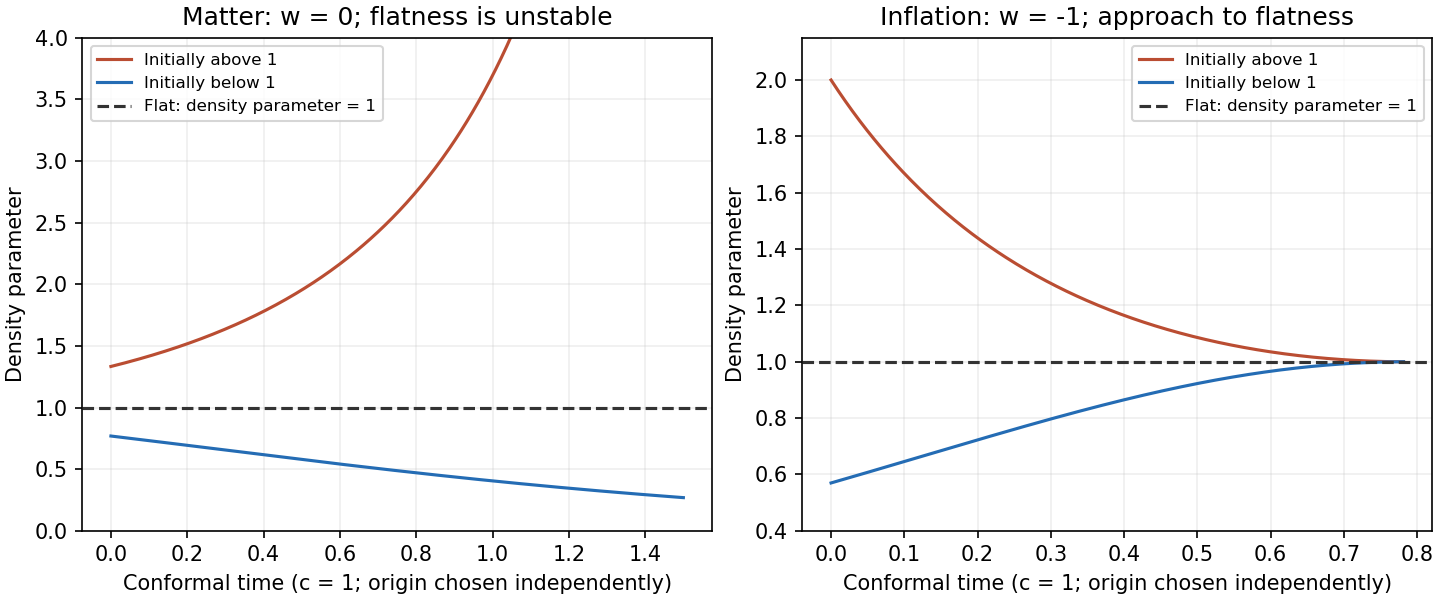
Conformal-time evolution of the cosmological density parameter during matter domination and inflation
. Details. 
In a decelerating matter or radiation era, small deviations from flatness grow: near one, . Observed near-flatness therefore requires extremely small earlier deviations, the flatness problem. During accelerated expansion with , this exponent is negative and curvature is driven toward negligible relative size. For , decays approximately as . Sufficiently long cosmic inflation supplies the inflationary solution of the flatness problem before ordinary decelerating evolution resumes.
Articles by others on the same topic
There are currently no matching articles.