Choose an integer whose reduction is a primitive root modulo . At least one of satisfies , because the binomial theorem givesand the added coefficient is nonzero modulo . Both choices still generate the multiplicative group modulo . Choose such a and write with .
For and , another binomial expansion showsThe intermediate binomial coefficients are divisible by , and the final term also has valuation at least because is odd. Induction therefore givesThus has order exactly modulo . The order of itself is divisible by , by reduction modulo , and divides the number of invertible residue classes. Its order must consequently be precisely that number. This proves the lifting a primitive root to odd prime powers result andFor the requested example choose . Modulo , and , excluding the proper divisors of ten, so its order is ten. Also , which is not divisible by . Hence
The polynomial Runge theorem states that, for a compact set with connected complement and a function holomorphic on a neighborhood of , for every there is a polynomial such thatThe connected-complement hypothesis permits polynomial approximation rather than approximation by rational functions with poles in bounded complementary components.
Use the Runge exhaustion of a slit disk, with the principal argument :These are nested compact subsets of . Their complements are connected: the inner disk and exterior region join through the omitted sector around the negative real radius. Every compact subset of has positive distance from zero, the unit circle and the slit, so it is contained in for all sufficiently large .
Since is holomorphic on , it is holomorphic on a neighborhood of each . The polynomial Runge theorem gives with . Given any compact , eventually , so the same estimate holds on . ThereforeThe nested exhaustion makes this one sequence work simultaneously on all compact subsets.
On the unit three-ball , the distance in the Poincare ball model is the infimum of the lengthsover piecewise smooth paths joining the two points. Equivalently the hyperbolic metric as a metric-space distance isIt has curvature-minus-one normalization; in particular .
For a nonempty finite set , define . The triangle inequality gives , so is continuous. Take . Any improving center satisfies , and thus lies in the closed hyperbolic ball .
This ball is compact: an isometry sending to the origin identifies it with the Euclidean closed ball of radius , and the Euclidean and hyperbolic topologies agree inside . The continuous function attains a minimum on . Centers outside have , so this is also the global minimum. Its associated closed ball proves a minimum enclosing ball in hyperbolic space exists. For the empty finite set, any center and radius zero suffice.
A binary cyclic code is a linear subspace of invariant under cyclic coordinate shift. Associate a word to in . Cyclic shift is multiplication by , so linearity and shift invariance make the code an ideal of this quotient.
Its inverse image in is an ideal containing . Since a polynomial ring over a field is a principal ideal domain, that inverse image is for a unique monic polynomial . Containment gives for some polynomial . Thus the generator polynomial of a cyclic code satisfiesFor a nonzero code is also its monic word polynomial of smallest degree. For the zero code use , whose residue is zero. Conversely every monic divisor defines a cyclic code, proving the full correspondence.
Over ,The quartic factor has no root in . The only monic irreducible quadratic over this field is , and division leaves remainder , so the quartic is not divisible by it. A reducible quartic with no linear factor would have two irreducible quadratic factors; hence this quartic is irreducible. There are exactly four binary cyclic codes of length five, given by the generator polynomials of a cyclic codeThey are respectively the full space, the even-weight code, the repetition code and the zero code, with dimensions .
These are nested Poisson regression models with independent counts and the default log link function. If is biomass and is the three-level pH group, model 1 specifies : one common intercept and slope. Model 2 specifies : three group-specific intercepts and a common slope. Model 3 specifies : three intercepts and three slopes, because the multiplication syntax includes both main effects and their interaction. The parameter counts are therefore .
The analysis of deviance compares model 1 against model 2 by testing equality of the three intercepts, conditional on a common biomass slope. The likelihood-ratio test statistic is with two additional parameters, giving the reported tiny p-value. The next test compares model 2 against model 3 by testing equality of their three slopes. Its statistic is , again with two degrees of freedom and reported . Both restrictions are rejected. Thus model 3 is the supported choice: both baseline richness and its biomass dependence vary with pH. Under the Poisson assumptions, residual deviance on residual degrees of freedom is also consistent with a satisfactory fit, although these nested tests themselves establish improvement rather than every possible aspect of model adequacy.
The prediction from model 2 is on its linear-predictor scale. Exponentiating gives its fitted means. The final expression is twice the saturated log likelihood minus the model-2 log likelihood, i.e. the Poisson deviance of model 2. ConsequentlyIn the saturated model each mean equals the corresponding observed count, with the usual continuous convention for a zero count.
Balancing the viscous and bending terms gives , so the elastohydrodynamic penetration length isInserting into the linear equation yields , with , and decay at infinity. Write , . Of the four roots of , precisely two have negative real part:The two decaying solutions are and , and the general decaying response is their linear combination. Both coefficients are nonzero: if one vanished, would force the other to vanish, contradicting .
Their real parts in the time-dependent response are proportional toConstant phases move respectively with velocities and , so these are damped travelling waves moving left and right. Since , the right-going wave has the longer attenuation length and dominates at large . Thus the less strongly damped, outward-moving wave dominates the far-field response. This is the oscillatory bending of a moment-free semi-infinite filament; the two boundary conditions determine its amplitudes without needing them explicitly here.
In Glendinning chaos, a continuous interval map is chaotic when some positive iterate has a horseshoe for an interval map. In the interval version, one may take an open interval containing two disjoint open intervals with .
Let a three-cycle be ordered . There are only two possible cyclic orderings; reflection of the coordinate interchanges them, so assume , , . ThenAlso and , so the intermediate value theorem gives with , whence . Both and therefore map across under .
To obtain exact open-interval images, use the following elementary first-passage observation. A continuous function on with endpoint values has a subinterval on which its endpoint values are and all interior values lie strictly between them: take the first hit of the second level, then the last hit of the first level before it. The intermediate value theorem makes its interior image exactly . Apply this to the two intervals, reversing endpoint order on the first. Their selected interiors and are disjoint and lie in , withThis proves the three-cycle forces a two-iterate interval horseshoe result and establishes the required horseshoe for .
Consider , extending it at zero by . It is holomorphic in the upper half-plane and on its boundary, and on large upper semicircles because . For real , indent the upper-half-plane contour above the pole of . The clockwise indentation contributes , while the large semicircle contributes zero in the limit. The Cauchy integral theorem givesWith the stated Hilbert transform convention this is . ButTaking real parts yields the Hilbert transform of the sinc function:At the right side has limit zero; the same value follows by oddness of the principal-value integrand. The apparent singularity of at zero is removable, so the contour calculation is valid there too.
Take the sheet to lie in the plane, with lengths in those directions. Its surface density is . Reflection symmetry about the coordinate axes makes the off-diagonal entries of the inertia tensor zero. Its principal moments of inertia areand similarly . Since integrates , the perpendicular axis theorem gives
Set , , and retain terms linear in the perturbations in Euler equations for a torque-free rigid body. Using givesConsequently , where . For the growing solution isThere is also a decaying mode with the opposite exponent. For negative , select the exponent as the growing one. This is the intermediate axis theorem: steady rotation about the intermediate principal inertia axis is unstable whenever .
With a prime denoting conformal-time differentiation, and . Multiplying the Friedmann equation by gives , and henceThe Friedmann acceleration equation and giveDifferentiate and substitute this expression:For , identically and the same equation holds directly. The relations assume , as is true on the expanding branch in the question.
For pressureless matter, , the cosmological density parameter flow points away from : initial increases, while decreases. In the closed case the expanding branch can end at a turnaround, where and this density parameter diverges. For vacuum domination, , the sign reverses: values above one decrease and positive values below one increase toward one. The plotted curves are representative conformal-time solutions with and separately chosen origins; inflationary future infinity occurs at a finite conformal time.
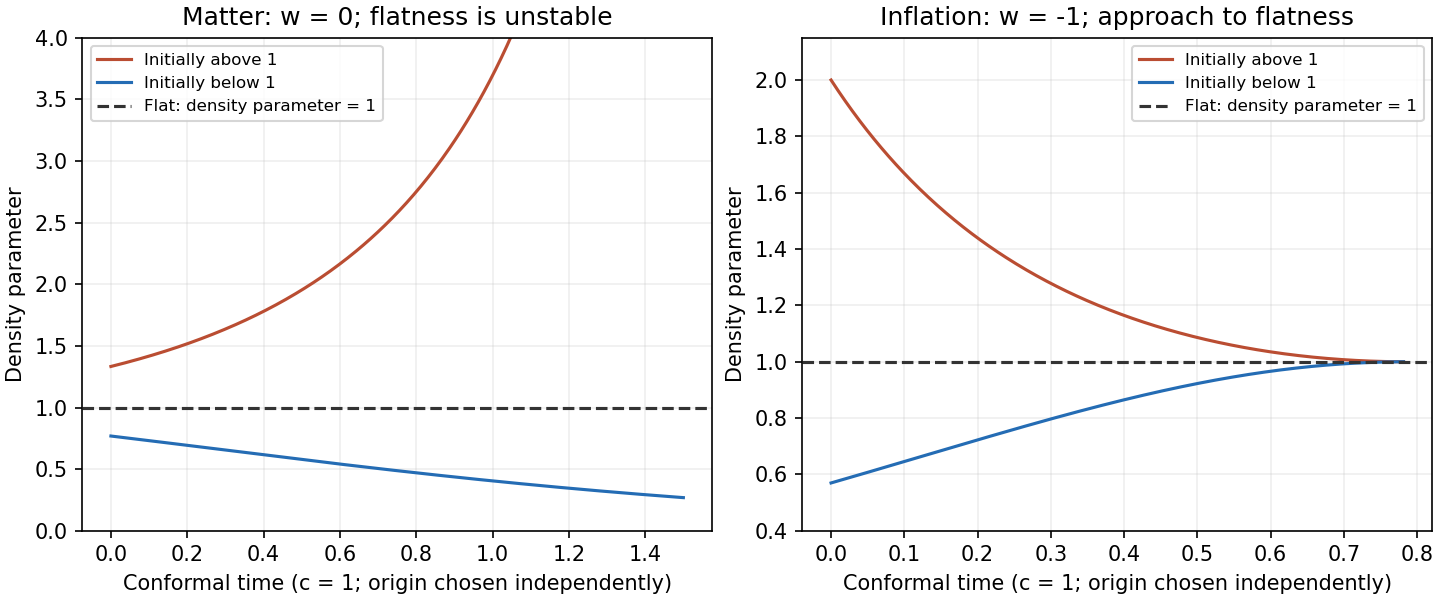
Conformal-time evolution of the cosmological density parameter during matter domination and inflation
. Details. 
In a decelerating matter or radiation era, small deviations from flatness grow: near one, . Observed near-flatness therefore requires extremely small earlier deviations, the flatness problem. During accelerated expansion with , this exponent is negative and curvature is driven toward negligible relative size. For , decays approximately as . Sufficiently long cosmic inflation supplies the inflationary solution of the flatness problem before ordinary decelerating evolution resumes.
Put and use conventional convergent indexing starting at zero; the same argument covers all the printed positive indices. The continued fraction complete quotients satisfy , . After the first step they exceed one, while their algebraic conjugates lie in . Indeed , and if with , then .
Write , where are integers and . This form follows by rationalization at each step: and , starting from . The two conjugate inequalities giveso . The standard convergent recursions also giveSubstitute the displayed form of and compare rational and irrational coefficients. This yields and . Therefore the small norm residues from square-root continued fractions obeyThe initial convergent satisfies the same relation with the usual . This avoids the insufficient estimate obtained by merely replacing the convergent error with .
For integer factorization, choose a factor base of small primes for which is a quadratic residue, together with to record negative residues; a prime dividing already supplies a factor. Test the small nonzero integers for being B-numbers. Complete factorization over the base records each prime exponent modulo two. Once enough relations are collected, linear algebra over can choose a nonempty subcollection whose exponent sum is even, including the sign. ThenIf , one of or can yield a nontrivial factor. Relations with a noninvertible may already give a factor through its gcd. The small-residue bound makes smoothness more likely; it does not guarantee that any one dependency gives a nontrivial factor.
A subgroup of the Möbius group is a discrete subgroup when the identity is isolated in its induced topology, equivalently every group element is isolated. We prove the compact-set criterion for a properly discontinuous group action: for every compact , only finitely many satisfy .
Fix an origin and take . If and , the triangle inequality and invariance of hyperbolic distance giveThe set of Möbius isometries with is compact. To see this explicitly, represent an isometry by a determinant-one complex matrix and use singular-value decomposition:The compact factors fix , and the diagonal factor moves it hyperbolic distance , as seen from the vertical dilation by in upper half-space. Thus the bounded-displacement set is the continuous image of , modulo central signs.
By the allowed closedness fact, its intersection with is a closed discrete subset of a compact space, hence finite. Otherwise an infinite sequence would accumulate in that intersection, contradicting isolation of its limit point. This proves every discrete Möbius subgroup acts properly discontinuously on hyperbolic three-space. Finite stabilizers are allowed; discreteness alone does not imply a free action.
Write and . Differentiating gives , soIn the independent exponential dispersion family, only depends on . Its derivative therefore gives the score functionThe residuals are independent, have mean zero and variance . Consequently their score covariance is the Fisher information matrix:This also equals minus the expected likelihood Hessian under the usual regularity conditions.
For the canonical link function, and , soTo obtain the maximum-likelihood estimate, solve , for example with Fisher scoring iterations . Equivalently use iteratively reweighted least squares, with weights and working response . Since , the common dispersion scale cancels from this update for . A nonsingular information matrix and a finite interior likelihood maximum are needed; iteration does not assert those for every possible dataset.
For a flow, a hyperbolic fixed point has no eigenvalue of its linearization with zero real part; a nonhyperbolic fixed point has at least one such eigenvalue. At the eigenvalues are , while at they are . Thus nonhyperbolicity occurs at the two stated parameters. The following centre manifold reductions show the associated actual bifurcations.
Near put , , . The transformed equations areAt , the non-extended stable subspace is the axis and the centre subspace is the axis. In the extended centre manifold, write , with . The symmetry allows an even graph. At quadratic order its invariance equation has left side of degree at least three and right side , so . Substitution givesThis is a supercritical pitchfork bifurcation in parameter . The central branch is stable for and unstable for near one; the two nonzero branches for are stable. At the bifurcation itself the cubic term attracts on the centre manifold.
Near put , , . ThenAt , the stable subspace is and the centre line is . Thus the leading extended centre graph is , and the reduced flow isThis is a transcritical bifurcation: is stable for , while the branch is stable for ; the opposite branches are unstable. At the critical point the quadratic term is only one-sided attracting.
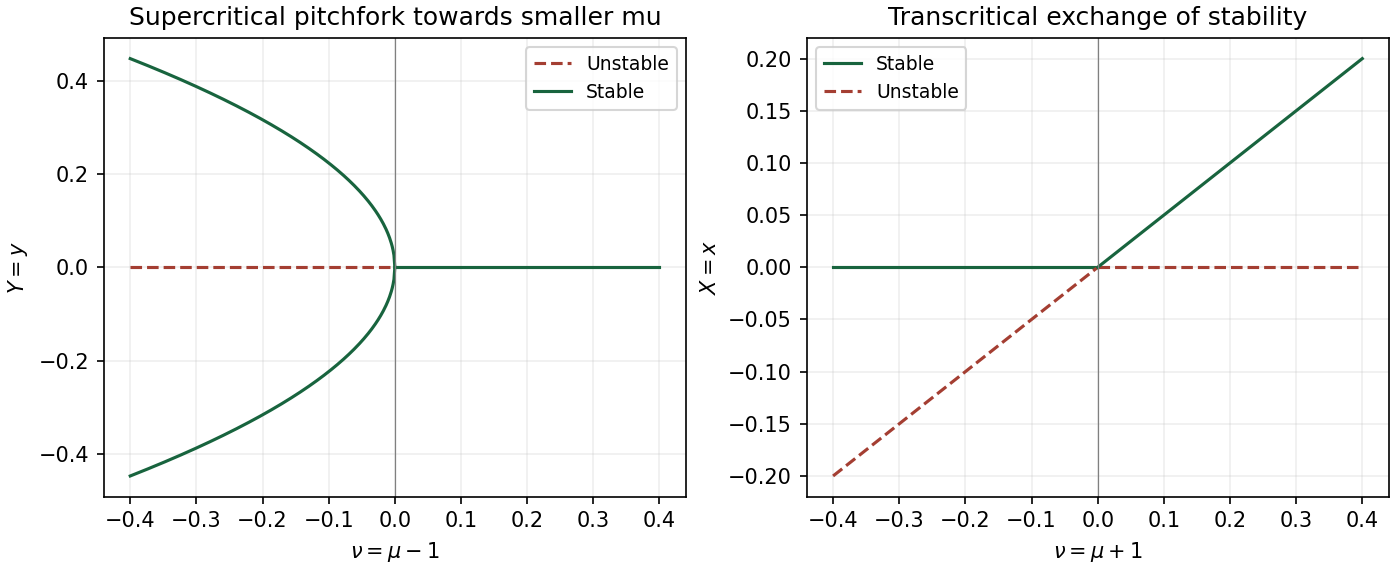
Local pitchfork and transcritical bifurcations, with stable branches solid and unstable branches dashed
. Details. 
The exact additional branch in isIt meets at and at , displaying the connecting pitchfork and transcritical branches in a quadratic-product flow. Its Jacobian has determinant and trace . Hence it is stable for and a saddle for . The negative- companion is needed for the pitchfork sketch near ; no separate analysis of is required.
With Hamilton's equations and , the chain rule givesFor the vortex problem, combine the two ordered terms for each unordered pair, writing and . Since , , its pairwise contribution to the Poisson bracket isEvery pair cancels, so and is conserved along any collision-free solution. The logarithmic Hamiltonian is undefined at coinciding vortices, so the derivation applies on its natural domain.
For a regular periodic energy orbit, differentiate the action integral with respect to its energy. On a branch , implicit differentiation gives . ThusThe integral follows the entire orbit, with its orientation; at turning points this formula is interpreted by the limiting integral from each branch. It is valid for a smooth family of nonseparatrix periodic orbits.
An adiabatic invariant means that the action variable remains constant to leading order when the external parameter changes on a timescale much longer than the orbital period. Denote that parameter by . With , the displayed identity integrates toIf the parameter change decreases for every intervening action , this integrand increases pointwise. At the adiabatically fixed positive , the energy increases. This uses the phrase “with any ” as a statement about the family of orbits, not merely a period decrease at a single selected action; that weaker premise alone would not determine the integral.
For Hartogs theorem, collect all well-order relations on all subsets of a set . They form a set, since the relations belong to the power set of . Replacement collects their ordinal order types in a set . DefineIf there were an injection , transfer the well-order of to its image. Its type would put in , giving , impossible. Thus some ordinal does not inject into , without using choice.
Assume the axiom of choice and let a nonempty partially ordered set have an upper bound for every chain. Suppose it has no maximal element. Choose, from every subset of with a nonempty set of strict upper bounds, one such strict upper bound. Every chain has a strict upper bound: first take an upper bound and then a strictly larger element, using the absence of maximal elements. Take a Hartogs ordinal for . Transfinite recursion chooses , for each , strictly above all previously chosen elements. Their predecessors form a chain at every stage, so this recursion is defined and strictly increasing. It gives an injection , contradicting the choice of . Hence has a maximal element, proving Zorn's lemma.
For the well-ordering theorem, take a choice function on the nonempty subsets of and recursively choose an element of not previously selected. If this process had not exhausted at any stage below its Hartogs ordinal , it would define an injection , again impossible. Therefore it exhausts at some ordinal stage . Order each element by its unique selection index; this transfers the ordinal well-order to all of . The empty set is already well-ordered. These proofs use transfinite recursion, not an unstated fixed-point theorem.
Define the multicolour graph Ramsey number as the least such that every colouring of the edges of the complete graph with colours contains, for some , a complete subgraph on vertices all of whose edges have colour .
Prove finiteness by induction on , temporarily allowing . If some , a single vertex supplies the required vacuous monochromatic clique, so the Ramsey number is one. Otherwise put , which is finite by induction, and takeFix a vertex and partition its other vertices according to the colour of their edge to . Some colour- class has at least vertices: if every class had at most , their total would be at most . In that class the inductive property either gives a colour- clique of size with , or a colour- clique of size . In the latter case add . ThusIn particular the requested two-colour diagonal number is , so it exists for every .
Now colour each positive integer by its partition class, say there are classes, and take . Colour the edge , , by the class of . There is a monochromatic triangle . Its three differences , , are positive integers in one class, andThis is the finite-Ramsey proof of the partition conclusion. The statement does not require and to be distinct.
The automorphisms satisfy and . The rotations and inversion maps are all distinct, so the dihedral group has order , including the case when it has order two. The invariantis fixed by both generators.
Use two standard field-theoretic results: the fixed-field theorem for a finite group of automorphisms gives and makes Galois with group ; and a nonconstant rational function in lowest terms satisfies . Here has coprime numerator and denominator and degree . Thus . Since , the tower law proves the dihedral fixed field in one rational variable:
For odd prime , every subgroup is one of , , a reflection subgroup for , or . Indeed, a subgroup containing a nonidentity rotation contains all rotations; with any reflection it is then . A subgroup with no nonidentity rotation contains at most one reflection, since the product of distinct reflections is a nonidentity rotation.
The Galois correspondence gives the following fixed fields. The trivial subgroup corresponds to , the rotation subgroup to , and to the base . Since composition of the stated automorphisms gives , the reflection subgroup corresponds toThis rational invariant has degree two, hence generates the fixed field of its order-two subgroup, by the same degree argument as part (i). These fields have degrees respectively over .
An intermediate field is Galois over the base exactly when its corresponding subgroup is normal in . The trivial subgroup, the rotations and are normal; no reflection subgroup is normal because is odd and greater than two. Hence the Galois intermediate extensions and groups areThe reflection fixed fields are not Galois over the base.
Work over the complex numbers. By Maschke's theorem, restriction to the normal subgroup is a direct sum of its isotypic components. For an irreducible -type , denote its isotypic component in by . Normality makes permute these components, by conjugating the -types. Any union of orbits spans a -invariant subspace, so irreducibility of means that all occurring components form a single orbit.
If there is only one component, restriction is isotypic, as claimed. Otherwise take one component and its stabilizer , a proper subgroup. This is an irreducible representation of : if were -invariant, the direct sum of its translates over coset representatives for would be a nonzero proper -invariant subspace of . It is direct because the translates lie in distinct isotypic components, and proper because .
The natural map from the induced representation sends to . It identifies the direct-sum coset decomposition with all isotypic components of , so is bijective and -equivariant. ConsequentlyThis proves the dichotomy directly, including the irreducibility of the representation being induced.
Induct on the order of the p-group. Every complex irreducible representation of an abelian group is one-dimensional: commuting group operators preserve a common eigenspace, and irreducibility makes that eigenspace the whole space. This handles the abelian cases.
If is not faithful, it is an irreducible representation of a smaller quotient , where is its kernel. Induction expresses it as induced from a one-dimensional representation of a subgroup of . Pulling back the subgroup and inflating the character gives the same induction statement for , because the coset spaces of the quotient subgroup and its inverse image agree.
Now suppose is faithful and is nonabelian. Use the allowed abelian normal subgroup not contained in the centre. If restriction to were isotypic, its irreducible type would be one-dimensional, so every would act as a scalar. It would therefore commute with every representing matrix of . Faithfulness would imply in for every , contradicting the choice of . By part (a), for an irreducible representation of a proper subgroup . Induction on gives with one-dimensional. Transitivity of induction yieldsThis proves the monomiality of irreducible representations of finite p-groups.
An integral basis of a degree- number field is a -basis of its ring of integers: each algebraic integer has a unique integer linear combination of those elements. For , the standard quadratic-integer criterion gives , since is squarefree and is not congruent to one modulo four. Thus
The polynomial is irreducible by Eisenstein criterion at two, so is a rational basis and each of these elements is integral. The nontrivial automorphism of sends to . For an algebraic integer , its relative trace and the trace of the algebraic integer areBoth are in , proving . Multiplying by its conjugate gives the field normAgain this is in , so both displayed coefficients are integers.
To finish the denominator argument, put , , , , all integers. The two norm coefficients implyThe second congruence modulo two first gives even. Modulo four it then gives even. Therefore vanishes modulo four, and the first congruence reads . The possible squares modulo four force even and then even. Returning to the second congruence now gives , so is divisible by four. Thus are all integers.
Conversely, every integer linear combination of these powers is integral. We have proved the integral basis of the fourth-root-of-two field:
More generally let be a homotopy inverse of and one of . Then satisfies , and satisfies . The first argument applies. Hence the separate one-sided hypotheses imply that is a homotopy equivalence, as expressed by separate homotopy inverses combine into a homotopy equivalence.
Take a homotopy equivalence with inverse , and universal covering maps . Since the covering spaces are simply connected, the path lifting theorem constructs lifts of and of , after specifying one value in the appropriate fiber. Explicitly, define the lift at a point by lifting the image of a path from the chosen base point; independence from the path follows from simple connectedness and homotopy lifting.
Lift a homotopy starting at . The homotopy lifting theorem for a covering map makes its endpoint a map with . Such a lift of the identity is a deck transformation and is a homeomorphism: lift the identity again with the base point image reversed, and uniqueness of path lifts makes the two compositions identities. Likewise for a deck transformation of .
Thus both compositions are homotopy equivalences, even though the lifted homotopies need not end at the particular identity lift. Part (i) then provesKeeping the possible deck transformations is essential when the original homotopies do not fix base points.
Let and choose with . The parallelogram identity givesCompleteness and closedness give , attaining the distance. Put . For and real , minimality gives , so . In a complex Hilbert space, also replace with to get the imaginary part zero. ThereforeThe decomposition is unique since . This proves the required orthogonal projection result rather than assuming it before the averaging argument.
For the unitary operator,Thus it is an isometry, and every power has norm one. The triangle inequality gives
The set is the range of the linear operator , hence is a linear subspace. If , the sum telescopes:Since is an isometry, . Hence the averages tend to zero on .
If , choose with . By part (i),The last term tends to zero by part (ii). Taking the limit superior and then proves for every .
If , then for all . The adjoint identity gives , so . Multiplying by givesSince , implies and yields the same result. Conversely a fixed vector is perpendicular to by this calculation, identifying as the fixed subspace.
Apply the proved projection result to and write with . By part (iii), , while part (iv) gives and hence . ThusThe limit is the orthogonal projection onto the fixed vectors of . This is norm convergence, not just weak convergence.
The function has the same periodicity, poles and normalized Laurent behavior as . Uniqueness in its definition therefore makes even, so is odd. At a nonzero half-period with , periodicity and oddness give , hence zero. Modulo the three such points are , , .
An elliptic function has equal total orders of zeros and poles in a period cell, by the argument principle and cancellation of opposite boundary edges. The derivative has exactly one pole modulo the lattice, of order three at zero. The three displayed zeros therefore exhaust its zeros, each with multiplicity one:
The only potential poles of outside the lattice are at and . Since , these points are distinct modulo the lattice and . At each point the squared factor vanishes to order two, canceling the double pole of the shifted Weierstrass elliptic function. The derivative term is regular there. Thus has no poles outside .
Near zero write , using evenness and the normalization. Taylor expansion at givesConsequentlyThe terms cancel exactly, and there are no terms. Thus there is at most one simple pole per period cell. The sum of residues of an elliptic function over a period cell is zero, again because opposite boundary contour integrals cancel; its sole possible residue must vanish. Hence is entire. Periodicity makes it bounded on the plane, and Liouville's theorem makes it constant. In fact is odd, so that constant is zero. The resulting Weierstrass shift-difference identity by pole cancellation is
For a compact triangulated surface, the Euler characteristic is , independent of the triangulation. For a connected closed orientable surface, the genus is its number of handles, characterized byA connected compact orientable surface with boundary components instead has . For multiple connected components the Euler characteristics add, with genus specified for each component. A compact boundaryless surface embedded in is orientable, so the usual closed-surface formula applies to each connected component.
Parametrize a regular curve by arclength , write its unit tangent as , and choose an oriented surface unit normal . Its signed geodesic curvature isIt vanishes exactly when the acceleration of the unit-speed curve is normal to the surface, equivalently when the curve is a geodesic with arclength parametrization. For an arbitrary regular parametrization, this means the curve becomes a geodesic after reparametrization.
The global Gauss-Bonnet theorem for a compact oriented surface with smooth boundary, positively oriented with the surface on the left, isFor piecewise smooth boundary, add the signed exterior turning angles at its corners to the left side.
A simple closed curve on the sphere bounds two topological disks. Equal areas give area for each, since the unit sphere has area . Apply Gauss-Bonnet theorem to either disk , with and :A continuous geodesic curvature that were strictly positive everywhere, or strictly negative everywhere, would have a correspondingly strict sign for this integral. Therefore neither everywhere strictly positive nor everywhere strictly negative geodesic curvature is possible. Orientation reversal changes its sign but not this conclusion.
The assertion is false without further global hypotheses. For a concrete non-spherical surface of constant Gaussian curvature one, fix and setHere , and , so this is a connected regular embedded surface of revolution with unit-speed meridian. Its metric is , whose Gaussian curvature is . This formula also follows by multiplying its principal curvatures and .
At these principal curvatures are and . Every point of a radius-one sphere is umbilical with both principal curvature magnitudes one. The displayed surface therefore cannot lie in any such sphere, despite having everywhere.
Work in the real space, consistent with the specified real step coefficients. First approximate an integrable function by a finite-valued measurable function with bounded support. Truncate its domain to and its values to ; the error tends to zero by integrability. Quantize those remaining values in intervals of mesh , producing a simple function with finite-measure Borel sets and error at most on the truncated domain. Thus can be made arbitrarily small.
For each , use the allowed approximation by a finite union of intervals , choosing the symmetric-difference errors soThese unions can be written as finite disjoint bounded intervals, and changing endpoints to the required half-open convention changes only a null set. The function is therefore a step function of the specified form, andCombining the two approximations proves the step functions are dense in . In the complex version of , the same argument applies to real and imaginary parts when complex step coefficients are allowed.
For , direct integration of each interval in the Fourier transform givesHence , andThe finite value at zero is and does not affect this limit.
Choose a step function with , by part (i). The Fourier transform satisfiesBy part (ii), . Since is arbitrary,This proves the Riemann-Lebesgue lemma with the transform convention in the question.
The model is a general-service infinite-server queue, usually denoted : arrivals form a Poisson process, each wandering time is a service time with distribution that of , and trapping ends service. Infinitely many servers mean that mosquitoes wander concurrently without waiting or delaying one another. General service times are not necessarily exponential, so the count alone need not be a Markov chain.
An arrival at time is still present at exactly when its independent service time exceeds . Thinning the marked Poisson process with this retention probability gives a Poisson count with parameterThusThis reasoning allows atoms in the service-time distribution; the strict survival inequality correctly treats a customer whose service has ended.
Articles were limited to the first 100 out of 152 total.
Articles by others on the same topic
There are currently no matching articles.