The divisors have no common irreducible component, since a common curve would give infinitely many intersection points. The Bézout theorem therefore gives total intersection multiplicity . As all intersection is supported at ,
Take , and . This projective cuspidal cubic is irreducible and meets only at . At , the derivative with respect to is , so is smooth. In the affine chart , it is , and is , so . Multiplicity is linear in the divisor , giving
Apply a projective transformation to put the cuspidal cubic in the form . Since meets at only one smooth point , the Bézout theorem forces intersection multiplicity three there. Hence is the tangent line at a flex.
The homogeneous Hessian matrix has determinantBy the Hessian criterion for a flex, every smooth flex lies in . These intersections are , the cusp, and , which is smooth. Thus the unique smooth flex of a cuspidal cubic is , with tangent line . Conversely the pair in part (b) has exactly the required properties. Therefore there is one projective-equivalence class, represented by
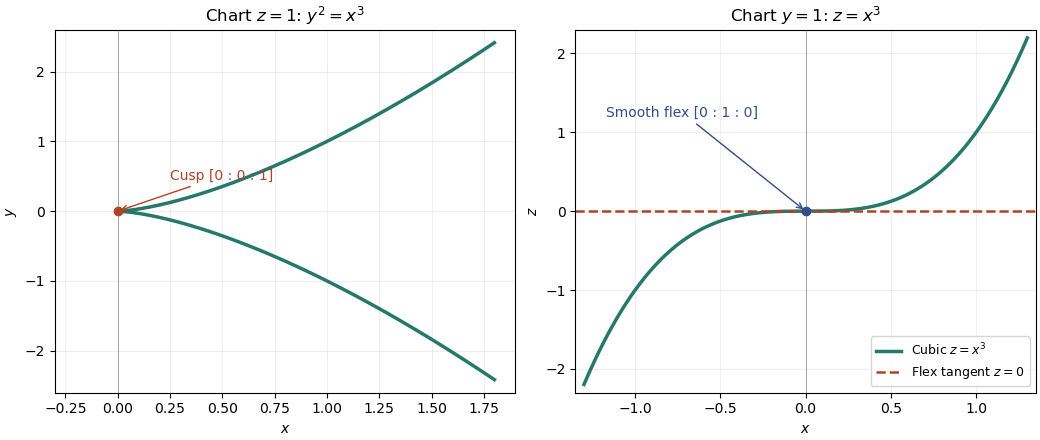
Cuspidal cubic in two projective charts: the cusp and its unique smooth flex
. Details. 
Articles by others on the same topic
There are currently no matching articles.