Write , and . Their self-intersection numbers vanish: each factor curve has trivial normal bundle, and the self-intersection of the diagonal of a curve is . Each pair meets transversely once. Their intersection pairing is thereforeIf a rational linear combination of their cycle classes vanished in , intersecting it with would multiply its coefficients by this invertible matrix and give zero. All coefficients must vanish, proving the three classes are linearly independent.
The cycle class map detects the Chow Künneth failure for an elliptic self-product. The codimension-one image of the external product of Chow classes consists of sums from and . Here , and every divisor's cohomology class is its degree of a divisor times the class of a point. Thus the image's cohomology is contained in the span of . The diagonal's independent class lies outside that span, so its Chow class lies outside the external-product image. Therefore the natural map of Chow groups is not surjective.
Embed in projective space and let be its hyperplane Cartier divisor. Since is surjective between integral surfaces, it is generically finite, with degree . Its pullback of a Cartier divisor is a nef divisor, and the projection formula for algebraic cycles gives . The same formula gives , because the curve is contracted to a point.
The Hodge index theorem for algebraic surfaces makes the intersection pairing on the Picard group of a surface have signature on . The orthogonal complement of any positive-square vector, including , is negative definite. The numerical class of is nonzero, since an ample divisor on intersects every nonzero effective divisor positively. Thus the contracted curve has negative self-intersection conclusion applies:
Let be an effective divisor linearly equivalent to . If were not a component of , all intersection multiplicities between its components and would be nonnegative, contradicting . Hence with effective and linearly equivalent to zero. For an ample divisor , this gives . Positivity of on every irreducible component of a nonzero effective divisor forces . Therefore , illustrating the rigidity of a negative curve.
Use countability of negative curves. A smooth projective surface over is a compact smooth manifold homotopy equivalent to a finite CW complex, so its integral cohomology group is finitely generated and therefore countable. Distinct irreducible curves with cannot have the same cohomology class: that would give , while distinct effective curves have nonnegative intersection multiplicities. Assigning a negative curve its cohomology class is thus injective, proving there are at most countably many negative curves.
For zero self-intersection, uncountable families do occur. On the product of two projective lines , every fiber has self-intersection zero, since a different fiber is disjoint and has the same numerical equivalence of divisors class. The parameter varies over an uncountable set. Thus yes, there can be uncountably many such curves.
Let have degree and hyperplane class . The adjunction formula gives . For a line , the same formula on the smooth rational curve yields , henceThus all lines are negative curves, and part (b) makes their set countable. The Fano scheme of lines is a closed projective scheme of . A positive-dimensional complex algebraic component would have uncountably many points, so this scheme is zero-dimensional. A projective scheme of finite type has only finitely many zero-dimensional points. This proves the finiteness of lines on a smooth surface of degree at least three.
Choose a projective embedding of the abelian surface . By Bertini's theorem, a general hyperplane section is a smooth projective curve that is connected. It is ample, so . Choose and translate the inclusion so it sends to the identity of . The universal property of the Jacobian variety then gives a homomorphism of abelian varietieswhose composition with the based Abel map of an algebraic curve is this translated inclusion.
The image is a closed connected algebraic subgroup, since is projective, and it contains a translate of . If the image had dimension one, that irreducible curve would be the image subgroup itself. A distinct coset is disjoint from it and has the same numerical divisor class: translation acts trivially on cohomology, being homotopic to the identity on the complex torus. Its self-intersection would therefore be zero, contradicting . The image has dimension two and is all of . Thus is surjective, as expressed by the principle that an ample curve on an abelian surface generates the surface.
The divisors have no common irreducible component, since a common curve would give infinitely many intersection points. The Bézout theorem therefore gives total intersection multiplicity . As all intersection is supported at ,
Take , and . This projective cuspidal cubic is irreducible and meets only at . At , the derivative with respect to is , so is smooth. In the affine chart , it is , and is , so . Multiplicity is linear in the divisor , giving
Apply a projective transformation to put the cuspidal cubic in the form . Since meets at only one smooth point , the Bézout theorem forces intersection multiplicity three there. Hence is the tangent line at a flex.
The homogeneous Hessian matrix has determinantBy the Hessian criterion for a flex, every smooth flex lies in . These intersections are , the cusp, and , which is smooth. Thus the unique smooth flex of a cuspidal cubic is , with tangent line . Conversely the pair in part (b) has exactly the required properties. Therefore there is one projective-equivalence class, represented by
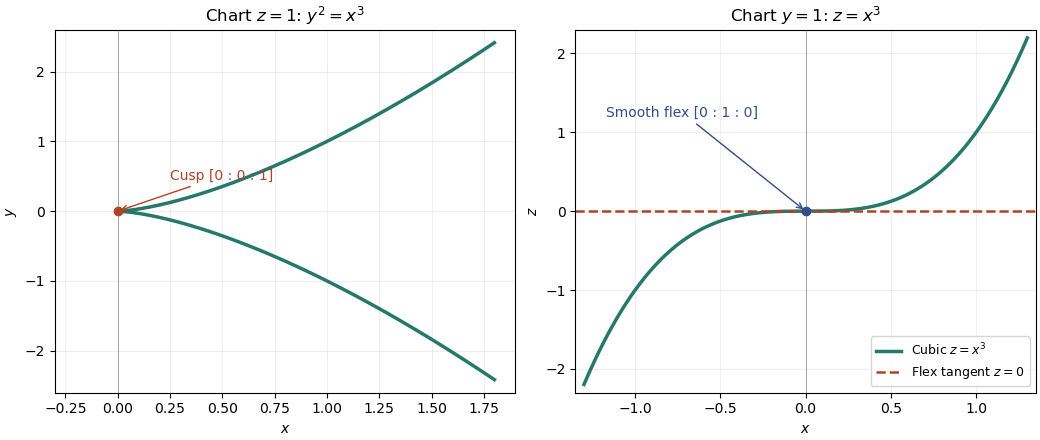
Cuspidal cubic in two projective charts: the cusp and its unique smooth flex
. Details. 
The adjunction formula on the degree- projective hypersurface gives . Since is a smooth rational curve, adjunction on gives . Its degree is , so the smooth rational-curve self-intersection on a projective hypersurface formula is
The Noether–Lefschetz theorem says that a very general smooth degree- surface in , for , has Picard group freely generated by its hyperplane class . Here very general means outside a countable union of proper closed loci in the parameter space of surfaces.
If such a surface contained a smooth rational curve , its divisor class would be for an integer . Since , one has and therefore . Part (a), however, gives , a contradiction. Thus a very general surface of degree at least four has no smooth rational curve. The statement concerns smooth embedded curves; a singular curve can still have rational normalization.
Articles by others on the same topic
There are currently no matching articles.