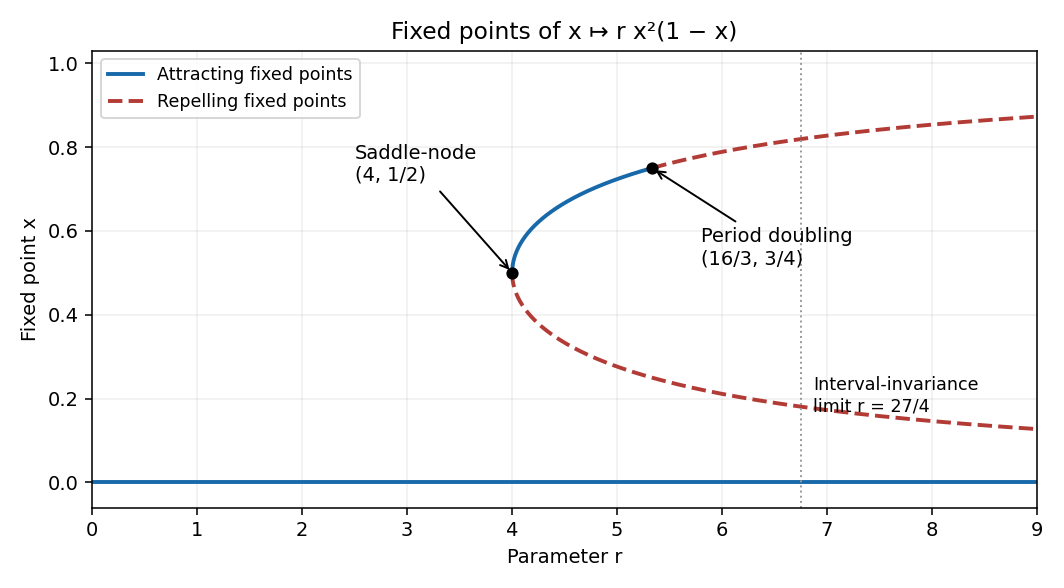
The fixed points satisfy . There is always , and the other branches areThey coincide at . For , and its maximum occurs at , with value . Consequently ; equality at the upper endpoint fails because the maximum is attained inside the interval.
The fixed-point multiplier at zero is zero, so zero is attracting for every . On either nonzero branch,The lower branch has multiplier greater than one for and is repelling. The upper branch is attracting for , reaches multiplier at , and is repelling for . At the multiplier is , and the two branches are created in a saddle-node bifurcation. The fixed point there is attracting from one side and repelling from the other: .
The second change is a supercritical period-doubling bifurcation at . To check its type, expand at that fixed point. The local map has quadratic coefficient and cubic coefficient when the multiplier is . Its second iterate has cubic coefficient . The multiplier decreases through as increases, so a small attracting two-cycle is born on the side. These exhaust the fixed-point bifurcations, since their multipliers have no other crossings of .

Articles by others on the same topic
There are currently no matching articles.