For every prime number with , the numerator contains one factor , whereas neither copy of contains one. Consequently the product of these prime numbers divides the binomial coefficient . Since this binomial coefficient is one positive summand of , and other summands are positive,For , choose with . The Chebyshev function is increasing, so telescoping givesFor the inequality follows from . Thus throughout the stated range.
For , extend the restriction of the continuous function to to a continuous function on by making it constant on each of the two remaining intervals. The Weierstrass approximation theorem supplies a polynomial with . Every compact set is eventually contained in , where . Hence eventually. This proves uniform convergence on every compact subset, without assuming any endpoint limits of . The first two polynomials can be chosen arbitrarily.
Write and use the same constant extensions as in part (a). They satisfy . Choose polynomials with for , and set the first two polynomials equal to zero. Then , while the argument of part (a) proves uniform convergence to on every compact subset of . The bound concerns the entire interval, rather than just each separate compact subset.
Consider the Möbius transformationsTheir group lies in , which is a discrete subgroup of the Möbius group: integer entries cannot approach the identity matrix except by eventually equalling it, and passing to the quotient by preserves this property.
For freeness let and . For every nonzero integer , andA reduced word involving both generators can be conjugated to a cyclically reduced word beginning with and ending with a nonzero power of , after interchanging the generators if necessary. Repeated use of these inclusions shows that this word sends into the proper subset of , so it cannot be the identity. Nonzero pure powers of either generator are also nonidentity. This is the ping-pong lemma in this particular action, and proves that is a free group of rank two as well as a discrete subgroup of .
Use the binary Hamming code , where the th column of the parity-check matrix is the four-digit binary expansion of , for . Thus the columns are precisely the nonzero vectors of . They include the four coordinate vectors, so and . Its code rate is therefore .
For a received word , compute its syndrome . If , report no error. Otherwise identify the unique column and flip bit . Indeed, if with , then , so this procedure recovers exactly. No column is zero and no two columns coincide; hence no nonzero codeword has Hamming weight one or two. Some three columns sum to zero, for example those indexed by , so the minimum distance is exactly three. Thus every single-bit error is corrected. The assertion requires at most one error; arbitrary multiple errors need not be detected by this procedure.
Partition the design matrix accordingly as . The blocks are orthogonal when , meaning that their column spaces are orthogonal vectors. Mutual orthogonality means that this holds for every pair of distinct blocks, so is block diagonal.
For the three scalar coefficients, the corresponding columns are . The necessary and sufficient conditions areUnder the assumed full rank, neither explanatory column is zero. The maximum-likelihood estimator is , and the normal distribution of impliesThus the three coefficient estimators are independent normal random variables, not merely uncorrelated. This is a sampling-distribution statement with the true fixed.
Let be the probability of occupying site after steps, with and . The master equation isWrite so that the limiting is a probability density. A Taylor expansion of this master equation givesThe weakly biased diffusion limit of a weakly biased random walk keeps and finite as , so . The limiting advection-diffusion equation isIts initial condition is the Dirac delta function at the origin. At finite spacing, the exact variance gained per step is . Thus a finite-step central limit theorem gives the variance-matched coefficient ; its difference from the displayed vanishes in the stated weak-bias diffusion limit of a weakly biased random walk. Keeping a fixed nonzero bias while taking diffusive space-time scaling would instead make diverge.
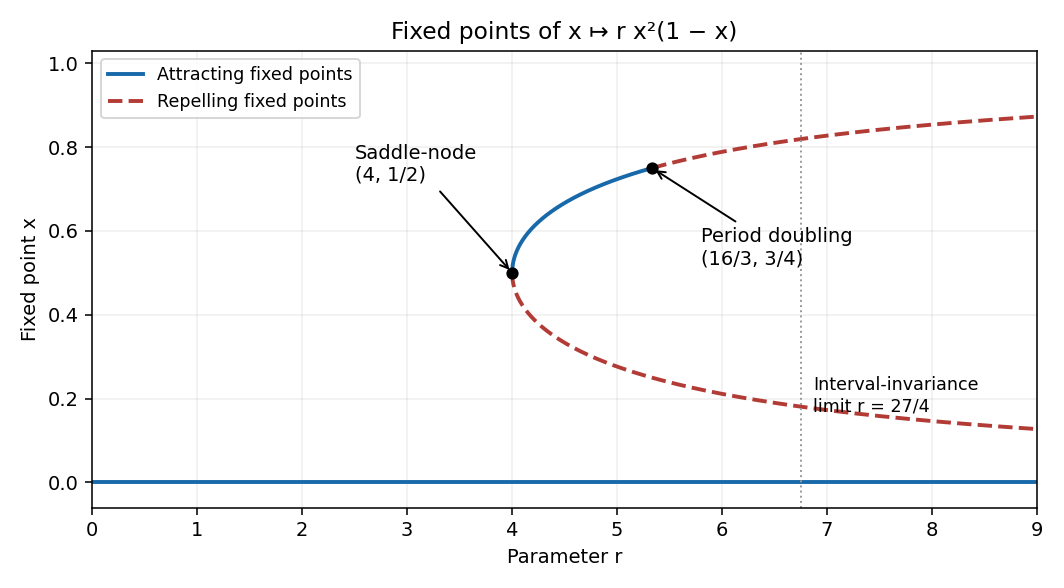
The fixed points satisfy . There is always , and the other branches areThey coincide at . For , and its maximum occurs at , with value . Consequently ; equality at the upper endpoint fails because the maximum is attained inside the interval.
The fixed-point multiplier at zero is zero, so zero is attracting for every . On either nonzero branch,The lower branch has multiplier greater than one for and is repelling. The upper branch is attracting for , reaches multiplier at , and is repelling for . At the multiplier is , and the two branches are created in a saddle-node bifurcation. The fixed point there is attracting from one side and repelling from the other: .
The second change is a supercritical period-doubling bifurcation at . To check its type, expand at that fixed point. The local map has quadratic coefficient and cubic coefficient when the multiplier is . Its second iterate has cubic coefficient . The multiplier decreases through as increases, so a small attracting two-cycle is born on the side. These exhaust the fixed-point bifurcations, since their multipliers have no other crossings of .
First suppose the integral of converges, for example if . Substitute the complexified coordinates , into the Poisson integral. The factorization of its denominator givesThe given Schwarz integral formula therefore writes as plus a constant. For , the real part of this integral is exactly the Poisson integral, sinceThe remaining constant has zero real part, giving with . The complex substitution is initially understood where the real-analytic harmonic function has its complexification; the holomorphic integral then continues the identity throughout the upper half-plane.
Decay of alone does not guarantee convergence of the printed unregularized integral. For example, choose a continuous which vanishes on and equals for , with continuous interpolation. It is bounded and tends to zero at both ends. Its Poisson integral tends to zero as in the closed upper half-plane: split the boundary function into a small uniform tail and a compactly supported part. Nevertheless diverges like , even as a symmetric principal value. With only the stated decay assumptions, the always convergent version isThe subtracted kernel is real on the integration line, so it changes only the imaginary constant and leaves the harmonic function unchanged. The kernel difference is , which ensures convergence for bounded .
Put the cylinder's centre at the origin, with , , and uniform density . Symmetry makes the inertia tensor diagonal and gives . Direct integration yieldsFor a transverse principal moment of inertia, the two contributions areTherefore are the three principal moments of inertia.
Set . The third of the Euler equations for a torque-free rigid body gives , so is constant. Define . The first two Euler equations for a torque-free rigid body becomeso . Since the body-frame angular momentum has components , its transverse components rotate at while its axial component is constant. Substitution of the principal moments of inertia givesThis is precession relative to the body axes; the angular momentum is constant in an inertial frame. If , the rate is zero even when . If the transverse components vanish, the precession cone degenerates to its axis.
Assemble the star by adding spherical shells. A shell of mass at radius has gravitational potential energy relative to infinity, givingMultiplication of the hydrostatic equilibrium equation by and integration by parts givesFor an isolated star with negligible surface pressure, . Using , the virial theorem becomes . If a nonzero external pressure is present, the surface term must be retained: . Thus the printed zero-surface-term identity implicitly assumes an isolated star.
Use the uniform-density configuration as a trial configuration for the white dwarf. Write , with the numerical coefficient suppressed by the approximate equation of state. Its particle density is , and the nonrelativistic degeneracy pressure has kinetic-energy density . HenceFor uniform density , so integration of the shell energy givesBoth constants are positive and independent of . Differentiating gives its unique stationary radius . The second derivative there is , and this is the global minimum since at zero and at infinity. ThusThe uniform-density approximation is used for this energy estimate; it does not require a spatially constant pressure to satisfy the exact hydrostatic equilibrium equation.
In the multiplicative group , the squaring map is a group homomorphism with kernel , since is odd. Every nonzero square therefore has exactly two square roots. There are quadratic residues and the same number of nonresidues, and consequently .
For , direct multiplication gives . Multiplicativity of the Legendre symbol, including its value zero on multiples of , impliesInversion permutes , so runs through all residue classes except . Thus
The polynomial form of the Runge approximation theorem says: if is compact, is connected, and is holomorphic on a neighborhood of , then for every there is a polynomial with . Choosing errors tending to zero gives a uniformly convergent sequence of polynomials. Equivalently, on an open domain with connected complement in the Riemann sphere, every holomorphic function is the compact-uniform limit of polynomials. The connected-complement hypothesis excludes enclosed holes containing poles of the function being approximated.
A compact set has exactly one unbounded complementary component, since its complement contains the outside of a sufficiently large disk. The connected, unbounded open set , being disjoint from , lies in that component. In particular belongs to the unbounded component.
Fill all bounded components of to obtain the polynomial hull . It is a compact set with connected complement, and . Therefore is holomorphic on a neighborhood of . The Runge approximation theorem gives polynomials converging uniformly to this function on , hence on . This proves the requested uniform polynomial approximation on , even when itself has holes. If is empty, the assertion is vacuous.
Take , , and . These satisfy the stated connectedness and disjointness conditions. If polynomials converged uniformly to on , convergence of the contour integrals would implya contradiction to the Cauchy integral theorem. Thus boundedness of this permits the obstruction excluded in part (b).
The species is the activator, since increasing increases its own production ; is the inhibitor, since increasing reduces that production. The unique positive uniform steady state solves and , giving .
The reaction Jacobian matrix at this state isIts eigenvalues solve . Since , both have negative real part precisely for . This proves stability of the spatially uniform reaction kinetics.
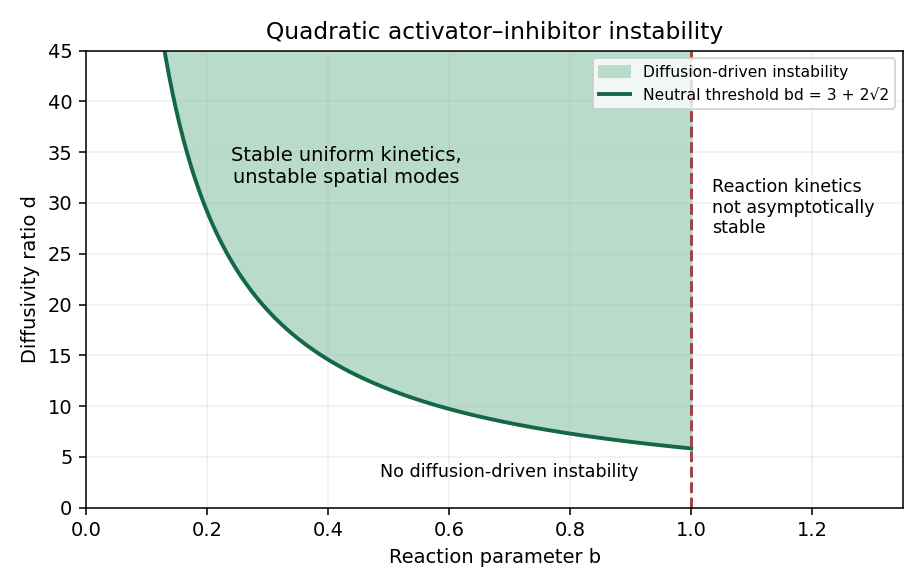
A perturbation proportional to replaces by . Put . Its trace is in the kinetically stable range, and its determinant isA growing spatial mode exists exactly when this determinant is negative for some . Its minimum occurs at , which is positive only if , and the minimum is negative precisely if . Together these conditions reduce to the Turing threshold of the quadratic activator-inhibitor model,The unstable band isAt the Turing instability threshold the band shrinks to its double root, yielding . On a bounded spatial interval, an allowed wavenumber must additionally lie in the unstable band; the displayed parameter condition assumes the continuous spatial spectrum.


Put . The two fixed points on the invariant line are and . There are also when . At equality they coalesce with .
The Jacobian matrix isAt its eigenvalues are and , so it is always a saddle equilibrium. At they are and , so it is a saddle equilibrium for and a stable node for , with a zero eigenvalue at .
At the characteristic equation is , givingFor these points are stable spirals; for they are stable nodes. At the double negative eigenvalue has only one independent eigenvector, so these are improper stable nodes. When they are center equilibria, as established in part (iii). Thus the collision at changes both the number and stability of fixed points; it is the bifurcation classified below.
Set and , and include for the extended center manifold. The equations near becomeThe stable direction has eigenvalue and the center directions are . Choose a symmetry-preserving center manifold , even in , containing the equilibrium line . Its invariance equation isWrite . At degree two, , so . At degree three, , so . ConsequentlyWith this is , the supercritical pitchfork bifurcation. For , is attracting; for it becomes a saddle equilibrium and two attracting branches appear, consistent with the exact .
For , the vertical invariant line flows from towards between those points. The two off-axis stable equilibria lie below the horizontal axis, one in each invariant half-plane and . For , these stable equilibria have merged into the stable node , while remains a saddle equilibrium. Filled green points mark attracting equilibria, green rings mark centers, and red crosses mark saddle equilibria. The plotted arrows and nullclines show the corresponding phase portraits; a focus can become a node within the first parameter range without changing the pitchfork classification.
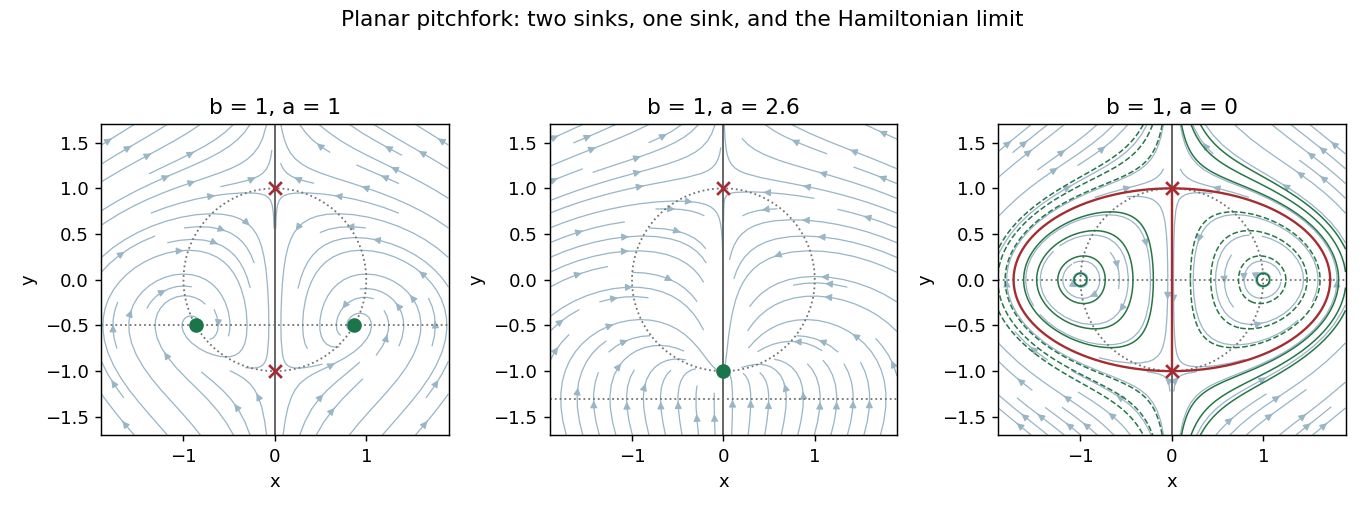
Phase portraits of the planar pitchfork system before collision, after collision, and in its Hamiltonian limit
. Details. 
When , define the Hamiltonian functionThen and , so . At the Hessian of is , a strict nondegenerate minimum; at it is , a strict maximum. Small regular level curves around either point are closed curves, and the vector field is nonzero on them. Motion around each curve therefore returns after a finite period, proving the existence of periodic orbits and classifying both equilibria as center equilibria.
The separatrix level is , consisting of and . The two arcs of this ellipse run from the lower saddle equilibrium to the upper one, while the vertical segment runs from the upper saddle to the lower one. They enclose the two families of periodic orbits, as shown in the last panel of the phase portrait. Outside the loops, regular levels are unbounded.
For the divergence of the original vector field is exactly . If a periodic orbit existed, uniqueness of trajectories would make it a simple closed curve, tangent everywhere to the vector field. The flux across its boundary would be zero, whereas the divergence theorem would give times its positive enclosed area. This contradiction is the Bendixson-Dulac criterion. Hence .
Mass conservation in the Zeldovich approximation gives . Expanding the trajectory Jacobian determinant to first order therefore yields . At the same order, andThe last equality uses and the vector calculus .
Split the gravitational potential into its homogeneous-background and perturbed parts. The background has . For the perturbation, Poisson equation and irrotationality givewith a harmonic or uniform-acceleration contribution set to zero by the perturbation boundary conditions. Its divergence is , as required. Insert this and the pressure gradient into . The background acceleration cancels using , leavingTake minus the comoving divergence, and expand . Since acts on a Fourier mode by , each mode satisfiesHere the expansion coordinate is comoving; confusing it with the physical coordinate would lose the factor .
For , the sound speed obeys . Using and givesThe mode equation is an Euler differential equation. Substituting produces . Thus, for distinct roots,A genuinely growing mode occurs only for ; at the exponents are and . At the larger root is zero. Between and , both roots are negative. At the repeated-root value , the independent solutions are and . Beyond it, write to obtain . Thus the phrase “growing and decaying” applies to the long-wavelength regime; pressure-stabilized modes decay instead.
The induced ordering on is a well-order. By transfinite recursion define for . Induction shows that each is an ordinal, that these values strictly increase, and that their range is the ordinal . The map is an order isomorphism from to this ordinal. Any order isomorphism between ordinals must fix their elements successively, so this ordinal is unique.
An increasing map between ordinals satisfies by induction: its predecessors include for all . Hence . Apply this to the inclusion , transported through their order isomorphisms, and then to . It follows that .
If each is an initial segment of later , uniqueness makes their ordinal enumerations compatible: the enumeration of restricts to that of . Their union is consequently an order isomorphism from to . This proves the asserted equality. Without the initial segment condition it fails: in , take . Then , whose union is , but .
For decreasing sets, is a nonincreasing sequence of ordinals. Its set of values has a least member, attained at some ; all later values must equal it. Hence the sequence is eventually constant. The intersection formula nevertheless fails: take . Every has order type , whereas their intersection is empty and has order type zero. Thus .
The Brooks' theorem states that a finite connected simple graph with maximum vertex degree has chromatic number at most , unless it is a complete graph or an odd cycle graph; those exceptions have chromatic number .
First, if the graph is not regular, choose a vertex of degree less than and a spanning tree rooted at . Order vertices with every child before its parent, and apply the greedy coloring algorithm. Every vertex except has an as-yet uncolored parent, so has at most colored neighbors; also has fewer than neighbors. Thus colors suffice. This justifies reducing to the regular case.
Now let be regular, 3-connected and not complete. A shortest path between two nonadjacent vertices contains an induced two-edge path with nonadjacent. By 3-connectivity, is connected. Color with the same color. Choose a spanning tree of the remaining graph rooted at and color its vertices in child-before-parent order. Each vertex other than again has an uncolored parent and thus at most already colored neighbors. At the last vertex , the two neighbors share a color, so its neighbors use at most distinct colors. A color is therefore available at every step, proving in the required 3-connected noncomplete case. A 3-connected graph has , so the odd-cycle exception cannot arise here.
The Vizing theorem states that for every finite simple graph of maximum vertex degree , its edge chromatic number satisfies . The lower bound follows because all edges incident to a maximum-degree vertex need different colors. The simplicity hypothesis matters: unrestricted multigraphs need not satisfy this upper bound.
The first assertion is false. The complete graph has , but : color each of its three perfect matchings with its own color. It is connected and has more than two vertices.
The second assertion is false. Take the crown graph with bipartition and , joining to exactly when . Its chromatic number is two. In the ordering , the greedy coloring algorithm assigns color to both : both see all previously used colors, but they are not adjacent to each other. It therefore uses five colors, exceeding . Taking more pairs makes the ratio arbitrarily large.
The third assertion is true. When an edge is colored greedily, at most adjacent edges have previously received colors. Thus the greedy coloring algorithm uses at most colors whenever the graph has an edge. The edgeless case is trivial. This bound holds for every edge ordering.
The Artin fixed-field theorem says that for a finite group of distinct automorphisms of a field , the extension is Galois extension and has degree . Here is invariant under translations because for . Hence . Also is a root of , so . The fixed-field theorem gives , forcing . The extension is separable; explicitly the derivative of is .
For the affine substitutions, transforms to , since and . Therefore is fixed by all substitutions. The polynomial has as a root and degree . Apply the same degree comparison and the Artin fixed-field theorem to obtainMoreover , so the minimal polynomial of is . It splits as , and its derivative is nonzero at every root. Thus is a Galois extension with group , acting by .
There is a harmless convention issue in labeling the substitutions: composes in the reverse order to the displayed affine matrices. It is naturally a right action on functions, or a left action after inserting inverses. The set of automorphisms and all the fixed fields just computed are unchanged by that convention.
The left group action on the homogeneous polynomials is , since . Every SU(2) matrix is conjugate to with . In the monomial basis , its eigenvalues are . Consequently the character of the homogeneous polynomial representation of SU2 isThe quotient is interpreted by continuity at the endpoints: and . The introductory action and character requests are independent of parts (i)–(iii), so this root Solution slot has been restored.
The monomials form a basis, so . For irreducibility, use the following compact-group facts: every finite-dimensional continuous representation is unitarizable by averaging an inner product; such representations decompose into irreducibles; their irreducible characters are orthonormal under normalized Haar measure. In particular the squared character norm is the sum of squares of the irreducible multiplicities.
The Weyl integration formula for SU2 gives, for a class function ,Using the character already found,Thus exactly one irreducible constituent occurs with multiplicity one: is irreducible for every .
The same Weyl integration formula for SU2 gives . More strongly, these characters are complete in the space of square-integrable class functions: multiplication by identifies that weighted space with , and sends to . The sine functions form a complete orthogonal basis of , as follows from the Fourier series theorem applied to odd extensions.
Suppose a finite-dimensional continuous irreducible group representation were not isomorphic to any . Character orthogonality would make its character orthogonal to every . Completeness forces its character to vanish in , and continuity then forces it to vanish everywhere. This is impossible at the identity, where the character equals the positive dimension of the representation. Hence . Since the dimensions differ, the index is unique.
The character of the dual representation is , using unitarizability. The displayed sine quotient is real, so this character equals . The theorem that characters determine finite-dimensional semisimple complex representations of a compact group therefore gives . This is complex-linear self-duality; it does not assert that every has an invariant real structure.
A chain homotopy from to consists of homomorphisms such thatfor every . If is a cycle, , so is a boundary. Hence and represent the same homology class. Every homology class has a cycle representative, proving in every degree.
For a finite chain complex of finite-dimensional vector spaces, its Euler characteristic is . For finitely generated free abelian groups, replace dimension by rank. Write and . The identities and show by cancellation that . An exact sequence thus has alternating rank sum zero.
Starting at the left, the three displayed sequences have alternating rank sums respectively . Therefore, given that one is exact, the first sequence is the exact one. For completeness its necessary image ranks, successively, are , all nonnegative and consistent with the adjacent module ranks. Split each middle free group as the incoming image plus a complementary outgoing image, and use identity maps on these summands, to realize an exact sequence of the first rank pattern. Vanishing of the alternating sum alone is not a general test for the exactness of unspecified maps; the supplied existence assertion is what selects the sequence.
For a compact space , the Arzelà-Ascoli theorem says that a family is relatively compact in the supremum norm if and only if it is pointwise bounded and equicontinuous. In the usual formulation is compact Hausdorff; the elementary argument below also works for any compact for real-valued continuous functions.
Pointwise bounded means for every . Equicontinuity means that for every and there is a neighborhood of such that for every and . Relative compactness means compactness of the closure in , where . This is a complete metric vector space, since uniform limits of continuous functions are continuous. Equivalently, every sequence in the family has a uniformly convergent subsequence, with limit in , though not necessarily in the original family.
Assume first that is compact in the supremum norm. A finite norm-net shows that the norms of its members are bounded, so pointwise boundedness follows. Given and , choose a finite -net in the closure. Their continuity gives a common neighborhood of where for every . For any , choose with ; the triangle inequality then gives . Thus the family is equicontinuous.
Conversely, suppose pointwise boundedness and equicontinuity. For a prescribed , choose neighborhoods where every varies from by less than . Compactness supplies a finite subcover . Pointwise boundedness makes the set of vectors bounded in . Partition a bounding box into finitely many boxes of coordinate diameter less than , and choose one function from each occupied box. If belong to the same box and , thenThe chosen functions are therefore a finite -net in the supremum norm. Thus is totally bounded. Its closure is complete and totally bounded, hence compact. To recall the last metric-space fact, successively selecting subsequences in balls of radii produces a Cauchy diagonal subsequence from every sequence; completeness supplies its limit. This proves both directions of the Arzelà-Ascoli theorem.
Set . These are nonnegative continuous functions, decrease pointwise, and converge pointwise to zero. For , the open sets increase and cover . A finite subcover exists by compactness; because the sets are increasing, one already covers . Hence for every and every , and . Therefore . This is Dini's theorem; continuity of the limit is essential to the openness used in the proof.
The lacunary series converges locally uniformly on : for , . It therefore defines a holomorphic function there. Let . For , is positive real. As , the sum of any fixed number of these tail terms tends to that number, while the earlier finite sum stays bounded. Thus . A analytic continuation through would be bounded in a small closed neighborhood and cannot have this radial divergence.
Roots of unity of orders are dense on the unit circle. If an analytic continuation existed through any boundary point, its neighborhood would contain one of these singular roots, and the identity theorem would make it agree with on the inside portion. This contradicts the divergence just proved. Hence the entire unit circle is a natural boundary. The exponent printed in the PDF is , not ; the latter would give a rational function and would not have this property.
Two function elements and define the same germ of a holomorphic function at when and they agree on some neighborhood of . Write the germ as . Basic open sets of the space of germs of holomorphic functions arefor open on which is holomorphic. If two such sets meet, equality of the germs gives a smaller open sheet contained in their intersection, so these sets form a basis. The projection maps each sheet homeomorphically onto . Compose this with a local coordinate on to define the complex charts on the germ space. Transition maps are the corresponding transition maps on , hence holomorphic; is a local biholomorphism and is onto, since even constant functions provide germs over every point.
The germ space is Hausdorff. Germs over different points are separated by base neighborhoods. For distinct germs over the same point, choose representatives on one small connected disk. If their two sheets met anywhere in that disk, the representatives would agree on an open set and hence everywhere on the disk by the identity theorem, a contradiction. These sheets thus separate the germs. Together with the allowed second-countability fact, the charts make each component a Riemann surface.
Here “covering in the sense of complex analysis” means this locally biholomorphic, possibly incomplete analytic germ projection. It does not mean an evenly covered topological covering map: an analytic branch can cease to exist at a singularity, so the restriction to a component need not project onto all of .
The evaluation map is holomorphic, since on the sheet it is just . Starting from one germ, continuation through overlapping disks produces exactly the germs in its connected component. Indeed such continuations give paths in the germ space; conversely, cover a path by finitely many successive sheets to obtain a chain of function elements. Components are path-connected because the surface is locally path-connected. No two distinct germs can be added to that component without being obtainable by continuation. It therefore represents the maximal analytic continuation, or complete holomorphic function, of any of its germs. Conversely every such maximal continuation embeds into the germ space by taking its local germs; completeness makes its image the entire component. These constructions are inverse, giving the requested bijection between complete holomorphic functions and connected components, with functions understood up to their natural equivalence as analytic continuations, rather than merely as single-valued functions defined on all of .
For a divisor on an algebraic curve , let and choose a basis of dimension . Regarding the basis as sections of the divisor line bundle, evaluation gives . If the linear system of divisors has no base points, at least one section is nonzero at each point, and these homogeneous coordinates define a morphism. If the effective divisor has a fixed part , first divide all sections by their common vanishing factor. The moving divisor is base-point-free, has the same section space, and gives the uniquely extended morphism on the smooth curve. Thus effectiveness alone does not make the raw evaluations everywhere nonzero, but cancellation supplies the usual map.
A morphism from a projective integral curve is a finite morphism onto its image precisely when it is nonconstant, equivalently : a positive-dimensional fiber of a curve would be the whole curve, while a nonconstant proper map with finite fibers is finite. It is an isomorphism onto its image precisely when its moving complete linear system is very ample. In section-space terms, putting , the criteria arewhere is allowed. These express absence of base points, separation of distinct points, and separation of tangent directions. In the base-point-free convention .
Now suppose the genus is two. The Riemann-Roch theorem gives and . There cannot be a nonconstant function with only a single simple pole on a positive-genus smooth projective curve: it would give a degree-one map to , an isomorphism. Hence for every point . Applying Riemann-Roch theorem to gives , so the canonical linear system has no base point. The resulting map has degree .
Set , of degree four. The Riemann-Roch theorem gives and for every , since the residual divisors have negative degree. Thus is a base-point-free map to with nondegenerate image . Degree of the pullback of a general line givesThe image cannot be a line because the three sections are independent. The only alternatives are a birational quartic or a double cover of a conic. In the latter case identify the smooth conic with . Its hyperplane bundle has degree two, so , where is a degree-two divisor with . Again Riemann-Roch theorem implies . Since has degree zero, it must be linearly equivalent to zero; hence . This would force , contrary to the hypothesis. Therefore the image is a plane quartic and the map is birational. A smooth plane quartic has genus , while its normalization here has genus two. Consequently .
The Theorema Egregium states that the Gaussian curvature of a surface in is determined entirely by its first fundamental form; in particular a local isometry preserves it.
Let be a regular parametrization, , a unit normal, and the second fundamental form. Differentiating the metric and decomposing into tangent and normal parts gives the Gauss formulaDifferentiating gives , the Weingarten formula. Compute two successive ambient derivatives of a tangent vector and subtract them. Ambient derivatives commute, so their tangential parts yield the Gauss equationwhere is the shape operator and is the intrinsic curvature of the connection with the displayed Christoffel symbols. Taking and the inner product with givesBut , soBoth the connection and its curvature on the right are computed from and its derivatives alone. This proves the theorem, rather than merely using its name as a substitute for the argument.
Write the plane as for a fixed unit vector , and put . Suppose misses the plane. Choose a point of and a number larger than its distance to the plane. The hypothesis makes bounded, and closedness of makes it compact. Thus attains its global minimum at some , with .
Locally the sign of is constant, and has a local minimum or maximum at . Its surface gradient vanishes, so the tangent plane of there is parallel to the given plane and its normal is . For a surface tangent vector, the intrinsic Hessian of is the normal component of the second fundamental form, namely at . The Hessian is semidefinite because this is a local extremum. Since is a minimal surface, . A semidefinite symmetric form with zero trace must be zero, so . This makes a planar point, contradicting the assumption. Therefore .
The boundaryless hypothesis ensures that the minimizing point is an interior surface point. The condition on ensures that the infimum is attained; disjointness from a plane alone would not do so.
For events , their limsup is the event that infinitely many occur. The first Borel-Cantelli lemma states that implies , without independence. Indeedand intersecting these decreasing tail-unions proves the claim.
The second Borel-Cantelli lemma states that independent events with satisfy . For each fixed ,Thus the probability that no event occurs after is zero; take the countable union over to exclude finitely many occurrences.
As printed, the requested real logarithm is undefined: independent Cauchy random variables are negative with probability , and the second Borel-Cantelli lemma shows that this happens infinitely often almost surely. There is therefore no real-valued sequence as stated. The natural corrected expression uses (or takes the limsup only over indices with ).
For the absolute-value interpretation,For every the events are summable and hence occur only finitely often; for they are independent with divergent probability sum and occur infinitely often. Applying the two Borel-Cantelli lemmas to a countable sequence of approaching one from above and below givesThe one-sided tail gives the same constant for the positive-subsequence interpretation. It does not repair the undefined logarithms at the remaining indices unless that interpretation is explicitly adopted.
Let be independent exponential random variables of rate , let and , and define . The strong law of large numbers gives , so there is no finite-time explosion. This defines the Poisson process of rate .
For , repeated convolution gives the gamma distribution with density . Independence of givesFor , the probability is . Hence for all , including the degenerate law at .
Articles were limited to the first 100 out of 148 total.
Articles by others on the same topic
There are currently no matching articles.