Start with a nonzero highest-weight vector and set . The sl2 highest-weight lowering formula follows inductively from the commutator relations:Indeed gives the weight formula, and turns the coefficient at step into at step . The nonzero have distinct eigenvalues, so are linearly independent. Finite dimensionality therefore forces a last nonzero vector . Applying to gives , hence . This also proves that no earlier vector can vanish. Thus the cyclic highest-weight representation generated by isIt is irreducible: spectral projections in select a weight vector from any nonzero invariant subspace, and its nonzero raising and lowering coefficients then generate the whole string. This gives the classification of finite-dimensional sl2 representations used for each root direction below.
For the SU(3) Lie algebra, the repeated-index relation is the trace constraint . The displayed generators are a basis of its complexification, not nine independent generators or three individually vanishing diagonal elements. Realize them by matrix units as ; the compact real algebra is obtained from anti-Hermitian combinations. Thenand , , , . Substituting into the given commutators givesThus both root pairs obey the required sl2 Lie algebra relations. More generally, their Cartan matrix isA weight vector with eigenvalues moves by under and by under . The third negative-root operator is and moves it by . In the required weight diagram coordinatesthese moves are , and respectively. Successive lowerings from a highest-weight vector, with linear dependencies removed, construct the following bases.
For Dynkin labels , use the defining action of SU(3) on . Its highest vector is ; lowering gives and . There are no further independent vectors. The weight diagram of the defining SU(3) representation, in the present rescaled coordinates, isand . Any invariant weight subspace raises to and lowers to all three vectors, proving irreducibility.
For , use the adjoint representation of SU(3) on traceless matrices, with acting by . The highest vector is : both and vanish, while . Lowering gives and . Further lowering produces and , then and , and finally . Consequently the basis is the six off-diagonal matrix units together with :The six nonzero weights have weight multiplicity one, and zero has multiplicity two. Thus . Its irreducibility follows also because an adjoint-invariant subspace is an ideal and is a simple Lie algebra.
For , take the symmetric cubic representation of SU(3), , realized by homogeneous degree-three polynomials. Hereso is a highest-weight vector with eigenvalues . For ,which is nonzero and constructs every monomial. These monomials form a basis and have distinct weights . If an invariant subspace is nonzero, joint spectral projections in select one monomial; repeated transfers its powers to , and repeated transfers all its powers to , reaching . Lowering then generates the whole basis, proving irreducibility without merely assuming the dimension formula. The plotted weights arewith multiplicity one at every point. Hence .
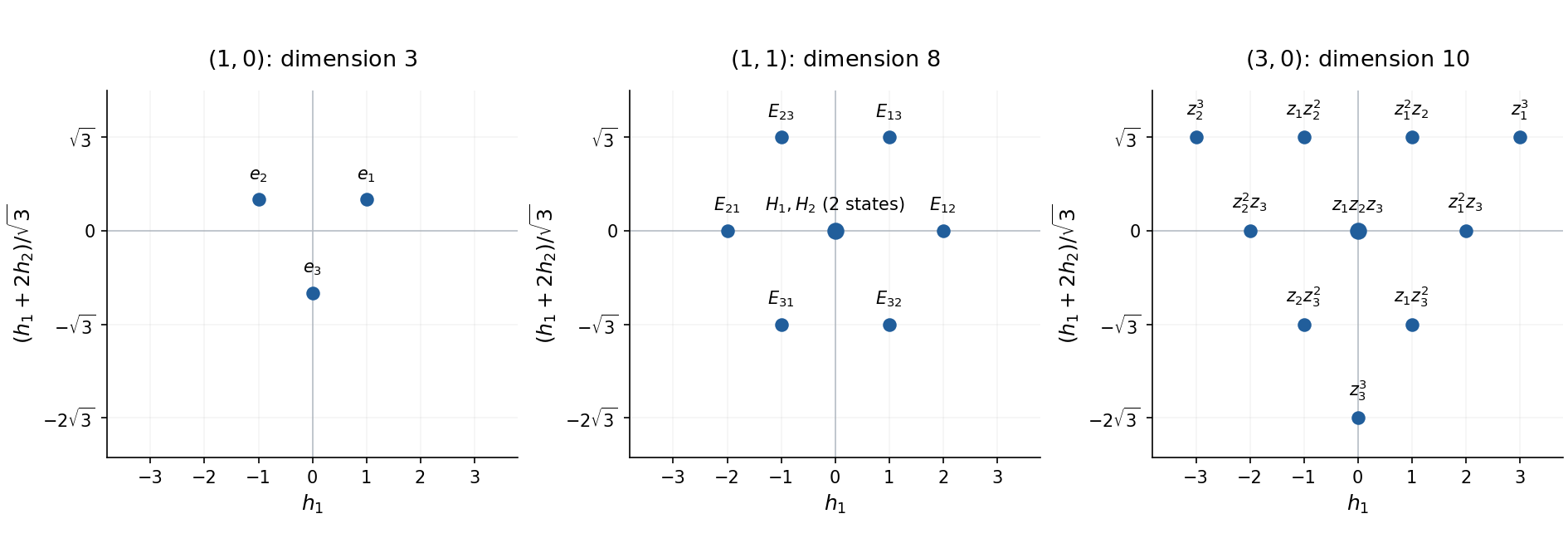
SU(3) weights in the three requested representations, with the two independent zero-weight octet states marked
. Details. 
For approximate flavor symmetry, identify with the up quark, down quark and strange quark. The defining representation is their flavour triplet. The baryon octet realizes and contains the spin- nucleons and the multiplets; its central double weight distinguishes and . The baryon decuplet realizes the symmetric flavour representation , containing the spin- multiplets. In standard isospin and flavor hypercharge normalization, and , so these plots use and . Three-quark spin and flavour combine subject to the Pauli constraint on three-quark flavour multiplets and the antisymmetric three-quark colour singlet. The adjoint flavour representation also describes a meson octet. A distinct, exact colour SU(3) gauge symmetry places quarks in its defining representation and gluons in its adjoint octet; colour and flavour here are different physical group actions.
Articles by others on the same topic
There are currently no matching articles.