The Adjoint double cover from SU(2) to SO(3) is obtained by writing a traceless Hermitian matrix as , where the are the Pauli matrices, and defining . Explicitly,Conjugation preserves , so is orthogonal; connectedness of SU(2) gives . Composition of conjugations makes a group homomorphism. A matrix in its kernel commutes with every Pauli matrix, so is scalar, and unit determinant then gives . Every spatial rotation occurs: induces the rotation through angle about . ThusSince SU(2) is the simply connected three-sphere, this is the universal double cover; the two Lie algebras are isomorphic, although the groups are not.
Define the conjugate fundamental spinor of SU(2) by . Regard as a row, so unitarity givesConsequently is an invariant Hermitian pairing. The basic invariant tensors are the Kronecker delta and the alternating tensors and . Choose , , so that . The unit-determinant identity makes invariant; its inverse gives the corresponding upper-index invariant. These contractions generate the tensor invariants of the defining representation. In particular transforms by , showing that the conjugate representation is equivalent to the defining one. The antilinear map squares to , so this is a pseudoreal representation, rather than a real structure.
For Representation theory of SU2, take , with acting on every index of a symmetric tensor. Its independent components are determined by the number of indices equal to , so there are of them. Equivalently, the homogeneous polynomial representation of SU2 has basis , , withThe basis weights are , and the raising operator and lowering operator connect consecutive basis vectors with nonzero coefficients until their endpoints. Any nonzero invariant subspace contains a weight vector, by applying polynomial spectral projections in . Raising it reaches , and lowering then obtains the entire basis. Thus is an irreducible representation, of spin . The classification of finite-dimensional representations of SU2 gives every finite-dimensional complex irreducible representation in this way. The central element acts on a rank- tensor as , so descent of an SU(2) representation to SO(3) gives
For the tensor contractions in the SU2 Clebsch-Gordan decomposition, contract indices of with indices of using , and symmetrize all the remaining free indices:Each is an irreducible symmetric tensor in . To prove these are precisely the constituents, use two sets of formal variables . The highest-weight vectorsare killed by the total raising operator and have weights . The determinant factor is invariant; lowering the remaining factor gives an irreducible string of dimension . Distinct highest weights give inequivalent summands. The unitary representation on this tensor product makes invariant complements available, and the dimension checkexhausts the space. Hence the contractions above are its irreducible projections, up to normalization, and the Clebsch-Gordan decomposition for SU2 is
For the decomposition of three SU(2) spinors, write and . The contractionstransform as defining spinors. Alternation in three indices in dimension two vanishes, giving ; there are exactly two independent contractions. An explicit inverse, with the epsilon convention above, isSymmetrizing this expression gives , while its first two contractions give , which verifies the decomposition. Thus
In the quark model, three spin- quarks therefore have total quark spin or . The two spin- copies correspond to coupling the first pair to spin or spin before adding the third quark. For ground-state baryons with orbital angular momentum , total : the nucleon has and the Delta baryon has . These two coupling copies alone do not assert two unrestricted physical baryon families. The antisymmetric three-quark colour singlet, the spatial wavefunction and flavor symmetry must also satisfy the Pauli constraint on three-quark flavour multiplets; orbital excitations can give other total angular momenta.
Let , where . In the given basis, the Adjoint representation of a Lie algebra isThe Jacobi identity gives , so , as required for a Lie algebra representation. The Killing form is the symmetric Trace form of a Lie algebra representationCyclicity of the trace proves its invariance directly:In components this is precisely , so the Killing form is an invariant bilinear form on a Lie algebra.
Choose the infinitesimal gauge transformation convention , with , and write . A gauge covariant derivative must satisfy for ; henceEquivalently . Expanding makes the cancellation transparent:Thus : it transforms in the same representation as . In adjoint covariant derivative notation, .
The commutator of two gauge covariant derivatives defines the gauge field strength:ThusConjugating the derivative commutator gives , so the gauge field strength transforms homogeneously in the Adjoint representation:Even if the matrices in a particular matter representation are not faithful, the displayed component formula defines the Lie-algebra-valued curvature independently of that representation.
Only contributes to the Yang-Mills theory Lagrangian, since is symmetric in . Thus take to be a constant real symmetric bilinear form. Its infinitesimal variation isArbitrary local field strengths and gauge parameters give the necessary and sufficient invariant gauge kinetic form conditionAn antisymmetric part is unconstrained but contributes nothing. A nondegenerate kinetic term additionally needs a nondegenerate bilinear form; positive energy additionally needs a positive internal metric in the signature convention. Neither extra condition follows solely from gauge invariance. For a compact simple real Lie algebra, is positive definite and is the standard choice up to a positive factor.
For the intended complex-simple setting, the Killing form is nondegenerate. Consequently write any invariant bilinear form on a Lie algebra uniquely as . Invariance of both forms impliesfor every , so commutes with the Adjoint representation. A subspace invariant under all adjoint maps is an ideal, hence simplicity makes the adjoint representation irreducible. By Schur lemma, , giving the uniqueness of an invariant bilinear form on a simple Lie algebra:The same conclusion holds for compact simple real algebras by complexification, with real; nondegeneracy excludes , and positive energy selects in the stated convention.
There is a genuine real-simple exception to uniqueness of the Killing form if “simple” is read as an arbitrary real simple algebra. Regard as real. It is real simple: its complexification consists of two complex simple factors exchanged by conjugation, so a conjugation-stable ideal is zero or the whole algebra. Both and are real symmetric invariant forms, while . With , the Killing form of the special linear Lie algebra gives and . Therefore the imaginary part cannot be a real multiple of . The uniqueness conclusion requires the customary complex-simple or compact-real interpretation.
Use units and the Minkowski metric . Composing two affine Poincaré group transformations, with the rightmost applied first, givesThe translations form a normal subgroup, so this is the semidirect product of the Lorentz group with . The transformations , , fix time and the spatial origin. Their products and inverses correspond to and , hence they form a subgroup isomorphic to SO(3).
A rotationless Lorentz boost changes the velocity of a frame without adding a spatial rotation. For a convenient active convention iswith . It satisfies , , and . Collinear boosts form a one-parameter subgroup with additive rapidity, but general boosts do not. For nonzero boosts along and , while : their product is not symmetric, whereas every rotationless boost above is symmetric. The product contains a Wigner rotation. Infinitesimally, the Poincare algebra gives for Hermitian generators, so the boost generators do not close amongst themselves.
There is a group-versus-cover qualification in the spin range: an honest unitary representation of the proper orthochronous Poincaré group permits integer spin only. Half-integer spin requires its double cover , or a projective unitary representation of the ordinary group. The construction below gives the requested range on that double cover and descends for integer spin.
Fix and the rest momentum . Its little group consists of rotations: if a proper orthochronous Lorentz transformation fixes , its time column is , the metric condition forces the corresponding time row, and the remaining block belongs to SO(3). On the Lorentz spinor double cover, this little group is SU(2). Choose its irreducible spin- representation, with rest-frame states , , and matrices , the Wigner D-matrices.
For each on the forward mass shell, , , choose the standard rotationless Lorentz boost and defineThe labels are canonical spin projections, defined by this choice of boosts. For any proper orthochronous , factorThe last factor fixes and hence is a Wigner rotation. On the double cover, use its lift to SU(2). Taking the translation convention yields the massive induced representation of the Poincare double cover:The argument of the translation phase is , since . The Wigner rotation identityproves the Lorentz part of the representation law; the phases multiply according to the affine product already derived.
Normalize the generalized momentum states by . The invariant mass shell measure and unitarity of make the induced representation unitary on . This covariant normalization accounts for the absence of an energy square-root factor in the displayed transformation law. To see irreducibility, translations force an operator in the commutant to act within momentum fibres; the little-group action and Schur lemma make its action scalar on each irreducible spin fibre. Lorentz transitivity on the forward mass shell makes this scalar constant. The commutant is therefore scalar, so the unitary representation is irreducible. Conversely, the simultaneous translation spectrum and its little-group representation give the massive positive-energy sector of Wigner's classification.
Thus every and gives such an irreducible representation on the double cover. Its central element over a spatial rotation acts as . Since this rotation is the identity in the ordinary Poincaré group,
For the parity operator, put and . The extension obeys . At rest, commutes with the rotations; Schur lemma therefore gives with a common phase . Since , the parity action on canonical massive spin states isFor the usual reflection convention , is the intrinsic parity. Canonical spin is an axial quantity and its label is unchanged; a helicity label instead changes sign because momentum is reversed. Either intrinsic parity extends a given massive spin representation.
Start with a nonzero highest-weight vector and set . The sl2 highest-weight lowering formula follows inductively from the commutator relations:Indeed gives the weight formula, and turns the coefficient at step into at step . The nonzero have distinct eigenvalues, so are linearly independent. Finite dimensionality therefore forces a last nonzero vector . Applying to gives , hence . This also proves that no earlier vector can vanish. Thus the cyclic highest-weight representation generated by isIt is irreducible: spectral projections in select a weight vector from any nonzero invariant subspace, and its nonzero raising and lowering coefficients then generate the whole string. This gives the classification of finite-dimensional sl2 representations used for each root direction below.
For the SU(3) Lie algebra, the repeated-index relation is the trace constraint . The displayed generators are a basis of its complexification, not nine independent generators or three individually vanishing diagonal elements. Realize them by matrix units as ; the compact real algebra is obtained from anti-Hermitian combinations. Thenand , , , . Substituting into the given commutators givesThus both root pairs obey the required sl2 Lie algebra relations. More generally, their Cartan matrix isA weight vector with eigenvalues moves by under and by under . The third negative-root operator is and moves it by . In the required weight diagram coordinatesthese moves are , and respectively. Successive lowerings from a highest-weight vector, with linear dependencies removed, construct the following bases.
For Dynkin labels , use the defining action of SU(3) on . Its highest vector is ; lowering gives and . There are no further independent vectors. The weight diagram of the defining SU(3) representation, in the present rescaled coordinates, isand . Any invariant weight subspace raises to and lowers to all three vectors, proving irreducibility.
For , use the adjoint representation of SU(3) on traceless matrices, with acting by . The highest vector is : both and vanish, while . Lowering gives and . Further lowering produces and , then and , and finally . Consequently the basis is the six off-diagonal matrix units together with :The six nonzero weights have weight multiplicity one, and zero has multiplicity two. Thus . Its irreducibility follows also because an adjoint-invariant subspace is an ideal and is a simple Lie algebra.
For , take the symmetric cubic representation of SU(3), , realized by homogeneous degree-three polynomials. Hereso is a highest-weight vector with eigenvalues . For ,which is nonzero and constructs every monomial. These monomials form a basis and have distinct weights . If an invariant subspace is nonzero, joint spectral projections in select one monomial; repeated transfers its powers to , and repeated transfers all its powers to , reaching . Lowering then generates the whole basis, proving irreducibility without merely assuming the dimension formula. The plotted weights arewith multiplicity one at every point. Hence .
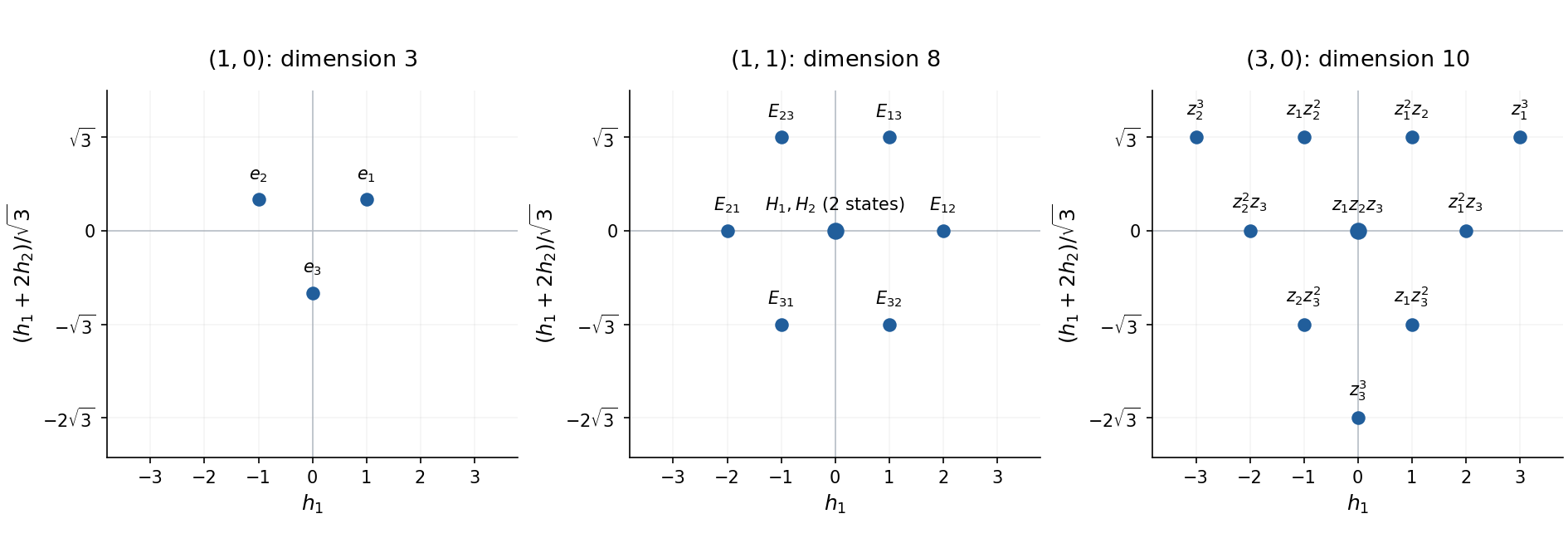
SU(3) weights in the three requested representations, with the two independent zero-weight octet states marked
. Details. 
For approximate flavor symmetry, identify with the up quark, down quark and strange quark. The defining representation is their flavour triplet. The baryon octet realizes and contains the spin- nucleons and the multiplets; its central double weight distinguishes and . The baryon decuplet realizes the symmetric flavour representation , containing the spin- multiplets. In standard isospin and flavor hypercharge normalization, and , so these plots use and . Three-quark spin and flavour combine subject to the Pauli constraint on three-quark flavour multiplets and the antisymmetric three-quark colour singlet. The adjoint flavour representation also describes a meson octet. A distinct, exact colour SU(3) gauge symmetry places quarks in its defining representation and gluons in its adjoint octet; colour and flavour here are different physical group actions.
Articles by others on the same topic
There are currently no matching articles.