A scalar cosmological perturbation has two scalar gauge freedoms. In Newtonian gauge in cosmology, these remove the scalar shift and spatial shear, leaving the lapse potential and spatial-curvature potential :A perfect fluid has no scalar anisotropic stress. The traceless spatial Einstein field equations therefore set for nonzero spatial Fourier modes, producing the line element in the question. Homogeneous perturbations include background and gauge changes and require separate treatment. The single potential describes the physical scalar perturbation in this gauge.
For constant barotropic equation of state , the cosmological perfect-fluid continuity equation gives . In conformal time the flat Friedmann equation becomes , where . Integration, for , givesChoose the conformal-time origin so that and work on the appropriate expansion branch. Write , so and .
Combining the supplied energy and momentum constraints gives the comoving-gauge density contrast Poisson relationFor this barotropic fluid . Substitute the energy constraint into the pressure equation to obtainso the bracket vanishes and the coefficient of is .
Because , the Poisson relation gives . Apply the same potential equation to : differentiating givesSince is a constant multiple of , the constant-equation-of-state comoving density equation isThe primes here denote conformal-time derivatives, corresponding to the overdots in the question. A pure vacuum fluid has zero enthalpy and no independent fluid velocity or nonzero-wave-number density perturbation; its formal equation should be interpreted with that degeneracy in mind.
For radiation in cosmology, , and the Fourier mode of the comoving-gauge density contrast satisfiesSet , the ratio to the radiation sound horizon scale. The radiation-era comoving density mode has the exact basisDirect differentiation verifies the equation. For , the first function is and the second is , so the outside-horizon solutions grow as or decay as . Regularity at early time removes the second one: . For , the regular solution is , a constant-amplitude acoustic oscillation. A regular mode thus grows while outside the sound horizon and oscillates after entering it.
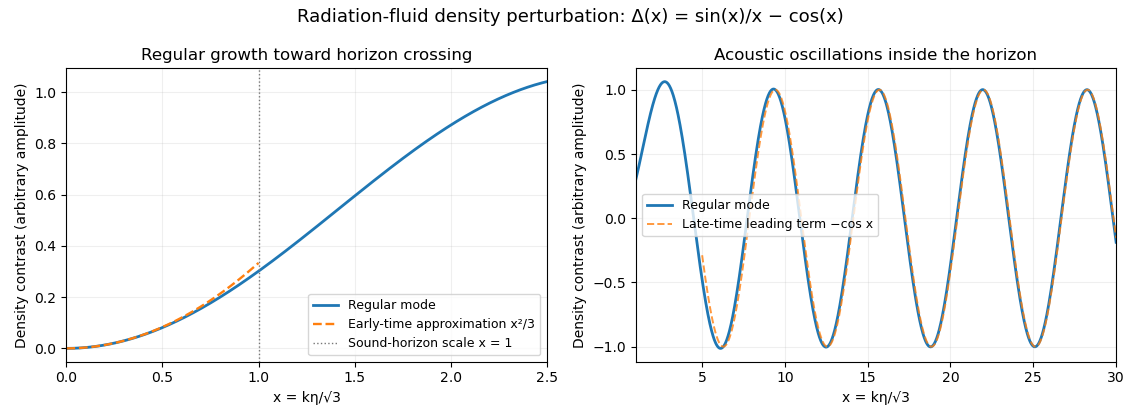

The amplitude is arbitrary; the plotted mode sets . The radiation-era comoving density mode approaches the early-time quadratic growth and the late-time cosine shown alongside it.
For pressureless matter, , the constant-equation-of-state comoving density equation reduces to . Substitution of gives . Since ,In the growing mode, is constant, so the Poisson constraint makes constant for a nonzero Fourier mode. The momentum constraint and the flat Friedmann equation giveThis is the growing-mode velocity potential in matter domination, in the question's convention where the peculiar velocity is .
Articles by others on the same topic
There are currently no matching articles.